
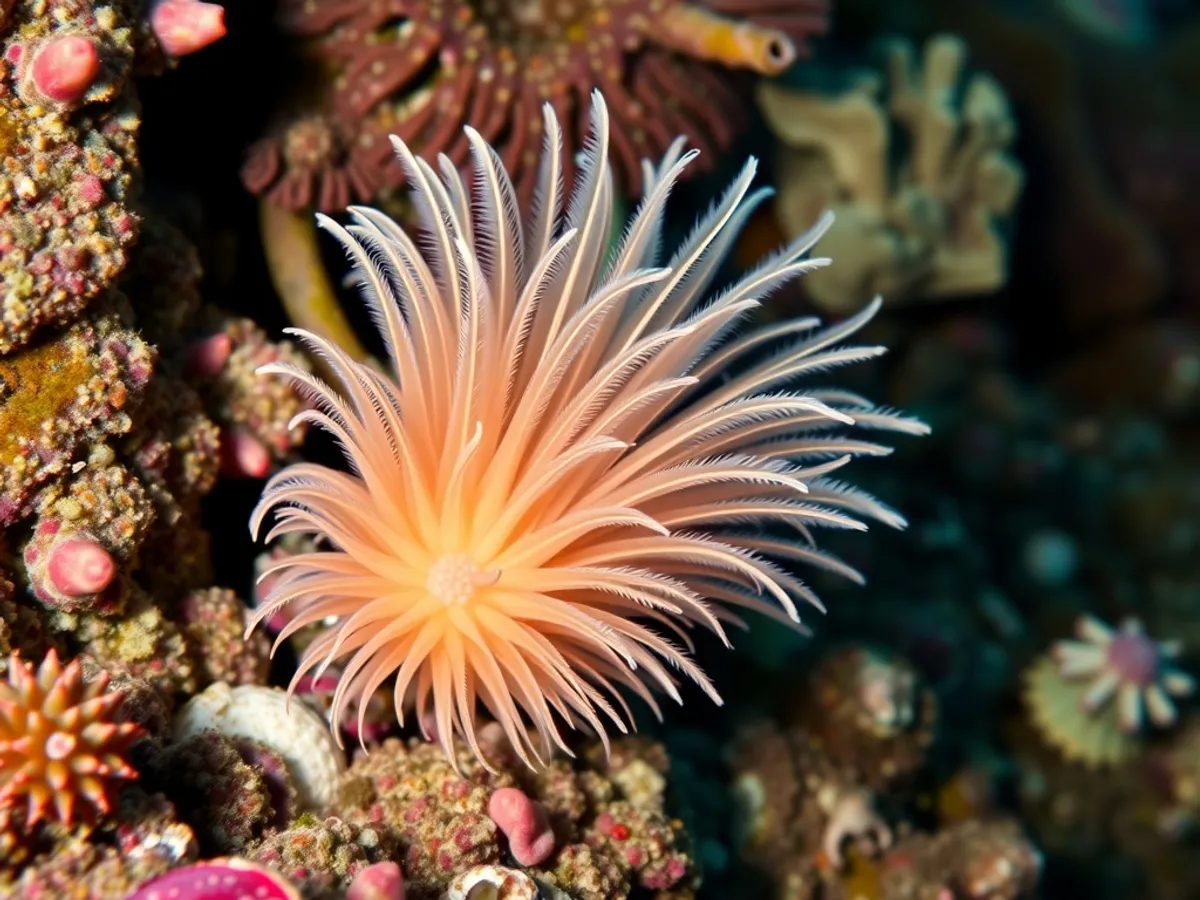
About the Feather Duster Worm
The Feather Duster Worm is a striking marine invertebrate known for its crown of feathery tentacles, which it extends to filter plankton and organic particles from the water. Its soft, segmented body is protected by a parchment-like tube anchored in sand or crevices on the ocean floor. When threatened, the worm quickly retracts its colorful tentacles into the tube for safety. Feather Duster Worms are commonly found in shallow, tropical and subtropical marine environments, contributing to reef health and water clarity. Their unique feeding structures and vibrant appearance make them popular in home aquariums.
Fascinating facts
Tube Builders
Feather Duster Worms secrete a mucus-based substance that hardens into a tube, providing them with protection from predators.
Sensitive to Disturbance
Their tentacles are highly sensitive to movement, allowing them to rapidly retract into their tubes at the slightest threat.
Vibrant Colors
The feathery crowns of these worms display a range of colors, from browns and whites to brilliant reds, purples, and yellows.
Detailed description
Sabellastarte spectabilis, commonly known as the Feather Duster Worm, is a large polychaete annelid distinguished by its ornate, radiolar crown composed of feathery tentacles. These radioles, which can span up to 10 cm in diameter, are arranged in two semicircular whorls and are vividly colored in hues of brown, white, yellow, or purple, often with intricate banding patterns. The worm’s body is elongated, segmented, and soft, typically reaching lengths of 10–20 cm, and is encased in a flexible, parchment-like tube constructed from secreted mucus and embedded sand or shell fragments. This tube provides both structural support and protection from predators. Sabellastarte spectabilis is sessile, anchoring itself within crevices or sandy substrates on coral reefs and rocky coasts, often at depths ranging from the intertidal zone to about 40 meters. The radiolar crown serves as both a feeding and respiratory organ, efficiently filtering plankton and organic detritus from the water column. When disturbed by potential threats or sudden changes in water movement, the worm can rapidly retract its crown into the tube using specialized longitudinal muscles. Feather Duster Worms are solitary but may occur in dense aggregations where suitable substrate is abundant. Their presence contributes to reef biodiversity and water quality by facilitating nutrient cycling. They are also known for their regenerative abilities, capable of regrowing lost tentacles or even portions of their body if damaged.
Did you know?
Despite their delicate appearance, Feather Duster Worms play an important role in filtering and cleaning seawater in reef ecosystems.
Research & sources
Behaviour & social structure
Feather Duster Worms are primarily sedentary, remaining within their tubes for the entirety of their adult lives. They extend their radiolar crowns during daylight hours to maximize feeding efficiency, retracting them quickly in response to shadows, vibrations, or chemical cues indicative of predators such as fish or crabs. Their feeding behavior is highly specialized: cilia on the radioles generate water currents, directing suspended particles toward the mouth, while mucus and ciliary action sort food by size and nutritional value. Social interactions are minimal, as individuals are non-territorial and do not exhibit cooperative behaviors, though competition for space can occur in densely populated areas. They exhibit a pronounced circadian rhythm, with increased feeding activity during periods of higher plankton availability, often coinciding with tidal or lunar cycles.
Reproduction & life cycle
Sabellastarte spectabilis is dioecious, with separate male and female individuals. Reproduction occurs via broadcast spawning, typically synchronized with environmental cues such as water temperature, lunar phase, or plankton blooms. During spawning events, both sexes release gametes into the water column, where external fertilization takes place. The fertilized eggs develop into planktonic trochophore larvae within 24–48 hours, which drift with currents for several days to weeks before settling and metamorphosing into juvenile worms. There is no parental care post-spawning. Breeding seasons vary by region but often peak in late spring to early summer in tropical habitats.
Adaptations & survival
Feather Duster Worms possess several key adaptations for survival. Their radiolar crowns are highly efficient at both feeding and respiration, maximizing surface area for gas exchange and particle capture. The rapid retraction mechanism, facilitated by well-developed longitudinal muscles, provides effective defense against predation. Their tube-building behavior offers physical protection and camouflage, as the tube blends with the substrate. The ability to regenerate lost body parts, including the crown, is a significant evolutionary advantage in environments with frequent predation or physical disturbances. Additionally, their ciliated tentacles can selectively reject inedible or harmful particles, reducing ingestion of toxins or sediments.
Cultural significance
Feather Duster Worms are popular in the marine aquarium trade due to their striking appearance and unique feeding behavior, often serving as educational ambassadors for reef ecology. While they do not hold significant roles in traditional folklore or mythology, their presence in public aquaria and educational materials has increased public awareness of polychaete diversity and the importance of invertebrates in marine ecosystems.
Recent research
Recent studies have focused on the regenerative capacities of Sabellastarte spectabilis, revealing molecular pathways involved in tissue regrowth and potential applications for regenerative medicine. Ongoing research also examines their role in nutrient cycling and biofiltration within reef ecosystems, with evidence suggesting they contribute to water clarity and microbial balance. Genetic analyses have clarified phylogenetic relationships within the Sabellidae family, supporting the use of molecular markers for species identification and population studies. Environmental DNA (eDNA) techniques are being developed to monitor their distribution and abundance in response to changing ocean conditions.
Sources
Sabellastarte spectabilis (Grube, 1878): Taxonomy and Biology
World Register of Marine Species (WoRMS) (2023)
scientificRegeneration and Tube-Building in Sabellastarte spectabilis
Wilkens, S.L. & Stanley, J.A. (2017)
scientificVideos
Habitat
Coral reefs and rocky coastal areas

Conservation
The Feather Duster Worm is currently classified as Least Concern on the IUCN Red List.
Threats & challenges
While currently listed as Least Concern, Sabellastarte spectabilis faces localized threats from habitat degradation, particularly coral reef destruction due to climate change, ocean acidification, and coastal development. Overcollection for the aquarium trade can impact populations in some regions. Pollution, sedimentation, and eutrophication may reduce water quality, affecting feeding efficiency and larval survival. Despite these pressures, the species remains widespread and resilient, with stable population trends in most areas. Ongoing monitoring is recommended, especially in areas of heavy human activity.
Taxonomy
Scientific name
Sabellastarte spectabilis
- Kingdom
- Animalia
- Phylum
- Annelida
- Class
- Polychaeta
- Order
- Sabellida
- Family
- Sabellidae
- Genus
- Sabellastarte
- Species
- spectabilis
Community notes
Share your observations about the Feather Duster Worm.
No community notes yet. Be the first!
Discover more wildlife
More fascinating animals from the encyclopedia.