
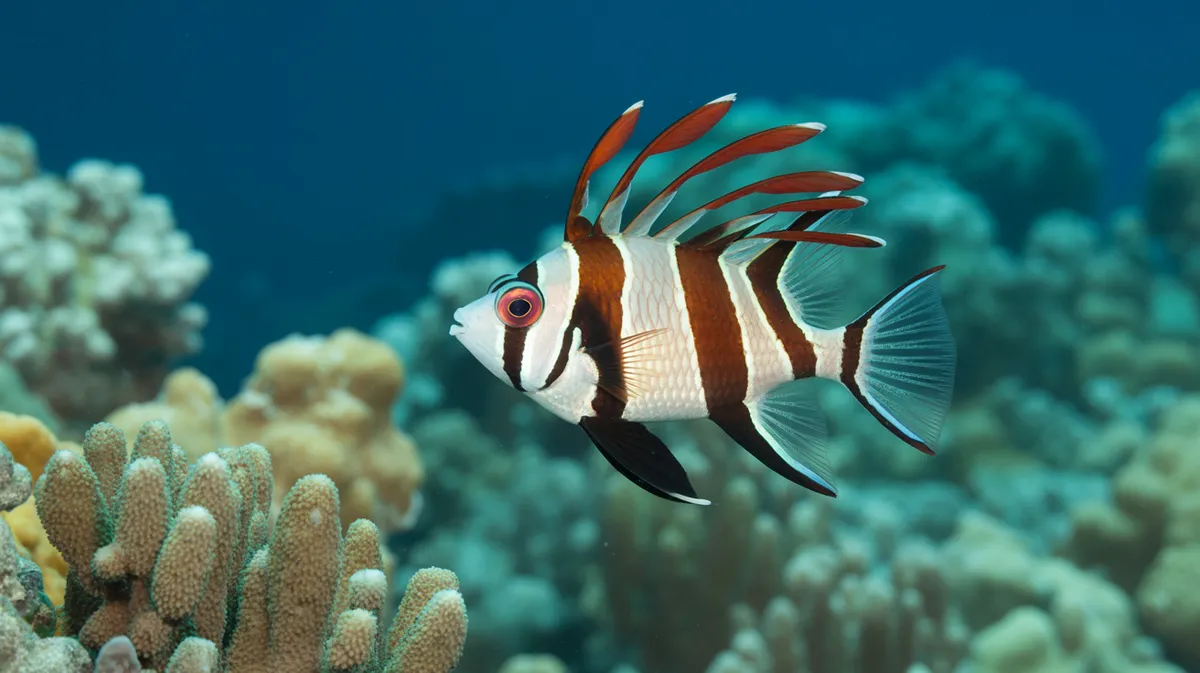
About the Firefish
The Firefish, also known as the fire dartfish or fire goby, is a small, vibrantly colored marine fish popular in the aquarium trade. Its slender body is white towards the front, blending into a striking orange-red tail, with long dorsal and pelvic fins that often wave like banners. Native to the coral reefs of the Indo-Pacific, the firefish is known for its shy nature, often darting into burrows or crevices when threatened. Despite its delicate appearance, the firefish is hardy and adaptable, thriving in warm, tropical marine environments.
Fascinating facts
Colorful Appearance
Firefish have a unique gradient coloration, shifting from white to deep orange-red, making them highly sought after in the aquarium trade.
Burrow Builders
They create and share burrows in sandy or rubble areas of coral reefs, using these hiding spots for protection from predators and as a home base.
Quick Reflexes
Firefish are known for their lightning-fast dashes to safety, often vanishing into their burrows at the slightest hint of danger.
Detailed description
Nemateleotris magnifica, commonly known as the firefish, fire dartfish, or fire goby, is a small, elongated marine fish reaching up to 9 cm (3.5 inches) in length. Its body is laterally compressed, with a distinctive coloration: the anterior half is a pearlescent white, transitioning sharply to a vivid orange-red posterior and tail. The dorsal fin is notably elongated, forming a filamentous 'banner' that can be raised or lowered, a feature used in both communication and predator deterrence. The pelvic fins are also elongated and aid in stabilization while hovering. The firefish possesses large, expressive eyes adapted for acute vision in the variable lighting of reef environments. Its mouth is small and slightly upturned, suited for capturing planktonic prey. Firefish are benthopelagic, typically hovering a short distance above sandy or rubble substrates near reef slopes at depths of 6–70 meters. They are known for their rapid darting movements, quickly retreating into burrows or crevices when alarmed. Despite their delicate appearance, firefish are robust and can tolerate a range of environmental conditions, contributing to their popularity in the aquarium trade. Their cryptic behavior and coloration provide effective camouflage from both predators and prey.
Did you know?
Firefish can rotate their eyes independently, allowing them to scan for predators and prey simultaneously.
Research & sources
Wikipedia summary
Firefish may refer to the following groups or species of fish:Nemateleotris, a genus of the family dartfish, Ptereleotridae Elegant firefish, purple firefish, Nemateleotris decora Nemateleotris magnifica, fire goby, fire fish, fire dartfish, red fire goby Scorpaenidae, firefish, turkeyfish, dragonfish, stingfish Pterois, a genus of venomous marine fish Devil firefish, common lionfish, Pterois miles Clearfin lionfish, radial firefish, tailbar lionfish, radiata lionfish, Pterois radiata Broadbarred firefish, Pterois antennata Blackfoot firefish, Parapterois heterurus
Behaviour & social structure
Firefish are diurnal, emerging from their burrows at dawn to hover several centimeters above the substrate, where they feed on zooplankton carried by currents. They exhibit a characteristic hovering posture, with dorsal fin erect and body angled upwards, allowing them to scan for both food and threats. When startled, they perform rapid, darting retreats into their burrows, a behavior that has earned them the name 'dartfish.' Firefish are generally solitary or found in monogamous pairs, rarely forming larger groups. Territorial disputes are resolved through displays involving fin erection and lateral posturing rather than direct aggression. They are highly site-attached, often returning to the same shelter after foraging. Social interactions are most frequent between established pairs, which may jointly defend a territory.
Reproduction & life cycle
Nemateleotris magnifica is oviparous, with external fertilization. During the breeding season, which typically coincides with warmer months, pairs engage in courtship displays involving synchronized swimming and fin displays. Spawning occurs in the safety of their burrow or a crevice, where the female lays adhesive eggs that attach to the substrate. The male often guards the eggs, fanning them with his fins to ensure oxygenation and prevent fungal growth. Incubation lasts approximately 7–10 days, after which the planktonic larvae are released into the water column. The larval stage is pelagic, lasting several weeks before juveniles settle onto the reef and establish their own territories.
Adaptations & survival
Firefish possess several adaptations for survival in reef environments. Their elongated dorsal fin acts as both a visual signal and a deterrent to predators, making them appear larger and more difficult to swallow. Their cryptic coloration blends with the light gradients of the reef, providing camouflage. The ability to rapidly dart into burrows reduces predation risk. Large eyes enhance visual acuity for detecting both prey and predators in the complex lighting of coral reefs. Their upturned mouth and hovering behavior are specialized for capturing planktonic prey from the water column. Firefish also exhibit site fidelity, returning to the same shelter, which aids in predator avoidance and energy conservation.
Cultural significance
Firefish are highly prized in the marine aquarium trade for their striking appearance and peaceful temperament. They are often featured in public aquaria as representatives of Indo-Pacific reef biodiversity. While they do not hold significant roles in traditional folklore or mythology, their beauty and unique behavior have made them symbols of vibrant reef life in educational and conservation campaigns.
Recent research
Recent research has focused on the firefish's social structure, revealing evidence of monogamous pair bonding and territory defense. Studies on their larval dispersal patterns have provided insights into reef connectivity and the importance of larval supply for population maintenance. Genetic analyses have clarified the phylogenetic relationships within the Ptereleotridae family, confirming Nemateleotris magnifica as a distinct species. Ongoing research is examining the impacts of climate change and habitat loss on their distribution and reproductive success.
Videos
Habitat
Coral reefs

Conservation
The Firefish is currently classified as Least Concern on the IUCN Red List.
Threats & challenges
Currently assessed as Least Concern by the IUCN, firefish populations are considered stable. However, localized threats include habitat degradation due to coral reef destruction, pollution, and climate change-induced bleaching. Overcollection for the aquarium trade can impact populations in some regions, although they are not considered threatened at a global scale. Their reliance on healthy reef habitats makes them susceptible to declines if reef ecosystems are compromised. Natural predators include larger reef fish such as groupers and lionfish.
Taxonomy
Scientific name
Nemateleotris magnifica
- Kingdom
- Animalia
- Phylum
- Chordata
- Class
- Actinopterygii
- Order
- Perciformes
- Family
- Ptereleotridae
- Genus
- Nemateleotris
- Species
- magnifica
Community notes
Share your observations about the Firefish.
No community notes yet. Be the first!
Discover more wildlife
More fascinating animals from the encyclopedia.