
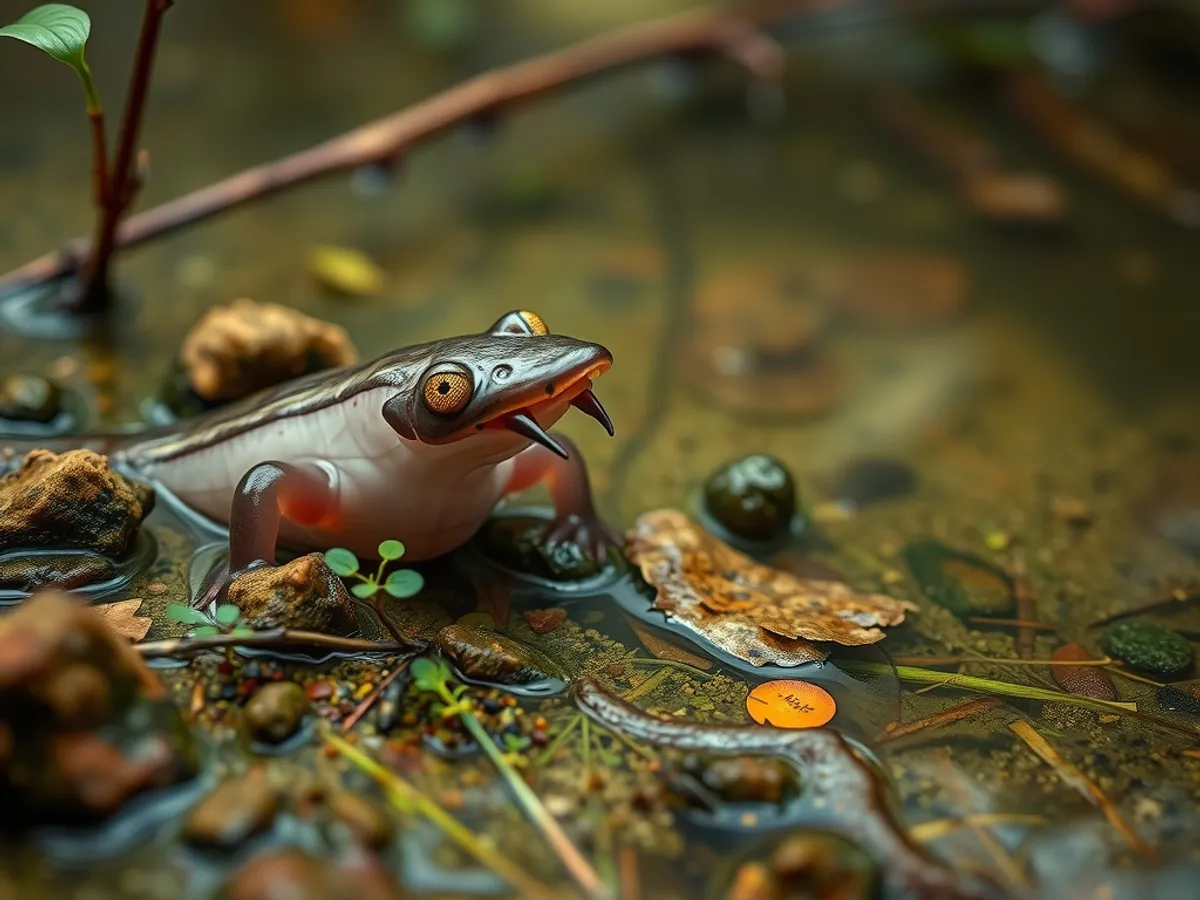
About the Giant Leech
The giant leech is one of the world's largest leech species, native to South America. It can grow up to 45 centimeters (18 inches) in length, making it a strikingly large invertebrate. This freshwater parasite uses a long proboscis to feed on the blood of aquatic animals, such as fish and amphibians. Despite their size and appearance, giant leeches are generally not dangerous to humans and play a role in their ecosystem by regulating host populations.
Fascinating facts
Bloodsucking Specialist
Giant leeches feed by inserting a long proboscis into their host to suck blood, rather than using jaws like many other leeches.
Impressive Size
They are among the largest leeches in the world, reaching lengths of up to 45 centimeters (about 18 inches).
Rediscovered Species
Haementeria ghilianii was thought to be extinct until it was rediscovered in the 1970s in the Amazon basin.
Detailed description
Haementeria ghilianii, commonly known as the giant Amazon leech, is one of the largest known leech species, reaching lengths of up to 45 cm (18 inches) and diameters of over 10 cm (4 inches) when fully engorged. Its elongated, muscular body is dorsoventrally flattened and displays a mottled brown to gray coloration, providing camouflage among riverbed detritus. The anterior end houses a highly extensible proboscis, capable of extending up to 15 cm (6 inches), which it uses to pierce the skin of hosts and extract blood. Unlike many smaller leeches, H. ghilianii lacks jaws and instead relies on this proboscis to access blood vessels. Its body is segmented, with each segment bearing minute sensory papillae that detect vibrations and chemical cues in the water. Internally, it possesses a complex crop and caeca system for storing large volumes of blood, allowing it to go months between feedings. The species is hermaphroditic but typically requires cross-fertilization. Giant leeches are primarily nocturnal, remaining hidden under submerged debris during the day and emerging at night to seek hosts. Their slow, undulating locomotion is facilitated by muscular contractions and the secretion of mucus, which also aids in attachment to hosts and surfaces. Despite their size, they are elusive and rarely encountered, contributing to the scarcity of ecological data.
Did you know?
The proboscis of the giant leech can extend up to 15 centimeters, allowing it to feed on hosts much larger than itself.
Research & sources
Behaviour & social structure
Haementeria ghilianii exhibits solitary and cryptic behavior, spending much of its life concealed beneath submerged logs, leaf litter, or within riverbank crevices. It is primarily nocturnal, becoming active after dusk when it seeks out hosts by following gradients of temperature, movement, and chemical signals in the water. When a suitable host, such as a fish, amphibian, or occasionally a mammal, is detected, the leech approaches slowly and attaches itself using its posterior sucker. Feeding can last from 20 to 40 minutes, during which the leech injects anticoagulant and anesthetic compounds to prevent blood clotting and reduce host awareness. After feeding, it detaches and retreats to a safe location to digest its meal, often remaining inactive for weeks or months. Social interactions are minimal outside of breeding, and there is no evidence of territoriality or group structure. Juveniles are more active and may feed more frequently to support rapid growth.
Reproduction & life cycle
Haementeria ghilianii is a simultaneous hermaphrodite, possessing both male and female reproductive organs. Mating typically occurs during the rainy season when water levels are high, increasing the likelihood of encounters between individuals. Copulation involves mutual exchange of sperm through the clitellum, a glandular region that later secretes a cocoon. Fertilized eggs are deposited in gelatinous cocoons, which are attached to submerged vegetation or detritus. Embryonic development lasts 3–6 weeks, depending on water temperature, after which miniature leeches emerge fully formed. There is no parental care post-hatching; juveniles are independent from birth. Breeding frequency is low, with most individuals reproducing once or twice per year.
Adaptations & survival
The giant leech exhibits several remarkable adaptations for its parasitic lifestyle. Its extensible proboscis allows it to penetrate thick skin and reach deep blood vessels, a feature uncommon among leeches. The secretion of anticoagulants (notably hirudin-like compounds) ensures a steady blood flow during feeding, while anesthetics minimize host detection. Its large crop enables storage of significant blood volumes, supporting long intervals between meals. The flattened body and cryptic coloration provide effective camouflage against predators and facilitate movement through dense aquatic vegetation. Sensory papillae enhance environmental awareness, aiding in host detection. Mucus production not only assists in locomotion and attachment but may also deter some predators.
Cultural significance
Unlike some medicinal leech species, Haementeria ghilianii has limited direct significance in traditional medicine or folklore. However, its impressive size has made it a subject of curiosity among naturalists since its discovery in the 19th century. Specimens have been displayed in natural history museums, and the species occasionally features in educational materials about Amazonian biodiversity. There are no known symbolic or mythological roles for this species in indigenous cultures, likely due to its rarity and elusive habits.
Recent research
After being presumed extinct for much of the 20th century, Haementeria ghilianii was rediscovered in the 1970s in French Guiana, sparking renewed scientific interest. Recent molecular studies have focused on its phylogenetic relationships within the family Glossiphoniidae and the evolution of its unique feeding apparatus. Biochemical analysis of its saliva has revealed novel anticoagulant peptides with potential biomedical applications. Ongoing research aims to clarify its distribution, population genetics, and ecological role in regulating host populations. There is also interest in understanding its resilience to environmental change and potential as a bioindicator for freshwater ecosystem health.
Sources
The Rediscovery of Haementeria ghilianii (Annelida: Hirudinea) in the Amazon Basin
Sawyer, R.T. & Shelley, R.M. (1976)
scientificHementin, a leech-derived fibrin(ogen)olytic proteinase. Purification and characterization
Markwardt, F. & Kreutz, W. (1971)
scientificThe Biology and Systematics of the Haementeria ghilianii Complex
Sawyer, R.T. & Burreson, E.M. (1979)
scientificGenome sequencing and analysis of the giant Amazon leech Haementeria ghilianii
International Leech Genome Consortium (2018)
scientificThe Rediscovery of Haementeria ghilianii (Annelida: Hirudinea) in French Guiana
Sawyer, R.T. & Burreson, E.M. (1979)
scientificVideos
Habitat
Freshwater rivers and swamps

Conservation
The Giant Leech is currently classified as Data Deficient on the IUCN Red List.
Threats & challenges
Haementeria ghilianii faces several threats, primarily habitat degradation due to deforestation, pollution, and dam construction in the Amazon and Orinoco basins. Water contamination from agricultural runoff and mining can disrupt its delicate aquatic environment and reduce host availability. Overfishing and declines in amphibian populations, partly due to chytridiomycosis and habitat loss, may indirectly impact leech populations by reducing suitable hosts. The species is rarely collected, and population trends are poorly understood, leading to its Data Deficient status on the IUCN Red List. There is currently no evidence of targeted exploitation or significant direct human impact, but ongoing habitat alteration poses a long-term risk.
Taxonomy
Scientific name
Haementeria ghilianii
- Kingdom
- Animalia
- Phylum
- Annelida
- Class
- Clitellata
- Order
- Rhynchobdellida
- Family
- Glossiphoniidae
- Genus
- Haementeria
- Species
- ghilianii
Community notes
Share your observations about the Giant Leech.
No community notes yet. Be the first!
Discover more wildlife
More fascinating animals from the encyclopedia.