
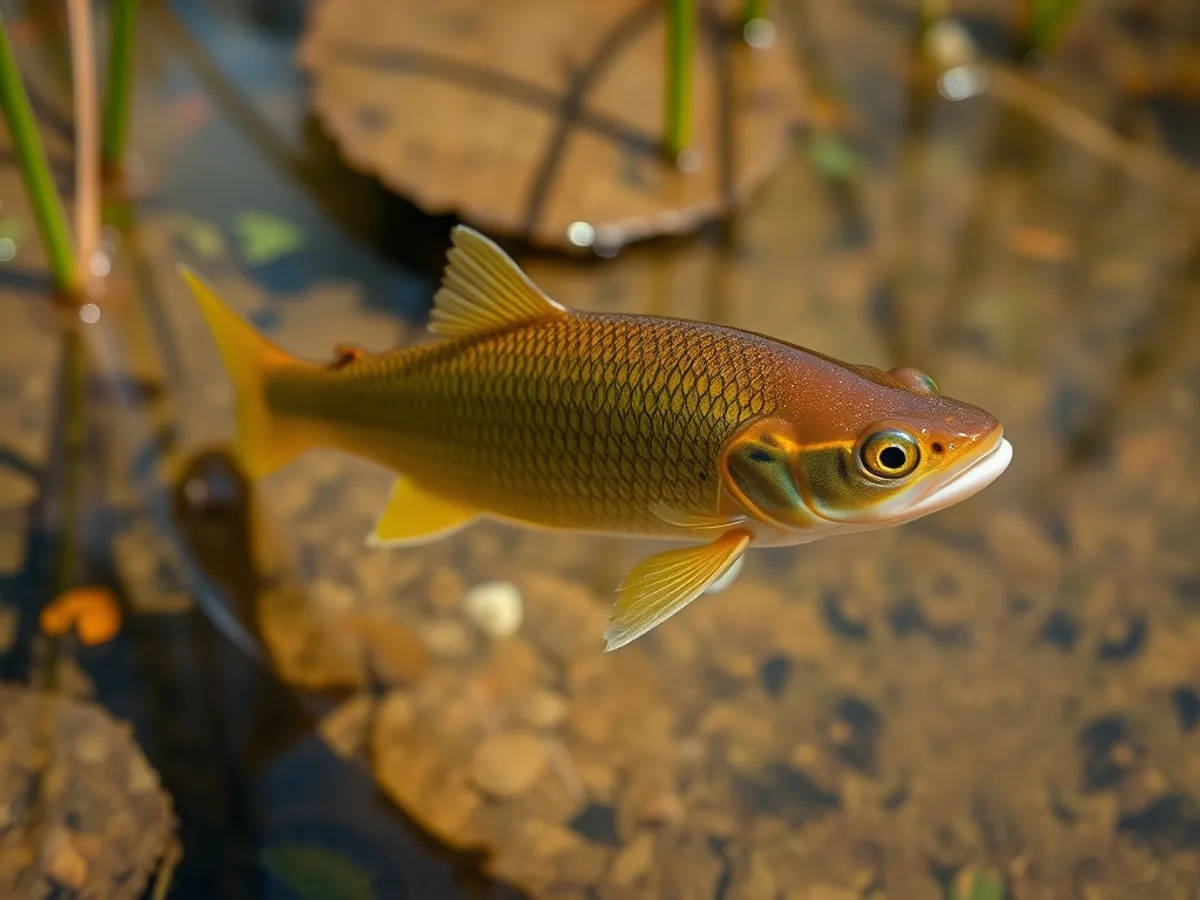
About the Golden shiner
The golden shiner is a small, slender freshwater fish native to eastern North America. Recognizable by its laterally compressed, golden-silvery body and deeply forked tail, this species is highly adaptable and often forms large, active schools. Golden shiners are a popular bait fish for anglers and are known for their tolerance to a wide range of environmental conditions. They play a significant role in aquatic ecosystems by controlling algae and serving as prey for larger fish.
Fascinating facts
Schooling Behavior
Golden shiners are highly social and often form large schools, which helps protect them from predators.
Flexible Diet
They eat a variety of foods, including algae, small insects, zooplankton, and plant material.
Popular Bait Fish
Golden shiners are widely farmed and used as bait in recreational fishing due to their hardiness and appeal to predator fish.
Detailed description
The golden shiner (Notemigonus crysoleucas) is a small, laterally compressed cyprinid fish, typically measuring 7.5–12.5 cm (3–5 in) in length, though individuals can reach up to 30 cm (12 in) in optimal conditions. Its body is deep and slender, with a distinctive arched back and a scaleless keel running from the pelvic fins to the anal fin. The scales are large, thin, and easily shed, giving the fish a metallic golden to olive-green sheen dorsally and silvery-white on the flanks and belly. The dorsal fin is set far back on the body, and the anal fin is long and pointed. Golden shiners possess a small, upturned mouth adapted for surface and midwater feeding. They lack teeth in the jaws but have pharyngeal teeth for processing food. This species is highly gregarious, forming large, coordinated schools that can number in the hundreds or thousands, which provides protection from predators. Golden shiners are known for their remarkable environmental tolerance, thriving in waters with low oxygen, high temperatures, and variable pH. They are opportunistic omnivores, feeding on a variety of plant material, algae, small invertebrates, and zooplankton. Their adaptability and prolific breeding make them one of the most successful and widespread baitfish in North America.
Did you know?
Golden shiner eggs can sometimes stick to aquatic plants or even other fish, helping the species spread to new habitats.
Research & sources
Wikipedia summary
The golden shiner is a species of freshwater ray-finned fish belonging to the family Leuciscidae. This fish occurs in Eastern North America. It is the sole member of its genus. Commonly used as a bait fish, it is probably the most widely pond-cultured fish in the United States. It can be found in Quebec, and its French name is "Mené jaune" or "Chatte de l'Est".
Behaviour & social structure
Golden shiners are diurnal and exhibit strong schooling behavior, which reduces predation risk and enhances foraging efficiency. Schools are highly synchronized, with individuals responding rapidly to changes in direction or speed initiated by neighbors. Feeding occurs throughout the water column, but golden shiners often feed near the surface in the early morning and late afternoon. They utilize visual and chemical cues to locate food and avoid predators. During periods of high predation risk, schools become tighter and more coordinated. Golden shiners are sensitive to environmental changes and can alter their depth and location in response to temperature, oxygen levels, and light. They are known to exhibit risk-sensitive foraging, balancing food acquisition with predator avoidance. In winter, they may reduce activity and form dense aggregations in deeper, warmer waters.
Reproduction & life cycle
Golden shiners are fractional spawners, with females releasing eggs multiple times over the breeding season, which typically extends from late spring to mid-summer (May to August) when water temperatures reach 20–28°C (68–82°F). Spawning occurs in shallow, vegetated areas where females scatter adhesive eggs over submerged plants or debris. Males do not build nests but may defend small territories within spawning sites. Fertilization is external, and a single female can produce 2,000–200,000 eggs per season, depending on size and age. There is no parental care; eggs hatch in 3–7 days, and larvae are immediately independent. Rapid growth in the first year allows juveniles to reach sexual maturity by age one or two.
Adaptations & survival
Golden shiners exhibit several key adaptations for survival. Their laterally compressed bodies and reflective scales provide camouflage in vegetated, sunlit waters. The upturned mouth and flexible diet allow exploitation of surface and midwater food resources. They are highly tolerant of environmental stressors, such as low dissolved oxygen, high temperatures (up to 35°C/95°F), and variable water chemistry, in part due to efficient gill ventilation and metabolic flexibility. Schooling behavior reduces individual predation risk and enhances foraging success. Golden shiners can detect and respond to alarm substances released by injured conspecifics, increasing group vigilance. Their high reproductive output and rapid maturation enable quick population recovery after disturbances.
Cultural significance
Golden shiners are of considerable economic importance as the most widely pond-cultured baitfish in the United States, supporting a multimillion-dollar industry. They are commonly used by anglers targeting predatory fish such as bass and pike. In some regions, especially in Quebec, they are known as 'Mené jaune' or 'Chatte de l'Est' and are occasionally used in traditional fishing practices. While not prominent in folklore or mythology, their abundance and ease of capture have made them a staple in recreational and commercial fishing cultures. Their role in scientific research, particularly in studies of collective animal behavior and sensory ecology, has also increased their significance.
Recent research
Recent research on golden shiners has focused on their collective decision-making and schooling dynamics, making them a model species for studies in behavioral ecology and neurobiology. Notably, experiments have demonstrated their ability to solve complex navigation tasks and exhibit social learning, where individuals can influence group movement based on prior experience. Genetic studies have explored population structure and adaptation to different environmental conditions, revealing significant plasticity and local adaptation. Ongoing research in aquaculture aims to optimize breeding, nutrition, and disease management to improve baitfish production. Additionally, golden shiners are used in ecotoxicology to assess the impacts of pollutants and water quality changes on freshwater ecosystems.
Videos
Habitat
Freshwater ponds, lakes, and slow-moving streams with abundant vegetation

Conservation
The Golden shiner is currently classified as Least Concern on the IUCN Red List.
Threats & challenges
Currently, golden shiners face few significant threats and are classified as Least Concern by the IUCN. However, localized challenges include habitat degradation from wetland drainage, pollution, and the introduction of invasive species. Overharvesting for the bait industry is generally sustainable due to their high reproductive rate, but intensive collection in some areas may impact local populations. Golden shiners are susceptible to certain fish parasites and diseases, especially in crowded aquaculture conditions. Climate change may alter their distribution by affecting water temperature and habitat availability, but their broad environmental tolerance suggests resilience to moderate changes.
Taxonomy
Scientific name
Notemigonus crysoleucas
- Kingdom
- Animalia
- Phylum
- Chordata
- Class
- Actinopterygii
- Order
- Cypriniformes
- Family
- Cyprinidae
- Genus
- Notemigonus
- Species
- crysoleucas
Community notes
Share your observations about the Golden shiner.
No community notes yet. Be the first!
Discover more wildlife
More fascinating animals from the encyclopedia.