
About the Golden star tunicate
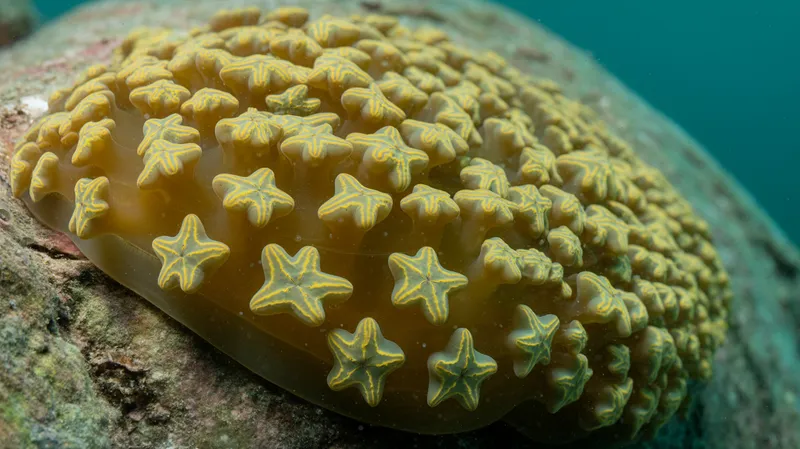
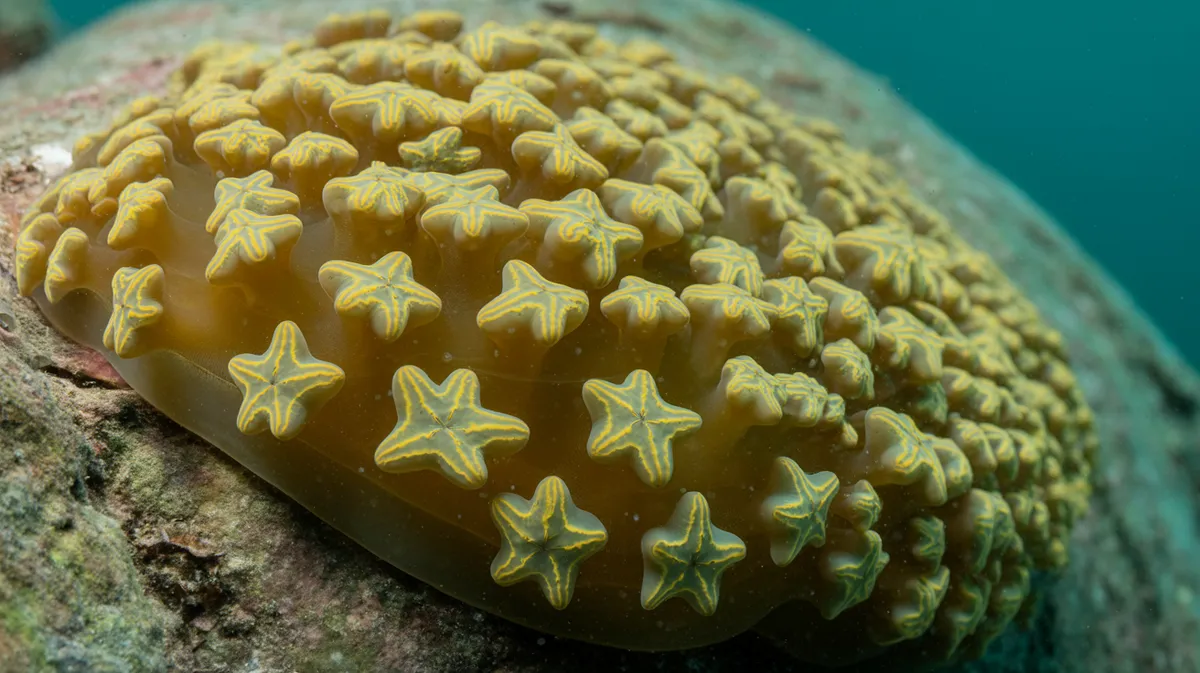
The golden star tunicate is a colonial marine invertebrate known for its striking star-shaped patterns formed by individual zooids within a shared gelatinous matrix. These tunicates are often yellow, orange, or greenish in color and form thin, encrusting sheets over rocks, docks, and other submerged surfaces. As filter feeders, they draw in seawater through tiny siphons, capturing microscopic plankton and detritus. Golden star tunicates are notable for their ability to rapidly colonize new environments and are considered invasive in many regions outside their native range.
Fascinating facts
Star-Shaped Colonies
Each colony of golden star tunicate forms a distinct star-shaped pattern made up of individual zooids arranged in circular clusters.
Worldwide Invader
Originally native to the Northeast Atlantic, this tunicate has spread to many parts of the world, including North America, Australia, and Asia, often through ship hulls and ballast water.
Model Organism
Botryllus schlosseri is studied extensively by scientists for its unique immune system and ability to regenerate lost tissue.
Detailed description
Botryllus schlosseri, commonly known as the golden star tunicate, is a colonial ascidian characterized by its thin, encrusting colonies that can reach up to 10 cm in diameter and only a few millimeters in thickness. Each colony is composed of hundreds of individual zooids, which are arranged in star-shaped clusters (systems) embedded within a shared, gelatinous tunic. The zooids themselves are typically 1–2 mm long and are connected by a network of blood vessels, allowing for coordinated physiological responses across the colony. The tunic is often yellow, orange, green, or brown, and its translucency reveals the intricate internal structure. Botryllus schlosseri attaches to hard substrates such as rocks, shells, docks, boat hulls, and even living plants and animals in sheltered, shallow marine environments. The colony grows by asexual budding, with new zooids forming at the periphery. Colonies can fuse with genetically compatible neighbors, forming chimeric supercolonies, or reject incompatible colonies through a well-studied allorecognition system. The species is highly tolerant of variable salinity and temperature, contributing to its invasive success. Botryllus schlosseri is a model organism in developmental biology and immunology due to its transparent tissues, regenerative abilities, and unique mechanisms of self/non-self recognition.
Did you know?
Golden star tunicates are one of the few chordates that can undergo natural whole-body regeneration, regrowing entire colonies from fragments.
Research & sources
Wikipedia summary
Botryllus schlosseri is a colonial ascidian tunicate. It is commonly known as the star tunicate, but it also has several other common names, including star ascidian and golden star tunicate. Colonies grow on slow-moving, submerged objects, plants, and animals in nearshore saltwater environments.
Behaviour & social structure
Golden star tunicates are sessile filter feeders, remaining attached to substrates throughout their adult life. Each zooid draws water in through an oral siphon, filtering out phytoplankton, bacteria, and detrital particles using a mucous net across the pharyngeal basket. Filtered water is expelled through a common excurrent siphon shared by each star-shaped system. Colonies exhibit coordinated contraction in response to disturbance, rapidly closing siphons to deter predators or dislodge debris. Socially, colonies can interact with neighboring colonies, either fusing to form larger chimeric colonies if genetically compatible or initiating rejection responses if not. Daily activity is largely dictated by water flow and plankton availability, with feeding occurring continuously when conditions are favorable. Colonies can undergo seasonal regression, resorbing zooids and surviving as dormant vascular tissue during adverse conditions.
Reproduction & life cycle
Botryllus schlosseri reproduces both sexually and asexually. Sexual reproduction involves hermaphroditic zooids that release sperm into the water column, which is then taken up by neighboring colonies for internal fertilization. Embryos develop within the body cavity of the parent zooid and are brooded until they reach the tadpole larva stage, at which point they are released to swim briefly before settling and metamorphosing into a new founder zooid (oozooid). Asexual reproduction occurs via weekly budding cycles, where new generations of zooids replace the old in a synchronized process known as 'takeover.' There is no parental care beyond brooding, and breeding can occur year-round in warmer climates, with peaks in spring and summer in temperate regions. The rapid life cycle and high reproductive output contribute to the species' invasive potential.
Adaptations & survival
Key adaptations include a robust, gelatinous tunic that provides protection from predation and environmental stress, and an efficient filter-feeding apparatus capable of exploiting a wide range of particulate food. The species' remarkable allorecognition system enables colonies to distinguish self from non-self, preventing fusion with genetically dissimilar colonies and reducing the risk of parasitism or resource theft. Botryllus schlosseri exhibits high regenerative capacity, able to regrow lost zooids and vascular tissue. Its tolerance to broad salinity (18–40 PSU) and temperature ranges (5–30°C) allows it to thrive in diverse coastal habitats. The ability to undergo seasonal dormancy and rapid recolonization further enhances survival in fluctuating environments.
Cultural significance
Botryllus schlosseri has limited direct cultural significance but is of considerable scientific importance. It is a model organism in studies of developmental biology, immunology, stem cell biology, and evolutionary genetics. Its unique allorecognition system has provided insights into the evolution of immune systems. In some regions, its fouling of aquaculture gear and boats has made it a species of economic concern, but it is not traditionally used for food or medicine.
Recent research
Recent research has focused on the molecular mechanisms of allorecognition, revealing a highly polymorphic gene complex analogous to the vertebrate major histocompatibility complex (MHC). Studies have also elucidated the processes of whole-body regeneration and stem cell migration within colonies. Genomic sequencing has provided insights into chordate evolution and the origins of vertebrate immune systems. Ongoing work explores the ecological impacts of B. schlosseri invasions and potential biocontrol methods. Its transparent tissues and rapid life cycle continue to make it a valuable laboratory model.
Sources
Botryllus schlosseri (Pallas, 1766): World Register of Marine Species
Claude Monniot et al. (2009)
scientificThe Botryllus schlosseri genome and the evolution of chordate karyotype
Voskoboynik, A. et al. (2013)
scientificVideos
Habitat
Shallow coastal waters, attached to hard substrates

Conservation
The Golden star tunicate is currently classified as Least Concern on the IUCN Red List.
Threats & challenges
While Botryllus schlosseri is not currently threatened and is classified as Least Concern, its invasive spread poses ecological challenges in non-native regions. It can outcompete native sessile invertebrates for space, alter community structure, and foul aquaculture equipment and vessels, leading to economic impacts. Natural predators include nudibranchs, sea stars, and some fish, but predation pressure is often insufficient to control populations in invaded areas. Human-mediated dispersal via hull fouling and ballast water is a significant factor in its global spread. Climate change may further facilitate range expansion by increasing suitable habitat.
Taxonomy
Scientific name
Botryllus schlosseri
- Kingdom
- Animalia
- Phylum
- Chordata
- Class
- Ascidiacea
- Order
- Stolidobranchia
- Family
- Botryllidae
- Genus
- Botryllus
- Species
- schlosseri
Community notes
Share your observations about the Golden star tunicate.
No community notes yet. Be the first!
Discover more wildlife
More fascinating animals from the encyclopedia.