
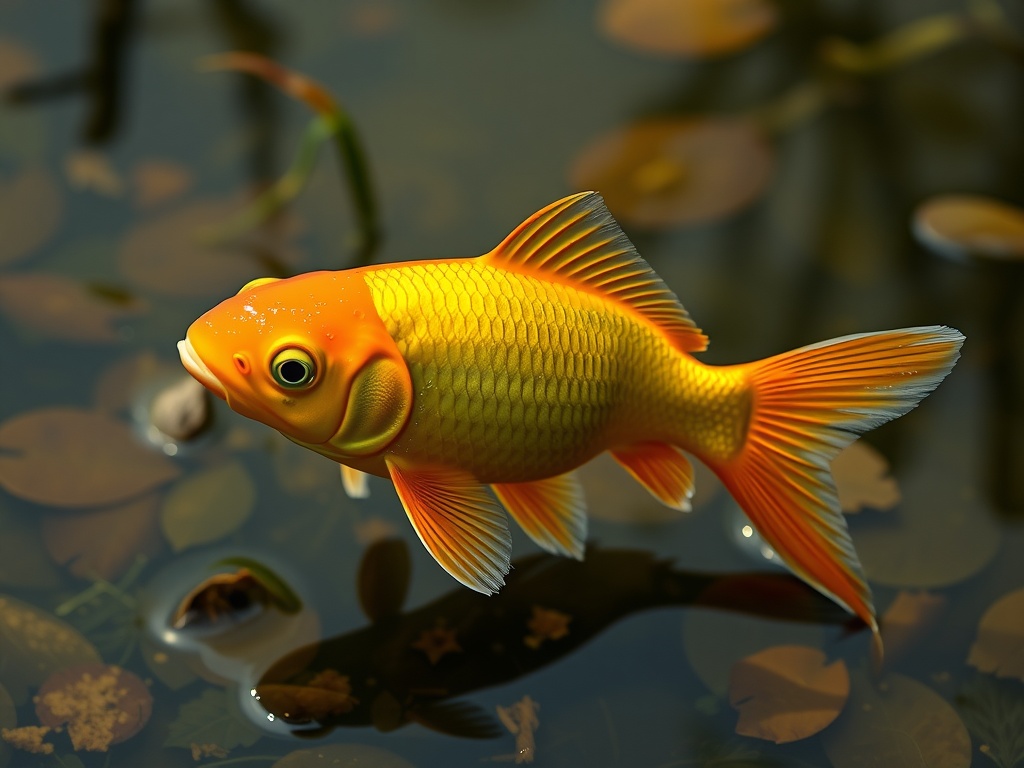
About the Goldfish
The goldfish is a domesticated form of the Prussian carp lineage, Carassius auratus, bred in China from at least the Song dynasty, when captive crucian carp that carried a mutation for orange rather than drab olive were selected and kept in ornamental ponds. Everything else - the fantails, telescope eyes, bubble eyes, lionhead wens - came later, and much of it from Chinese and then Japanese breeders working over centuries. The claim that goldfish have a three-second memory is simply false: laboratory fish learn to press levers, navigate mazes, and remember feeding schedules and colour cues for months, and Israeli researchers have even trained goldfish to drive a wheeled tank across a room toward a target. Goldfish have no true stomach, so food passes almost directly into the intestine and they must feed little and often; overfeeding is the commonest cause of death in home aquaria. Their growth is not limited by tank size in the way folklore suggests - stunting is caused by accumulating waste hormones and poor water, and a well-kept pond goldfish routinely reaches 25 to 35 cm and can live 20 to 40 years. Released goldfish become serious invasives, uprooting plants and clouding water in lakes across North America, Europe and Australia.
Fascinating facts
Domesticated for Centuries
Goldfish were first domesticated in China over 1,000 years ago, originally bred from wild carp for ornamental purposes.
Great Eyesight
Goldfish can see more colors than humans, including ultraviolet light, which allows them to perceive their environment in unique ways.
Tolerant of Temperatures
Goldfish are highly adaptable and can survive in a wide range of water temperatures, but sudden changes can be harmful.
Detailed description
The goldfish (Carassius auratus) is a small to medium-sized freshwater fish, typically ranging from 15 to 20 cm (6–8 in) in length in captivity, though wild and pond specimens can exceed 30 cm (12 in) under optimal conditions. Its body is laterally compressed with a variable shape, depending on the breed, ranging from the streamlined, torpedo-shaped 'common goldfish' to the rounded, egg-shaped varieties like the 'fantail' and 'oranda.' The species exhibits a remarkable diversity of coloration, including orange, red, yellow, white, black, and calico patterns, a result of centuries of selective breeding. Goldfish possess a single dorsal fin, paired pectoral and pelvic fins, and a deeply forked caudal fin, with some ornamental breeds displaying elaborate fin morphologies. Their eyes are large and positioned laterally, providing a wide field of vision, and some breeds, such as the telescope and bubble-eye, have exaggerated ocular features. Goldfish are equipped with pharyngeal teeth for grinding plant material and small invertebrates. They have a well-developed lateral line system for detecting vibrations and changes in water pressure. Goldfish are ectothermic and display a high degree of physiological plasticity, tolerating a wide range of temperatures (0–30°C) and oxygen levels. Their lifespan can exceed 10–15 years in optimal conditions, with some individuals living over 20 years. Goldfish are highly social, displaying shoaling behavior, and are known for their learning ability and memory, capable of recognizing individual humans and responding to feeding cues.
Did you know?
A goldfish's coloration can fade or change depending on exposure to sunlight and diet, and without light, some goldfish may even turn completely white.
Research & sources
Wikipedia summary
The goldfish is a freshwater fish in the family Cyprinidae of order Cypriniformes. It is commonly kept as a pet in indoor aquariums, and is one of the most popular aquarium fish. Goldfish released into the wild have become an invasive pest in parts of North America and Australia.
Behaviour & social structure
Goldfish are diurnal, most active during daylight hours, and exhibit exploratory and foraging behaviors throughout the day. They are omnivorous, feeding on a variety of plant material, detritus, small crustaceans, insect larvae, and zooplankton. In aquaria, they display learned behaviors such as associating human presence with feeding and can be trained to perform simple tasks. Socially, goldfish prefer the company of conspecifics and often form loose shoals, which provides safety and enhances foraging efficiency. Aggression is minimal, though competition for food or space can lead to fin nipping, especially among certain ornamental breeds. Goldfish communicate through body language, such as fin displays and changes in swimming patterns. They spend significant time sifting through substrate in search of food, a behavior that can stir up sediment in aquaria. Rest periods are characterized by reduced activity and hovering in the water column, but goldfish do not have eyelids and do not sleep in the conventional sense.
Reproduction & life cycle
Goldfish are oviparous, with external fertilization. Spawning typically occurs in spring or early summer, triggered by rising water temperatures (above 18°C/64°F) and increased daylight. Males develop breeding tubercles—small white bumps—on their gill covers and pectoral fins, and chase females to stimulate egg release. Females can lay several thousand adhesive eggs per spawning event, which are scattered among aquatic vegetation or substrate. Fertilized eggs hatch in 2–7 days, depending on temperature. There is no parental care; adults may consume eggs or fry if not separated. Sexual maturity is reached at 1–2 years, though optimal breeding occurs at 2–4 years. Selective breeding in captivity has produced a wide range of ornamental varieties, often requiring controlled breeding environments to maintain desired traits.
Adaptations & survival
Goldfish exhibit several adaptations for survival in variable freshwater environments. Their gills are highly efficient at extracting oxygen, allowing them to survive in low-oxygen conditions. They possess a specialized swim bladder for buoyancy control, and their pharyngeal teeth are adapted for grinding a wide range of food items. Goldfish can survive periods of low temperature by slowing their metabolism and entering a state of torpor. They are capable of anaerobic metabolism, producing ethanol as a byproduct, which allows survival in oxygen-depleted waters for extended periods. Their coloration provides camouflage in natural habitats, while domesticated forms rely on human care. Behavioral plasticity, such as rapid learning and memory, aids in adapting to changing environments, including captivity.
Cultural significance
Goldfish have been kept as ornamental fish in China for over a thousand years, with their domestication dating back to the Tang Dynasty (7th–10th centuries CE). They are symbols of luck, prosperity, and abundance in East Asian cultures and are often featured in art, literature, and folklore. Goldfish are common motifs in Chinese New Year celebrations and are believed to attract good fortune. The practice of selective breeding for ornamental traits spread to Japan and Europe by the 17th century, leading to the development of numerous fancy varieties. Goldfish have played a role in scientific research on learning, memory, and vision, and are among the first vertebrates to be domesticated for aesthetic purposes.
Recent research
Recent research has focused on the genetic basis of color and morphological diversity in goldfish, revealing complex patterns of gene duplication and expression. Studies have examined their remarkable tolerance to hypoxia and ability to produce ethanol during anaerobic metabolism, making them a model for vertebrate metabolic adaptation. Behavioral studies have demonstrated advanced cognitive abilities, including spatial learning and long-term memory. Ongoing research addresses the ecological impact of feral goldfish populations, including their effects on native biodiversity and ecosystem processes. Advances in genomics and developmental biology continue to shed light on the mechanisms underlying the vast phenotypic diversity observed in domesticated goldfish.
Videos
Habitat
Freshwater ponds, lakes, and slow-moving rivers

Conservation
The Goldfish is currently classified as Least Concern on the IUCN Red List.
Threats & challenges
While goldfish are listed as Least Concern by the IUCN, they face several challenges. In captivity, poor water quality, overcrowding, and inadequate nutrition can lead to health problems and reduced lifespan. Released or escaped goldfish have become invasive in many regions, including North America and Australia, where they disrupt native ecosystems by competing with indigenous species, uprooting vegetation, and increasing water turbidity. Invasive populations can alter nutrient cycling and contribute to algal blooms. Hybridization with wild Carassius species is a concern in some areas. Disease transmission, particularly of parasites and pathogens, is facilitated by the global trade in ornamental fish. Conservation challenges focus primarily on managing invasive populations and preventing further introductions.
Taxonomy
Scientific name
Carassius auratus
- Kingdom
- Animalia
- Phylum
- Chordata
- Class
- Actinopterygii
- Order
- Cypriniformes
- Family
- Cyprinidae
- Genus
- Carassius
- Species
- auratus
Where to see a goldfish
2 zoos and aquariums in 1 country are recorded as keeping this species.
 Santa Barbara Zoological Gardens🇺🇸 Santa Barbara, United States
 Sacramento Zoo🇺🇸 Sacramento, United States
Community notes
Share your observations about the Goldfish.
No community notes yet. Be the first!
Discover more wildlife
More fascinating animals from the encyclopedia.