
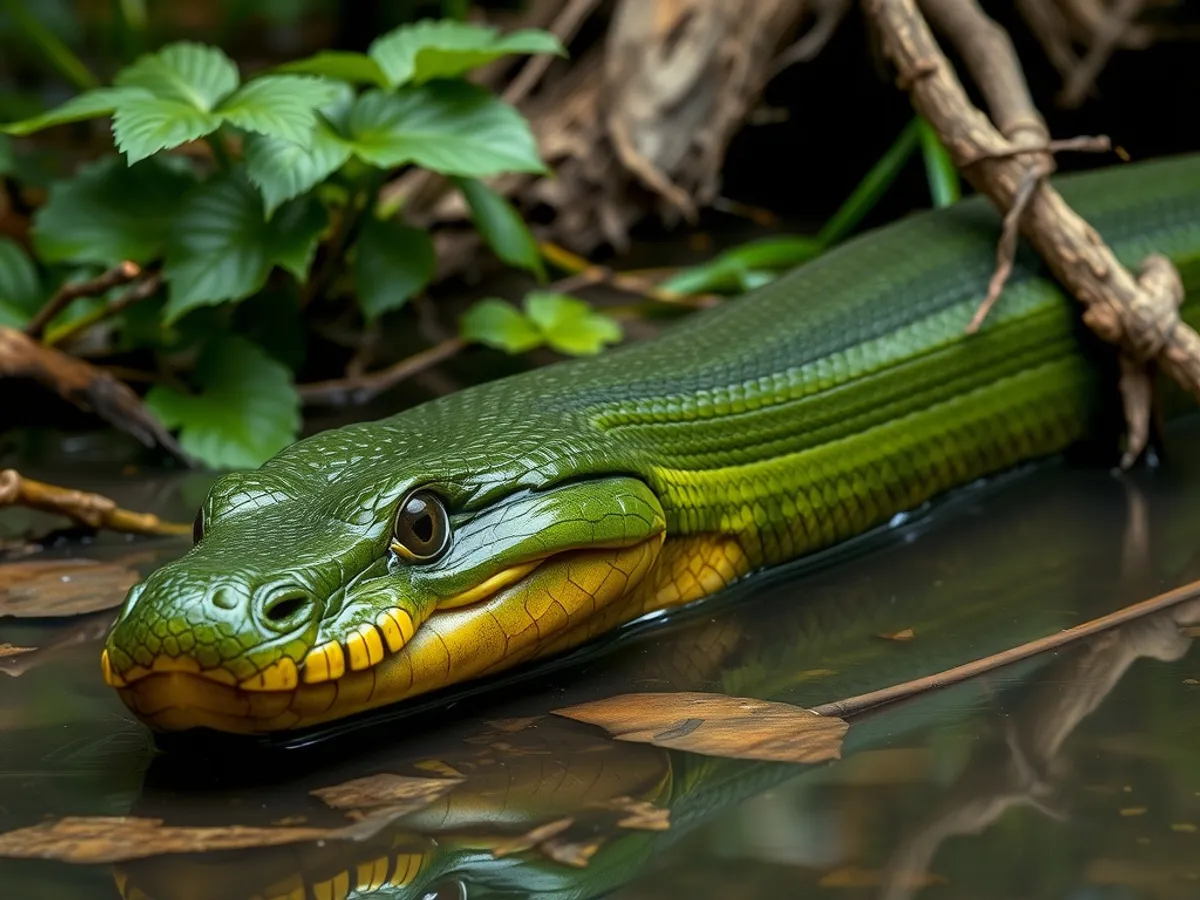
About the Green Anaconda
Eunectes murinus is the heaviest snake alive - not the longest, a title the reticulated python holds - with reliable records around 5 to 6 m and over 90 kg, and the persistent tales of 10 m animals have never been backed by a specimen or a photograph despite a standing cash prize offered for one since the 1900s. Its bulk is possible because it is essentially aquatic: an anaconda spends most of its life in slow-moving Amazon and Orinoco water, where buoyancy carries a mass that would be crippling on land, with eyes and nostrils set high on the head so it can lie almost entirely submerged. It kills by constriction, tightening with each exhalation of the prey until circulation fails - the mechanism is circulatory arrest, not suffocation or bone-crushing. Females are dramatically larger than males, often four to five times the mass, one of the widest size gaps in any terrestrial vertebrate, and during the breeding season a dozen or more males may coil around a single female for weeks in a slow-writhing "breeding ball", where the outcome is decided by squeezing endurance rather than fighting. Anacondas bear live young, up to a few dozen at a time. In 2024 genetic work split off a northern population as a separate species, Eunectes akayima.
Fascinating facts
Record Size
The largest confirmed Green Anaconda measured 5.21 meters (17.1 feet) long, but unverified reports suggest some may reach lengths of over 7 meters (23 feet).
Aquatic Lifestyle
Green Anacondas are excellent swimmers and spend most of their lives in or near water, where they can move stealthily to ambush prey.
Live Births
Unlike many snakes, Green Anacondas are ovoviviparous, meaning females give birth to live young rather than laying eggs.
Detailed description
The Green Anaconda (Eunectes murinus) is the largest and heaviest snake species in the world, with adult females—typically larger than males—reaching lengths of 5 to 6 meters (16–20 feet) and exceptional specimens exceeding 7 meters (23 feet). Weights can surpass 150 kg (330 lbs), with girths as thick as a human torso. Its robust, muscular body is olive-green with black blotches, providing camouflage in murky waters and dense vegetation. The head is relatively small with eyes and nostrils positioned dorsally, allowing the snake to breathe and observe while mostly submerged. The Green Anaconda is primarily nocturnal and highly aquatic, rarely venturing far from water. It is a solitary ambush predator, relying on stealth and strength rather than speed. The species exhibits sexual dimorphism, with females sometimes twice the mass of males. Reproduction is ovoviviparous: females give birth to live young, typically 20–40 neonates per litter, though litters of over 80 have been recorded. Juveniles are independent from birth. Adaptations such as heat-sensing pits, powerful constriction muscles, and a slow metabolism allow the Green Anaconda to thrive in the challenging environments of South America’s wetlands.
Did you know?
A female Green Anaconda can give birth to as many as 40 live young at one time, rather than laying eggs like many other snakes.
Research & sources
Wikipedia summary
The green anaconda, also known as the giant anaconda, emerald anaconda, common anaconda, common water boa, or southern green anaconda, is a semi-aquatic boa species found in South America and the Caribbean island of Trinidad. It is the largest, heaviest, and second longest snake in the world. No subspecies are currently recognized, but there are two different species that have the name of the Green Anaconda which are the Northern Green Anaconda and Southern Green Anaconda. Like all boas, it is a non-venomous constrictor. The term "anaconda" often refers to this species, though the term could also apply to other members of the genus Eunectes. Fossils of the snake date back to the Late Pleistocene in the Gruta do Urso locality.
Behaviour & social structure
Green Anacondas are predominantly solitary except during the breeding season. They spend much of their time submerged, with only their nostrils and eyes above water, minimizing detection by prey and predators. Their hunting strategy is ambush-based: they remain motionless in water or dense vegetation, striking rapidly at passing prey. Diet is highly opportunistic, including fish, birds, mammals (such as capybara and deer), reptiles, and occasionally caimans or even jaguars. After a large meal, an anaconda may fast for weeks or months. They are generally slow-moving on land but agile swimmers. Social interactions are limited, though multiple males may congregate around a single female during mating season, forming 'breeding balls' that can last several weeks. Daily activity peaks at dusk and night, with daytime spent basking or resting in water.
Reproduction & life cycle
Breeding occurs during the rainy season (typically April to May), when females emit pheromones to attract males. Several males may compete for a single female, forming breeding aggregations known as 'mating balls,' sometimes involving up to a dozen males. Copulation can last several hours. The species is ovoviviparous: fertilized eggs develop inside the female, and she gives birth to live young after a gestation period of 6–7 months. Litter size ranges from 20 to 40, but can exceed 80 in large females. Neonates measure 60–80 cm (24–31 in) at birth and are fully independent, receiving no parental care. Sexual maturity is reached at 3–4 years for males and 4–5 years for females.
Adaptations & survival
Key adaptations include dorsally placed eyes and nostrils for aquatic hunting, cryptic coloration for camouflage, and extremely strong musculature for constriction. The loose ligaments in their jaws allow them to swallow prey much larger than their head diameter. Their slow metabolism enables survival on infrequent, large meals. Heat-sensing pits along the upper lip aid in detecting warm-blooded prey. The skin is tough and resistant to abrasions from aquatic vegetation. Green Anacondas can remain submerged for up to 10 minutes, an adaptation for both hunting and predator avoidance. Females’ larger size is an evolutionary response to fecundity selection, allowing them to produce larger litters.
Cultural significance
The Green Anaconda features prominently in South American folklore and mythology, often depicted as a river spirit or guardian. Indigenous peoples have traditionally respected or feared the anaconda, attributing supernatural powers to it. In some cultures, it symbolizes strength, fertility, or the primordial forces of water. The species has also been exploited in the skin trade and occasionally as a food source. In popular media, the anaconda is often exaggerated as a monstrous man-eater, contributing to both fascination and fear.
Recent research
Recent genetic studies have clarified the taxonomy of Eunectes, supporting the distinction between northern (E. akayima) and southern (E. murinus) populations. Ongoing research focuses on movement ecology using radio telemetry, revealing that individuals have relatively small home ranges and strong site fidelity. Studies on reproductive biology have documented extreme sexual size dimorphism and the energetic costs of reproduction in females. Fossil evidence from the Late Pleistocene in Brazil suggests the genus has a long evolutionary history in South America. Conservation research is increasingly concerned with the impacts of wetland loss and climate change on population viability.
Videos
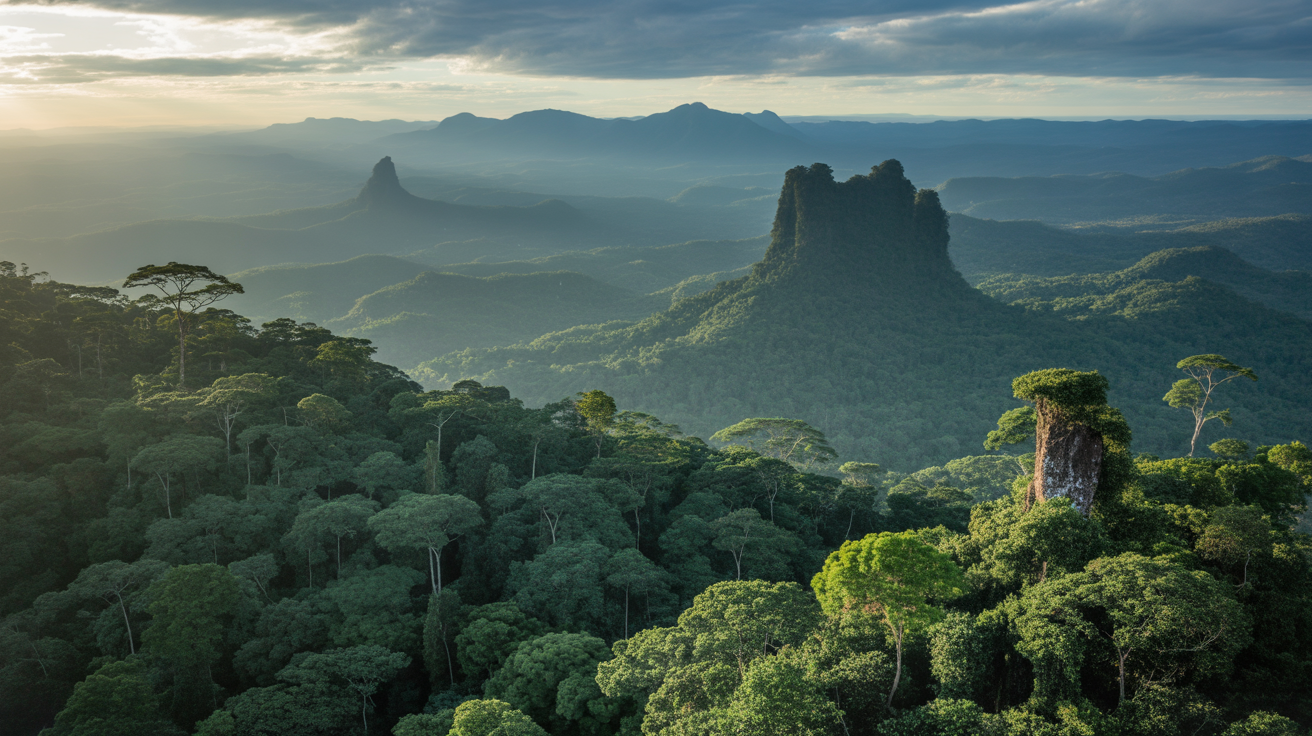
Habitat
Tropical rainforests, swamps, marshes, and slow-moving rivers

Conservation
The Green Anaconda is currently classified as Least Concern on the IUCN Red List.
Threats & challenges
Despite their formidable size, Green Anacondas face threats from habitat destruction (wetland drainage, deforestation), water pollution, and direct persecution by humans who fear or hunt them for skin and meat. They are occasionally captured for the exotic pet trade, though their size makes them unsuitable for captivity. Road mortality and accidental killings also occur. While currently listed as 'Least Concern' by the IUCN, localized population declines have been reported. Climate change, altering rainfall patterns and wetland dynamics, poses a long-term threat. There is little evidence of significant natural predation on adults, but juveniles are vulnerable to birds of prey, caimans, and large fish.
Taxonomy
Scientific name
Eunectes murinus
- Kingdom
- Animalia
- Phylum
- Chordata
- Class
- Reptilia
- Order
- Squamata
- Family
- Boidae
- Genus
- Eunectes
- Species
- murinus
Where to see a green anaconda
16 zoos and aquariums in 4 countries are recorded as keeping this species.
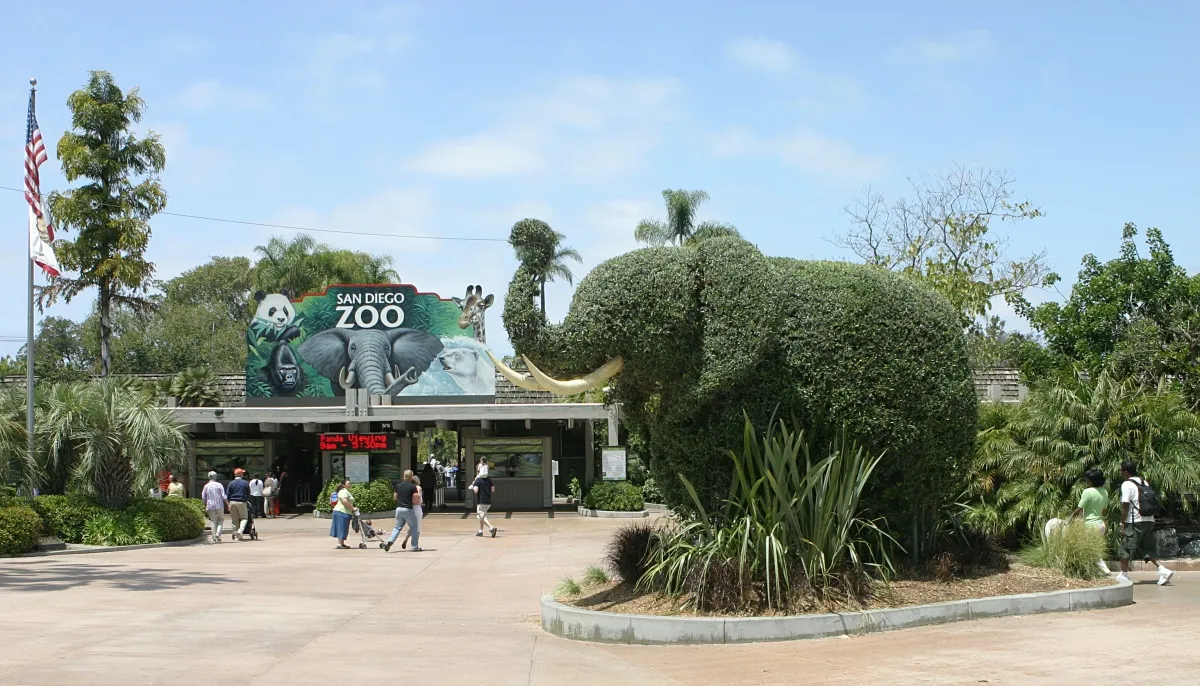 San Diego Zoo🇺🇸 San Diego, United States
 Milwaukee County Zoo🇺🇸 Milwaukee, United States
 National Zoological Park🇺🇸 Washington, United States
 New England Aquarium🇺🇸 Boston, United States
 Shedd Aquarium🇺🇸 Chicago, United States
Community notes
Share your observations about the Green Anaconda.
No community notes yet. Be the first!
Discover more wildlife
More fascinating animals from the encyclopedia.