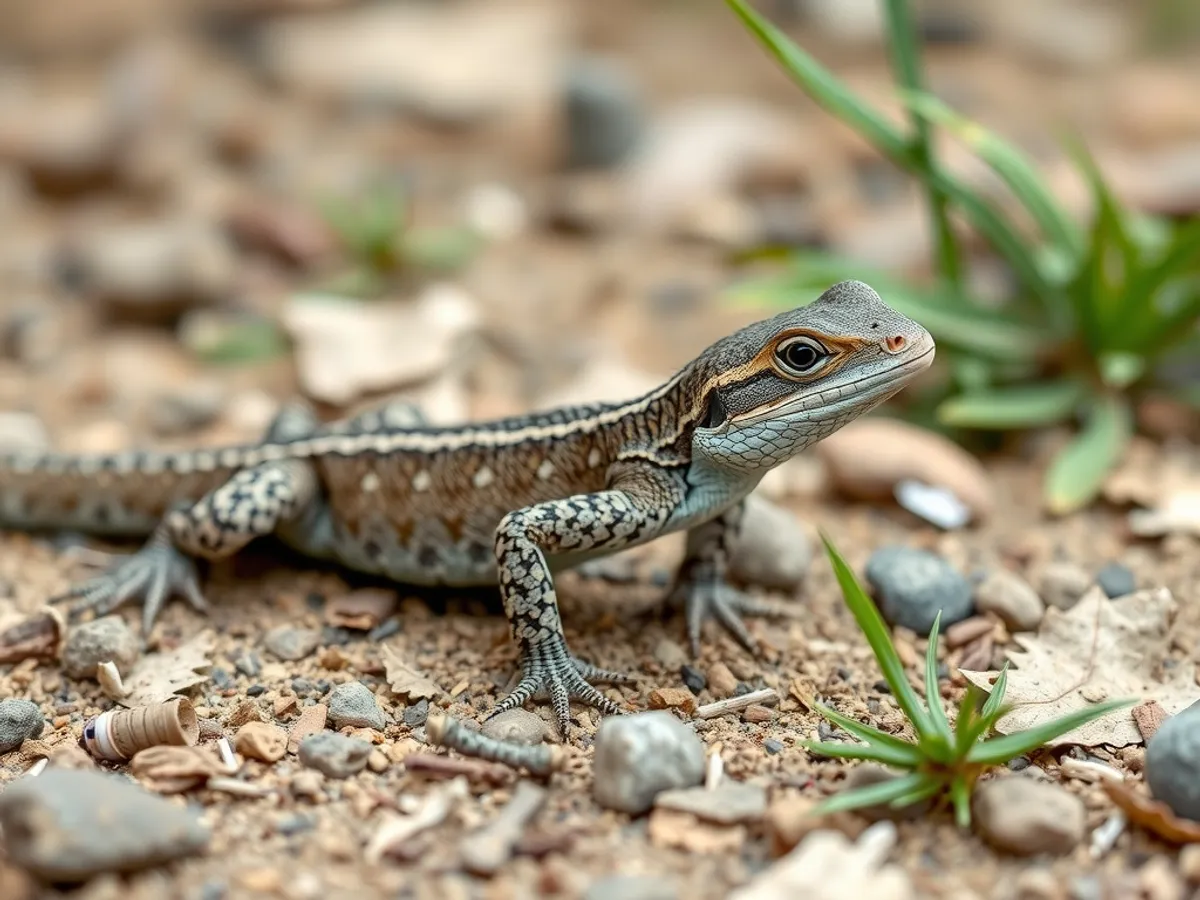
Reptiles
Cold-blooded vertebrates with scales, typically laying eggs on land.
244 species
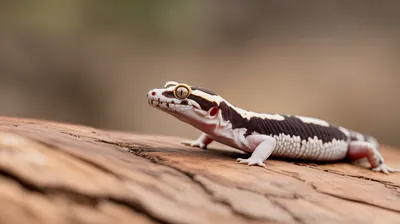
African Fat-tailed Gecko
Hemitheconyx caudicinctus
The African Fat-tailed Gecko is a medium-sized, nocturnal lizard native to West Africa. Recognized for its distinctive broad tail, which stores fat as an energy reserve, this gecko displays earthy color patterns with bold stripes or bands. It prefers arid to semi-arid environments, often sheltering under rocks or in burrows to avoid the harshest heat. Calm and docile, the African Fat-tailed Gecko is a popular choice for reptile enthusiasts due to its manageable size and hardy nature.
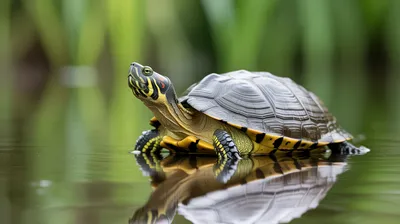
African Helmeted Turtle
Pelomedusa subrufa
The African Helmeted Turtle is a small to medium-sized freshwater turtle known for its distinctive domed shell and broad, flattened head. Found throughout much of sub-Saharan Africa and parts of the Middle East, it is highly adaptable and inhabits a variety of freshwater bodies, including ponds, lakes, and slow-moving rivers. This turtle is famous for its ability to survive in temporary water sources by burrowing into mud during dry periods, a behavior known as aestivation. It is an opportunistic feeder, consuming a wide range of animal and plant matter. African Helmeted Turtles are also known for their social basking behavior and occasional group hunting.
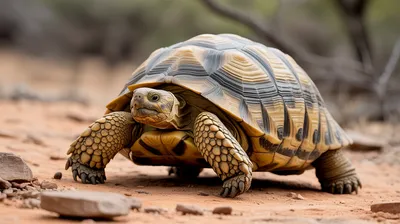
African Pancake Tortoise
Malacochersus tornieri
The pancake tortoise abandoned the one thing tortoises are famous for: armour. Its shell is flat, thin and riddled with large fenestrations — genuine holes in the underlying bone — so the whole carapace flexes like a stiff leather pad. Squeezed into a crack in a granite kopje, the tortoise inflates its lungs and braces outward with its legs, wedging itself so firmly that a predator cannot extract it; the flexible shell lets it exploit crevices far too narrow for a domed tortoise. It does not withdraw and sit tight, because it cannot — instead it is the fastest tortoise known, and will simply run for the nearest rock and disappear. The low mass that comes with a hollow shell also means that, unlike a heavy domed species, a flipped pancake tortoise can right itself with a flick of the neck and leg. It lives on rocky outcrops in Kenya and Tanzania, lays a single egg at a time several times a year, and was moved to CITES Appendix I in 2019 after collectors stripped whole kopjes for the pet trade.
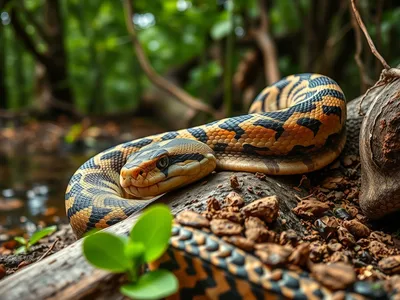
African Rock Python
Python sebae
The African Rock Python is Africa's largest snake and one of the largest python species in the world. Characterized by its thick, muscular body and distinctive dark blotched pattern, it can grow up to 6 meters (20 feet) in length. This non-venomous constrictor is highly adaptable and found across a wide range of habitats, including savannas, forests, and near water bodies. African Rock Pythons are solitary and ambush predators, relying on stealth and power to subdue large prey such as antelope, monitor lizards, and even crocodiles. Despite their formidable size, they face threats from habitat loss and hunting.
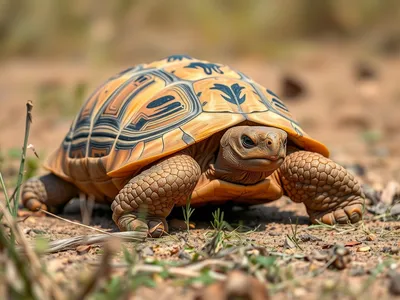
African Spurred Tortoise
Centrochelys sulcata
The sulcata is the largest mainland tortoise on Earth — outweighed only by the island giants of Aldabra and Galapagos — and it can pass 100 kg. It survives the Sahel by engineering its own climate: it excavates burrows that can run 3 m deep and over 10 m long, where humidity stays high and temperature stable, and it aestivates through the worst of the dry season inside. Those burrows are a keystone resource, sheltering rodents, snakes, lizards and invertebrates that would otherwise cook. The tortoise stores water in an enlarged bladder and reabsorbs it as needed, which is why it can go months without drinking, feeding on dry grasses that most herbivores cannot digest. The "spurs" of its name are the conical, horny scales on the back of each thigh. Its size is also its tragedy in captivity: sold as a hatchling the size of a golf ball, it grows into a burrowing, fence-flattening animal that outlives its owner, and reptile rescues across the United States are permanently overwhelmed with abandoned adults.
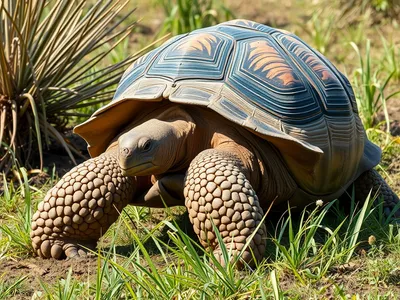
Aldabra Giant Tortoise
Aldabrachelys gigantea
Aldabra Atoll in the Seychelles carries roughly 100,000 giant tortoises — many times the number in all of Galapagos, making it by far the largest population of giant tortoises on Earth, and one of the last places where a reptile is the dominant grazing herbivore. Their grazing has produced "tortoise turf": a dwarfed, low-growing sward of grasses and herbs that flower at ground level, plants that evolved under constant cropping in the same way that grasses coevolved with mammalian grazers elsewhere. The main killer on Aldabra is not predation but heat. A tortoise has no way to shed heat quickly, and on an atoll with little shade, animals caught out in the open at midday can die of hyperthermia; competition for shade is real and lethal. They will stand on their hind legs to reach higher browse, and populations differ in neck length accordingly. They are also opportunistic and unsentimental feeders, gnawing bones and eating carrion for calcium and protein.
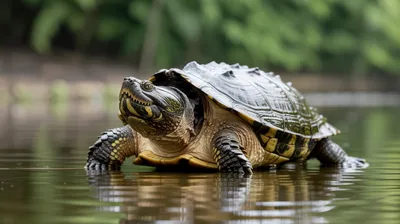
Alligator Snapping Turtle
Macrochelys temminckii
The alligator snapping turtle is one of very few vertebrates that fishes with a lure. It lies on the river bottom with its jaws open and wiggles a pink, worm-shaped appendage on the floor of its tongue; a fish that comes to inspect the "worm" is taken by a strike that closes the jaws in a fraction of a second. It is a genuine ambush specialist that may sit motionless for so long that algae grow on its shell, and its three high ridges of keels, hidden eyes set at the sides of the head, and hooked beak separate it clearly from the far more aggressive common snapper. The popular claim that it can bite through a broomstick is not true: measured bite forces are around 150 pounds of force, respectable but comparable to a large dog and well below the crushing power of many turtles that eat shellfish. Males can exceed 100 kg. Populations across the Mississippi basin were gutted in the twentieth century by commercial harvest for turtle soup, and the species is slow-maturing enough that recovery takes decades.
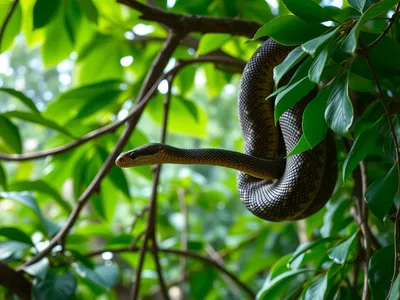
Amazon tree boa
Corallus hortulana
The Amazon tree boa is a slender, highly arboreal snake native to the rainforests of South America. This species exhibits remarkable color variation, with individuals ranging from bright yellow to deep red, orange, or gray, often with intricate patterns. Known for its agility, the Amazon tree boa uses its prehensile tail to navigate branches in search of prey, which includes small mammals, birds, and lizards. Though non-venomous, it is known for its defensive nature and can deliver a painful bite if threatened. Its nocturnal habits and cryptic coloration make it a master of camouflage in its dense, leafy habitat.
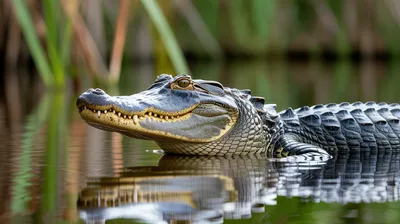
American Alligator
Alligator mississippiensis
The American alligator (Alligator mississippiensis) is a formidable reptilian inhabitant of the Southeastern United States, thriving in freshwater environments such as swamps, marshes, rivers, and lakes. Male American alligators can grow up to 15 feet (4.6 meters) in length and weigh as much as 1,000 pounds (450 kilograms), making them significantly larger than their distant relative, the Chinese alligator (Alligator sinensis), which rarely exceeds 7 feet (2.1 meters). This size advantage is crucial for their role as apex predators, allowing them to control populations of prey species such as fish, birds, and mammals. Their robust jaws exert a bite force of about 2,980 psi (pounds per square inch), enabling them to crack turtle shells with ease. American alligators possess a unique adaptation in their heart, which can shunt blood away from the lungs, optimizing oxygen utilization during prolonged dives. This physiological trait is vital for their survival in aquatic habitats. They are also known for their vocalizations, particularly the male's bellowing during mating season, which can be heard up to 165 yards (150 meters) away.
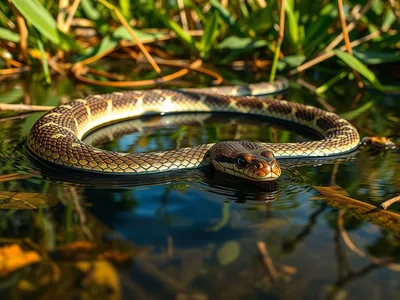
Arafura file snake
Acrochordus arafurae
The Arafura file snake is a large, aquatic, non-venomous snake native to northern Australia and southern New Guinea. It is recognized by its loose, baggy skin covered in rough, file-like scales, which help it grip slippery prey underwater. This nocturnal reptile spends most of its life in freshwater rivers, billabongs, and floodplains, rarely venturing far from the water’s edge. Females are significantly larger than males and can reach lengths of up to 2.5 meters. The Arafura file snake is well-adapted for aquatic life and is known for its slow, deliberate movements.
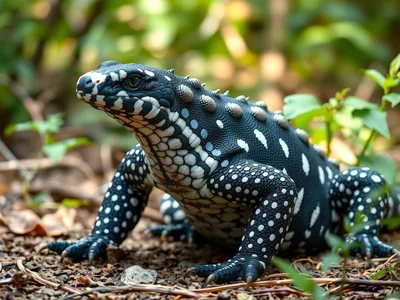
Argentine Black and White Tegu
Salvator merianae
The Argentine Black and White Tegu is the largest species of tegu lizard native to South America, particularly Argentina, Brazil, and surrounding countries. It is easily recognized by its distinct black and white banded pattern and robust, muscular build. Tegus are highly intelligent reptiles, capable of learning simple tasks and even recognizing their human caretakers. They are terrestrial, spending much of their time foraging on the ground, and are known for their docile temperament, making them increasingly popular in the exotic pet trade.
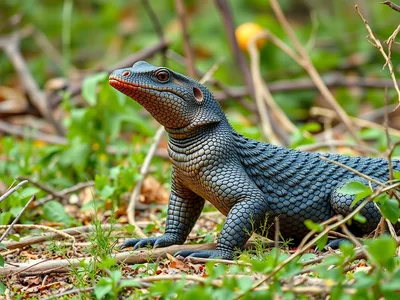
Argus Monitor
Varanus panoptes
The Argus Monitor is a large, alert lizard native to northern Australia and southern New Guinea. It is renowned for its keen senses, powerful limbs, and distinctive pattern of yellowish spots across its brown body. Argus Monitors are highly active hunters, often seen digging for prey or basking in open woodlands and savannas. They are skilled climbers and swimmers, able to traverse a variety of environments in search of food.
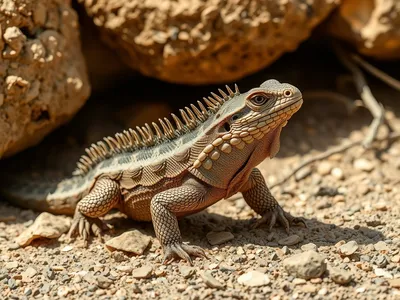
Armadillo girdled lizard
Ouroborus cataphractus
The armadillo girdled lizard defends itself exactly the way its namesake does. Threatened, it takes its own tail in its mouth and curls into a tight ring, turning the soft belly inward and presenting nothing but a wall of heavy, spined scales — an armoured doughnut that a predator can get no purchase on and cannot easily swallow. It lives in the rocky, arid scrub of western South Africa, sheltering in cracks in sandstone outcrops, and unusually for a lizard it is social: groups of up to several dozen share the same crevices. That sociality is precisely why it has become such a target for the illegal pet trade, since an entire colony can be taken at once by cracking open a single rock. It is unusual in another way too — it gives birth to live young, one or two at a time, rather than laying eggs, and females have been recorded feeding their offspring, which is close to unheard of among lizards. It reproduces very slowly and is now protected.
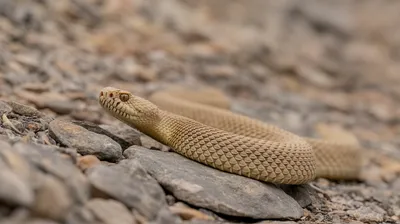
Aruba Island Rattlesnake
Crotalus unicolor
The Aruba Island Rattlesnake is a highly endangered pit viper species endemic to the island of Aruba in the southern Caribbean. It has a light brown or grayish coloration with faint, diamond-shaped patterns that help it blend into the arid, rocky hillsides where it lives. Adapted to a desert-like environment, this snake is primarily nocturnal, emerging at dusk to hunt small mammals, birds, and lizards. With a calm disposition compared to other rattlesnakes, it is rarely encountered by humans and plays a vital role in its ecosystem as both predator and prey.
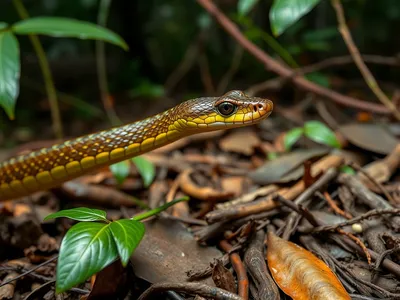
Asian Vine Snake
Ahaetulla prasina
The Asian Vine Snake is a slender, mildly venomous arboreal snake native to South and Southeast Asia. Easily recognizable by its elongated, pointed snout and brilliant green coloration, this snake is perfectly adapted for life among the foliage, where it relies on its camouflage to ambush prey. Its thin, whip-like body allows it to move gracefully through branches and leaves in search of small vertebrates, especially lizards and frogs. Although its venom is not considered dangerous to humans, it uses it effectively to subdue its prey.
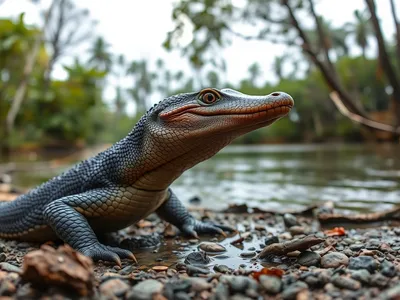
Asian Water Monitor
Varanus salvator
The Asian water monitor is the second-heaviest lizard alive, behind only the Komodo dragon, and it is one of the very few big reptiles that has done well out of human cities. It swims powerfully with a laterally flattened tail, can stay submerged for half an hour, climbs, runs, and is entirely comfortable scavenging — which is why the canals and parks of Bangkok, including Lumphini Park in the centre of the city, hold a substantial urban population living on rubbish, fish and carrion. It hunts with a deeply forked tongue feeding a Jacobson's organ, following scent trails, and it will dig up crocodile and turtle nests for eggs. Monitors turn out to have a lung anatomy nobody expected: airflow through the lung is largely unidirectional, looping in a one-way circuit like a bird's rather than tidally in and out like a mammal's, which suggests this efficient design long predates birds. Monitors also possess venom glands, though for a water monitor the real danger of a bite is mechanical damage and infection, not toxin.
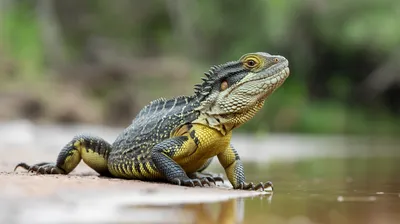
Australian Water Dragon
Intellagama lesueurii
The Australian Water Dragon is a large, semi-aquatic lizard native to eastern Australia. Recognizable by its long tail, crested head, and prominent spines along its back, this reptile is well-adapted to life near rivers and streams. They are skilled swimmers, able to remain submerged for up to 90 minutes to evade predators. Australian Water Dragons are diurnal and spend much of their time basking on rocks, darting into the water when threatened. Their coloration provides excellent camouflage among the riverbanks and forested habitats they frequent.
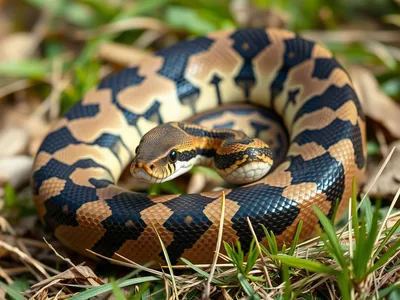
Ball Python
Python regius
The ball python is named for its defence: rather than strike, it tucks its head into the centre of its coils and rolls into a tight ball that a predator struggles to open. It is a small, slow, mild African python — rarely over 1.5 m — and it is now the most heavily traded live African animal in the world, exported by the hundreds of thousands from Togo, Benin and Ghana under a system where wild-gravid females are collected, their eggs hatched, and a portion of the young released. In captivity, selective breeding has produced well over 8,000 documented colour and pattern morphs, an intensity of designer breeding matched by almost no other reptile — and it has surfaced real welfare problems, because the popular "spider" morph is inseparably linked to a neurological head-wobble. Its heat-sensing labial pits let it strike accurately at warm-blooded prey in total darkness. Females coil around the clutch and shiver to warm it, fasting for the roughly two months of incubation.
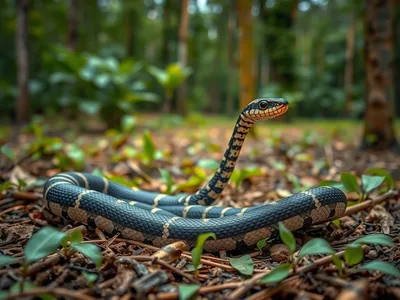
Banded Krait
Bungarus fasciatus
The Banded Krait is a highly venomous elapid snake native to South and Southeast Asia. It is easily recognized by its distinctive black and yellow crossbands, which serve as a warning to potential predators. Primarily nocturnal and secretive, the banded krait is often found near water bodies such as rice paddies, marshes, and slow-moving streams. Although it possesses potent neurotoxic venom, it is generally shy and rarely bites humans unless provoked. Due to its reclusive behavior, encounters with this snake are infrequent despite its wide distribution.
Banded Rock Rattlesnake
Crotalus lepidus klauberi
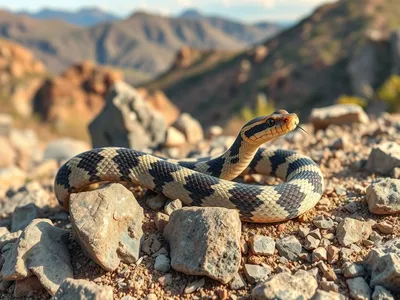
The Banded Rock Rattlesnake is a small, venomous pit viper native to rocky, mountainous regions of the southwestern United States and northern Mexico. Distinguished by its pale gray to lavender body adorned with dark, well-defined crossbands, this snake is an expert at camouflage among rocks and outcrops. It is a secretive and elusive species, usually active during dusk or after rainfall. Although venomous, it is generally shy and avoids human contact, preferring to remain hidden in crevices.
Banded sea krait
Laticauda colubrina
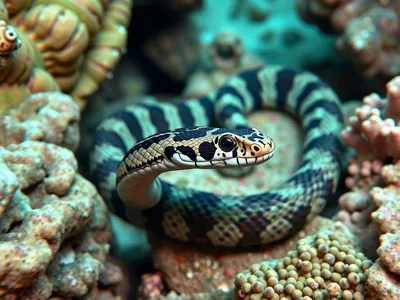
The banded sea krait is amphibious in a way true sea snakes are not. It retains broad belly scales, so it can crawl properly on land, and it hauls out constantly — to digest, to shed its skin, to mate and, crucially, to lay eggs, which it does in crevices and caves above the tide line. True sea snakes give birth at sea and would be effectively stranded on a beach. Its hunting is specialised and strikingly divided by sex: larger females work deeper water and take conger eels, while the smaller, slimmer males hunt moray eels in shallow reef crevices, so the sexes are not competing for the same prey. It carries extremely potent neurotoxic venom, but it is famously placid and bites people almost never, so fishermen in the Pacific handle them casually. It also cannot drink seawater: it needs fresh or brackish water and depends on rain, drinking from the freshwater lens that floats briefly on the sea surface after a downpour.
Bar-necked Rock Monitor
Varanus albigularis angolensis
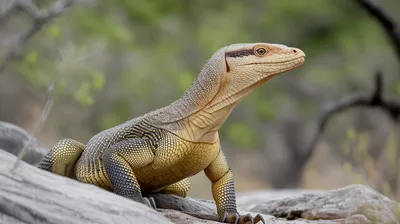
The Bar-necked Rock Monitor is a robust, medium-to-large lizard native to southern Africa, recognized by the distinctive pale bands or bars on its neck. This subspecies is part of the white-throated monitor complex and is known for its stocky build, strong limbs, and powerful tail, which it uses both for balance and defense. Bar-necked Rock Monitors are primarily terrestrial, often found in rocky outcrops and savannas, where they use their keen senses to hunt prey and evade predators. Their adaptability and intelligence make them one of the most successful monitor lizards in their range.
Barbados Threadsnake
Tetracheilostoma carlae
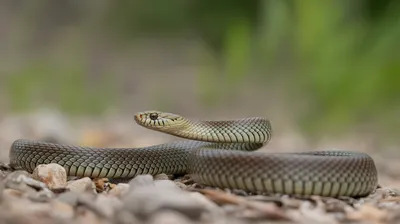
The Barbados threadsnake is the smallest snake in the world: an adult is about 10 cm long and roughly as thick as a strand of spaghetti, and one can coil comfortably on a US quarter. It was described only in 2008, by Blair Hedges, from specimens including one that had been sitting misidentified in a museum for decades. Its size is close to an actual physical floor for snakes, and the reason is reproductive: it lays a single egg, and the hatchling emerges about half the length of its mother. That ratio is extreme, and it reflects a hard constraint — a snake much smaller than this could not produce an offspring large enough to survive and still fit inside itself. Big snakes lay many small eggs; the smallest species are forced into one relatively enormous one. It is a blind, burrowing snake, effectively eyeless, that eats termite and ant larvae underground. It is known only from a few fragments of forest on Barbados, an island whose native forest has been almost entirely cleared for sugar cane.
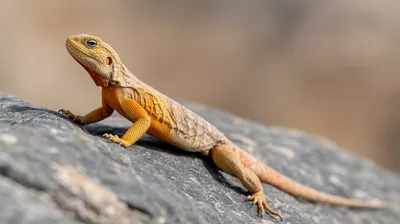
Barbary Coast Agama
Agama bibronii
The Barbary Coast Agama is a robust, medium-sized lizard native to the rocky and arid regions along the northwestern coast of Africa. It displays striking sexual dimorphism, with males often showing vivid blue or reddish hues during the breeding season, while females are generally more subdued in color. This diurnal reptile is well-adapted for climbing and can be seen basking on rocks or walls during the day. Its energetic movements and territorial displays make it a fascinating subject for behavioral observation. The Barbary Coast Agama plays a vital role in its ecosystem by controlling insect populations.