
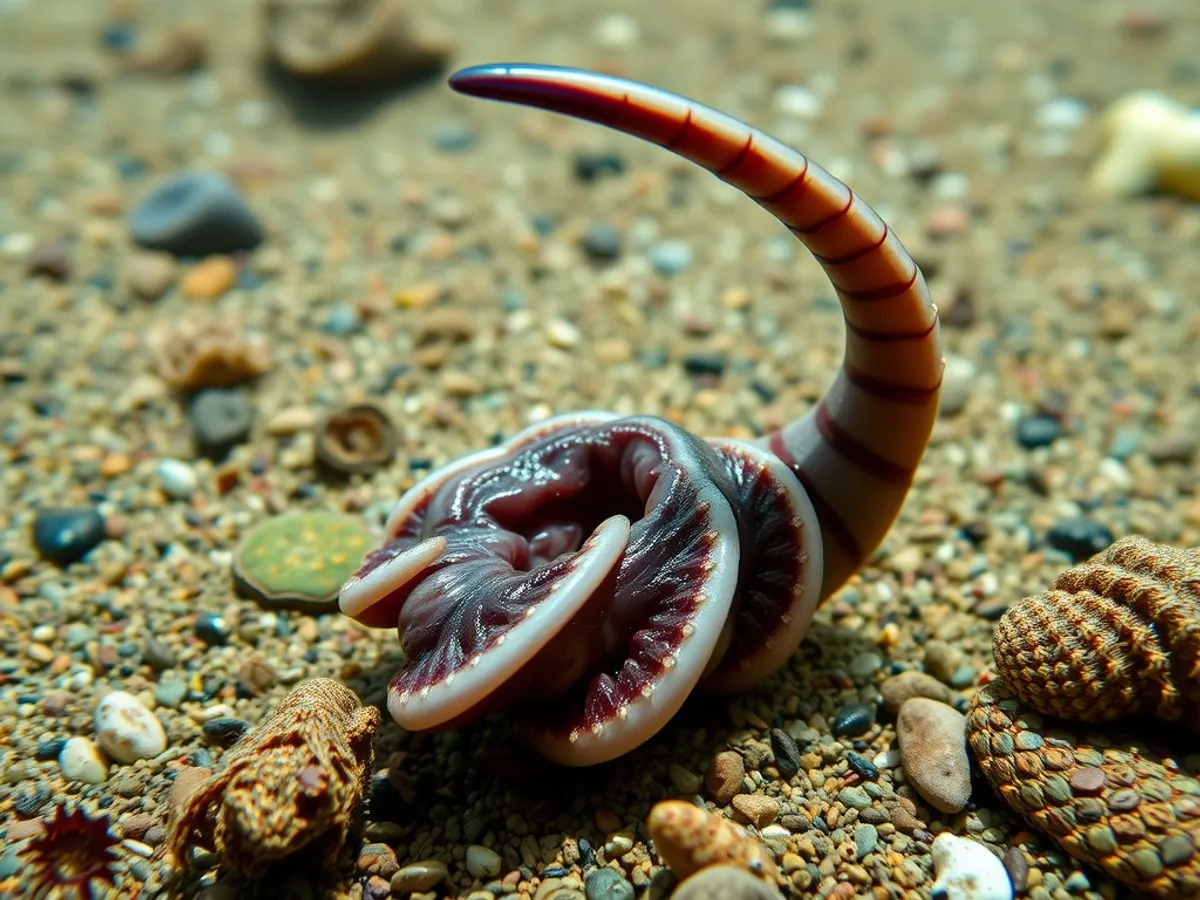
About the Horseshoe Worm
The Horseshoe Worm is a slender, unsegmented marine invertebrate belonging to the phylum Phoronida. These worms are known for their horseshoe-shaped feeding structure called a lophophore, which they use to filter plankton and organic particles from the water. Horseshoe Worms live in tubes that they secrete from their bodies, often attaching themselves to rocks, shells, or other hard substrates in shallow coastal waters. Although usually small and inconspicuous, they play an important role in marine ecosystems as filter feeders. Their simple body plan and unique feeding apparatus make them a fascinating subject for studies on animal evolution and development.
Fascinating facts
Lophophore Feeding
Horseshoe Worms use a specialized, horseshoe-shaped crown of tentacles called a lophophore to capture food particles from the water.
Tube Dweller
These worms secrete chitinous tubes in which they live, anchoring themselves to rocks, shells, or other hard surfaces.
Evolutionary Enigma
Although they resemble worms, Horseshoe Worms are part of the small phylum Phoronida and are closer to brachiopods and bryozoans than to annelid worms.
Detailed description
Phoronis australis, commonly known as the Horseshoe Worm, is a slender, unsegmented marine invertebrate belonging to the phylum Phoronida. Adult individuals typically measure between 2 and 5 cm in length and about 1.5 mm in diameter, though some phoronids can reach lengths up to 50 cm. The body is cylindrical and flexible, encased within a secreted chitinous tube that is anchored to hard substrates such as shells, rocks, or coral fragments in shallow coastal waters, often at depths ranging from the intertidal zone to about 400 meters. The most distinctive anatomical feature is the lophophore, a horseshoe-shaped or sometimes spiral crown of ciliated tentacles that surrounds the mouth and is used for filter feeding. The lophophore is highly efficient at capturing suspended plankton and organic particles from the water column. Internally, Phoronis australis possesses a U-shaped gut, with the anus located near but outside the lophophore ring. The nervous system is relatively simple, with a nerve ring encircling the base of the lophophore and a ventral nerve cord. Respiration occurs primarily across the body surface and the tentacles. The worm’s soft body is highly contractile, allowing rapid withdrawal into its protective tube when threatened. Phoronis australis is solitary but may be found in dense aggregations where suitable substrate is abundant, contributing significantly to benthic community structure and nutrient cycling. Their simple body plan and unique feeding apparatus provide valuable insights into the evolution of lophophorates and the origins of body plan diversity among marine invertebrates.
Did you know?
The lophophore of the Horseshoe Worm is shaped like a horseshoe, which is how the group got its common name.
Research & sources
Wikipedia summary
Phoronids are a small phylum of marine animals that filter-feed with a lophophore, and build upright tubes of chitin to support and protect their soft bodies. They live in most of the oceans and seas, including the Arctic Ocean but excluding the Antarctic Ocean, and between the intertidal zone and about 400 meters down. Most adult phoronids are 2 cm long and about 1.5 mm wide, although the largest are 50 cm long.
Behaviour & social structure
Phoronis australis is a sessile suspension feeder, spending the majority of its life anchored within its tube. The worm extends its lophophore into the water column to feed, using cilia on the tentacles to generate water currents and direct food particles toward the mouth. Feeding activity is largely continuous, but the worm can rapidly retract the lophophore and body into its tube in response to mechanical disturbances or the presence of predators. Social interactions are minimal, as individuals are not known to exhibit cooperative behaviors, but dense aggregations can occur in favorable habitats, sometimes forming 'phoronid beds.' Daily activity is influenced by tidal cycles, with increased feeding during periods of higher water movement that bring more suspended particles. Phoronis australis does not actively hunt; instead, it relies on passive filtration. The tubes may be decorated with sand grains or shell fragments for additional camouflage and protection.
Reproduction & life cycle
Phoronis australis is a hermaphroditic species, possessing both male and female reproductive organs, though cross-fertilization is common. Gametes are typically released into the surrounding water, where external fertilization occurs. The species exhibits a planktonic larval stage known as the actinotroch, which is free-swimming and disperses with ocean currents for several days to weeks before settling and metamorphosing into the adult form. Breeding seasons are often linked to local environmental conditions, such as temperature and food availability, and may occur once or multiple times per year depending on the region. There is no parental care; larvae are entirely independent after fertilization. The actinotroch larva is notable for its ciliated bands and preoral lobe, which aid in swimming and feeding during the dispersal phase.
Adaptations & survival
Phoronis australis has evolved several adaptations for a sessile, filter-feeding lifestyle. The chitinous tube provides both physical protection from predators and environmental stability, while the ability to rapidly retract into the tube minimizes predation risk. The lophophore’s ciliated tentacles are highly specialized for efficient suspension feeding, maximizing food capture in nutrient-rich coastal waters. The U-shaped gut allows for compact body organization within the narrow tube. The actinotroch larva is adapted for wide dispersal, increasing the species’ colonization potential. Additionally, the worm can regenerate lost body parts, an adaptation that enhances survival following partial predation or injury.
Cultural significance
Phoronis australis and other phoronids have little direct significance in human culture, mythology, or traditional use, largely due to their small size, cryptic habits, and lack of economic value. However, they are of considerable scientific interest as model organisms in studies of animal development, evolutionary biology, and marine ecology. Their unique position among lophophorate animals has made them important for understanding the evolutionary relationships between major invertebrate groups.
Recent research
Recent research on Phoronis australis has focused on its developmental biology, particularly the molecular and genetic mechanisms underlying lophophore formation and metamorphosis from the actinotroch larva to the adult form. Studies have also examined the phylogenetic relationships of phoronids within Lophotrochozoa, using molecular data to clarify their evolutionary history. Ongoing ecological research investigates the role of phoronids in benthic nutrient cycling and their responses to environmental stressors such as hypoxia and pollution. Notably, the regenerative abilities of phoronids are being explored for insights into invertebrate tissue repair and stem cell biology.
Videos
Habitat
Shallow coastal marine environments

Conservation
The Horseshoe Worm is currently classified as Least Concern on the IUCN Red List.
Threats & challenges
Currently, Phoronis australis is not considered threatened and is classified as Least Concern. However, localized populations may be affected by habitat degradation, pollution (especially sedimentation and chemical contaminants), and coastal development that reduces the availability of suitable hard substrates. Climate change, particularly ocean acidification, may impact tube formation and larval development in the future. The species is not targeted by fisheries or subject to significant direct human exploitation, but its ecological role as a filter feeder makes it sensitive to changes in water quality and benthic community structure.
Taxonomy
Scientific name
Phoronis australis
- Kingdom
- Animalia
- Phylum
- Phoronida
- Class
- Phoronida
- Order
- Phoronida
- Family
- Phoronidae
- Genus
- Phoronis
- Species
- australis
Community notes
Share your observations about the Horseshoe Worm.
No community notes yet. Be the first!
Discover more wildlife
More fascinating animals from the encyclopedia.