
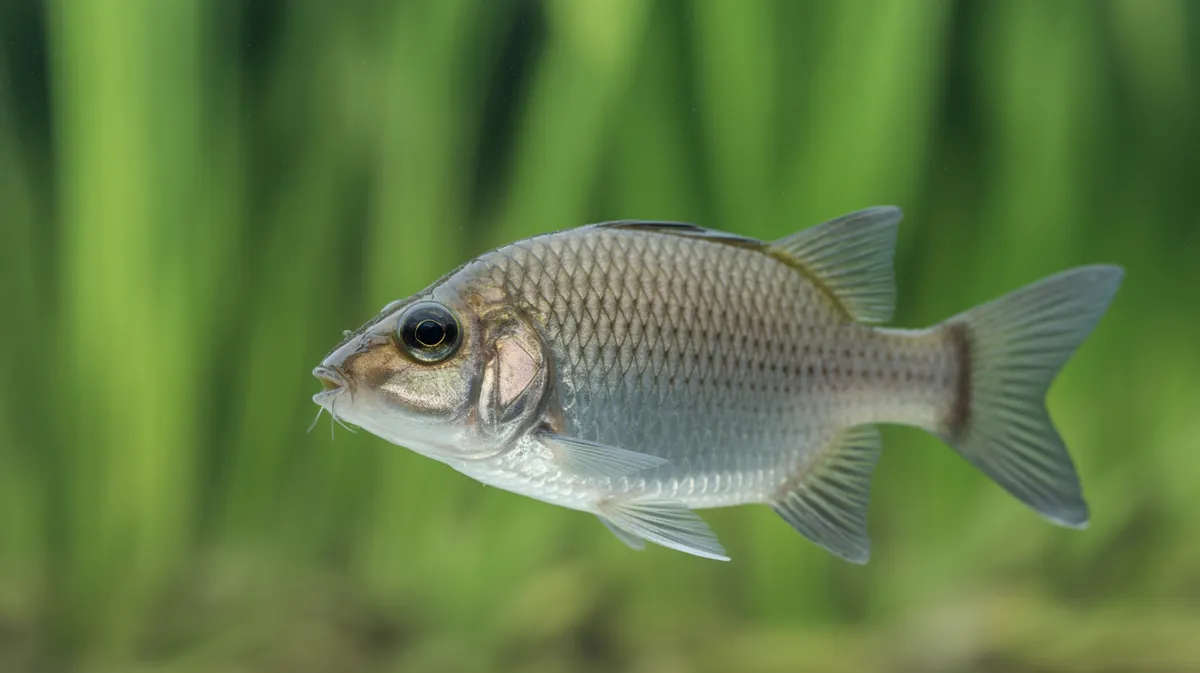
About the Japanese rice fish
The Japanese rice fish, also known as medaka, is a small freshwater fish native to East Asia, particularly Japan. It is renowned for its adaptability to a wide range of environmental conditions, including rice paddies, rivers, and ponds. The species is often pale, translucent, or golden in color and reaches only a few centimeters in length. Japanese rice fish are popular in scientific research due to their transparent embryos and short generation time, as well as in the aquarium trade for their hardiness and peaceful nature.
Fascinating facts
Model Organism
Japanese rice fish are extensively used in scientific studies of genetics, embryology, and toxicology due to their transparent eggs and rapid development.
Rice Paddy Resident
These fish naturally inhabit rice paddies, where they help control mosquito larvae and thrive in seasonal flooding.
Space Travelers
Japanese rice fish have been part of space missions to study the effects of microgravity on vertebrate development.
Detailed description
The Japanese rice fish (Oryzias latipes), commonly known as medaka, is a small, slender-bodied teleost fish typically measuring 2.5–4 cm in standard length. Its body is laterally compressed with a slightly upturned mouth adapted for surface feeding. Wild medaka display a range of coloration from translucent silvery-white to yellowish or pale orange, while domesticated and laboratory strains exhibit a variety of colors, including gold, white, and even fluorescent hues due to genetic modification. The species possesses large, prominent eyes and a single dorsal fin positioned posteriorly, aiding in stability and maneuverability in shallow waters. Medaka are renowned for their tolerance to a broad range of salinities (euryhalinity), thriving in both freshwater and brackish environments, including rice paddies, marshes, slow-moving streams, and coastal tide pools. They are diurnal, with most activity occurring during daylight hours, and exhibit a peaceful temperament, often forming loose shoals. Their transparent embryos and external fertilization make them a model organism for developmental biology. Medaka have a relatively short lifespan of 1–2 years in the wild, though they may live longer in captivity. Their adaptability, small size, and ease of breeding have made them a staple in both scientific research and the aquarium trade.
Did you know?
The Japanese rice fish was one of the first vertebrates to have its entire genome sequenced, making it a model organism in genetics.
Research & sources
Wikipedia summary
The Japanese rice fish, also known as the medaka, is a member of genus Oryzias (ricefish), the only genus in the subfamily Oryziinae. This small native of Japan is a denizen of rice paddies, marshes, ponds, slow-moving streams and tide pools. It is euryhaline, occurring in both brackish and freshwater. It became popular as an aquarium fish because of its hardiness and pleasant coloration: its coloration varies from creamy-white to yellowish in the wild to white, creamy-yellow, or orange in aquarium-bred individuals. Bright yellow, red or green transgenic populations, similar to GloFish, have also been developed, but are banned from sale in the EU. The medaka has been a popular pet since the 17th century in Japan. After fertilization, the female carries her eggs attached anterior to the anal fin for a period before depositing them on plants or similar things.
Behaviour & social structure
Japanese rice fish are omnivorous micro-predators, feeding on a variety of small invertebrates, zooplankton, insect larvae, algae, and detritus. They employ a surface-oriented feeding strategy, often picking at floating food particles or small organisms just beneath the water surface. Medaka are social and exhibit schooling behavior, particularly in the presence of predators or during foraging, which provides safety in numbers. They communicate through subtle body movements and changes in swimming patterns. Territorial aggression is minimal, though males may display brief bouts of chasing or fin-flaring during courtship or when establishing dominance. Activity peaks at dawn and dusk, with individuals spending much of the day actively foraging and exploring their environment. At night, they rest near the substrate or among aquatic vegetation.
Reproduction & life cycle
Medaka are oviparous with external fertilization. Breeding occurs primarily from late spring to early autumn, triggered by increasing water temperatures (typically 18–28°C) and photoperiod. Males court females with a series of rapid swimming displays and body undulations. After successful courtship, the female releases a clutch of 10–30 eggs, which are immediately fertilized by the male. Uniquely, the fertilized eggs remain attached to the female’s ventral surface, clustered near the anal fin, for several hours before she deposits them onto aquatic plants or substrate using adhesive filaments. Embryonic development is rapid, with hatching occurring within 7–10 days depending on temperature. There is no parental care post-oviposition; larvae are independent upon hatching and begin feeding on microplankton. Medaka reach sexual maturity in as little as 2–3 months under optimal conditions, allowing for multiple generations per year.
Adaptations & survival
Oryzias latipes exhibits several notable adaptations. Its euryhalinity allows it to survive abrupt changes in salinity, an advantage in fluctuating environments such as rice paddies and estuaries. The species has a high tolerance for low oxygen levels, aided by efficient gill structures and surface respiration behaviors. Transparent embryos facilitate gas exchange and rapid development, while adhesive egg filaments ensure successful attachment and reduce predation risk. Behavioral plasticity, such as shoaling and flexible feeding strategies, enhances survival in diverse habitats. Genetically, medaka possess a compact genome and display remarkable resistance to environmental stressors, which has contributed to their success as a laboratory model.
Cultural significance
Medaka have been kept as ornamental fish in Japan since at least the Edo period (17th century), symbolizing resilience and adaptability. They are featured in Japanese art, literature, and folklore, often associated with rural life and rice agriculture. Medaka are also used in educational settings to teach genetics and embryology, and have been sent into space as part of biological research missions. In traditional medicine, they have occasionally been used as a food source or in folk remedies, though this is rare today.
Recent research
Oryzias latipes is a premier model organism in genetics, developmental biology, and toxicology. Its small genome (approximately 800 Mb), short generation time, and transparent embryos make it ideal for in vivo imaging and gene editing studies. Medaka was the first vertebrate to have its entire genome sequenced in Japan (2004), providing insights into vertebrate evolution and comparative genomics. Recent research has focused on CRISPR/Cas9 gene editing, environmental adaptation, and the effects of endocrine disruptors. Medaka are also used in ecotoxicology to assess the impact of pollutants on aquatic life. Studies on their circadian rhythms, sexual differentiation, and behavioral genetics continue to yield important findings. Notably, medaka have contributed to understanding vertebrate sex determination, as they possess both XX/XY and ZZ/ZW sex chromosome systems in different populations.
Videos
Habitat
Freshwater ponds, rice paddies, and slow-moving streams

Conservation
The Japanese rice fish is currently classified as Least Concern on the IUCN Red List.
Threats & challenges
Currently assessed as Least Concern by the IUCN, Japanese rice fish populations are stable in much of their native range. However, localized declines have been reported due to habitat loss from agricultural intensification, urbanization, and water pollution. The introduction of non-native predatory fish and competition with invasive species pose additional threats. Genetic introgression from domesticated or transgenic strains into wild populations is a potential concern, particularly near urban centers. Conservation efforts focus on habitat preservation, pollution control, and monitoring of wild populations. Climate change and extreme weather events may also impact breeding habitats and population dynamics in the future.
Taxonomy
Scientific name
Oryzias latipes
- Kingdom
- Animalia
- Phylum
- Chordata
- Class
- Actinopterygii
- Order
- Beloniformes
- Family
- Adrianichthyidae
- Genus
- Oryzias
- Species
- latipes
Community notes
Share your observations about the Japanese rice fish.
No community notes yet. Be the first!
Discover more wildlife
More fascinating animals from the encyclopedia.