
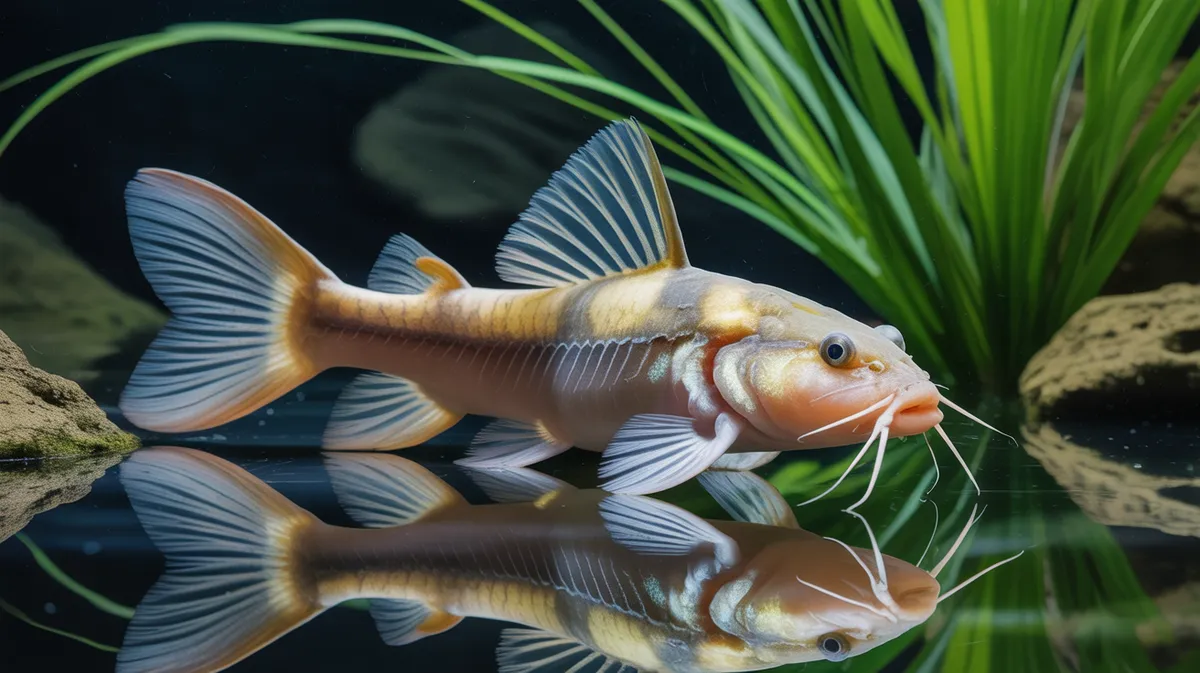
About the Mandarin Catfish
The Mandarin Catfish, also known as the Chinese perch, is a large freshwater predatory fish native to East Asia. It features a robust, elongated body with a large mouth, sharp teeth, and mottled golden-brown coloration that provides excellent camouflage among aquatic vegetation. Favored by anglers and aquaculturists, the Mandarin Catfish is prized both for its culinary value and sporting challenge. It is typically found in slow-moving rivers, lakes, and reservoirs, where it preys on smaller fish. This species plays a significant role in Chinese aquaculture and has distinct ecological importance in its native habitats.
Fascinating facts
Ambush Hunter
Mandarin Catfish are sit-and-wait predators, relying on their camouflage and quick bursts of speed to capture prey.
Culinary Favorite
This species is a staple in Chinese cuisine and often featured in gourmet dishes due to its tender meat.
Habitat Range
Mandarin Catfish inhabit a wide variety of freshwater systems, including the Yangtze, Yellow, and Amur River basins.
Detailed description
The Mandarin Catfish (Siniperca chuatsi), also widely known as the Chinese perch, is a robust and predatory freshwater fish endemic to the river systems and lakes of East Asia, particularly China, Russia’s Amur basin, and northern Vietnam. Adults typically reach 30–60 cm in length, with exceptional specimens exceeding 70 cm and weighing up to 8 kg. Its body is elongated and laterally compressed, featuring a large, terminal mouth lined with sharp, recurved teeth adapted for grasping slippery prey. The dorsal fin is divided into spiny and soft-rayed sections, aiding in maneuverability and defense. The skin is covered in small, cycloid scales, and its coloration—mottled golden-brown with irregular dark blotches—provides effective camouflage among submerged vegetation and rocky substrates. Mandarin Catfish are primarily solitary ambush predators, relying on stealth and sudden bursts of speed to capture prey. Their sensory systems are highly developed, with large eyes adapted for low-light hunting and a sensitive lateral line for detecting vibrations. This species is eurythermal, tolerating a broad range of water temperatures (5–30°C), which contributes to its success in both wild and aquaculture environments. Juveniles exhibit rapid growth rates, and adults can live up to 10–12 years in optimal conditions. The species plays a crucial ecological role as an apex predator, regulating populations of smaller fish and maintaining aquatic ecosystem balance.
Did you know?
Despite their name, Mandarin Catfish are not true catfish (family Siluridae), but rather belong to the family Sinipercidae, more closely related to perches.
Research & sources
Behaviour & social structure
Mandarin Catfish are crepuscular, exhibiting peak activity during dawn and dusk when they hunt actively. They are solitary and highly territorial, especially during the breeding season, and will aggressively defend their preferred hunting grounds. Their feeding strategy is primarily ambush-based: they remain motionless among aquatic plants or submerged structures, striking rapidly at passing prey, which consists mainly of small fish (such as cyprinids and gobies), crustaceans, and occasionally amphibians. Juveniles may consume aquatic insects before transitioning to piscivory. Mandarin Catfish are known to exhibit site fidelity, returning to favored hunting spots repeatedly. Social interactions are minimal outside of the breeding season, and direct encounters between adults can result in displays of aggression, including lateral displays and jaw gaping.
Reproduction & life cycle
Spawning occurs once annually, typically from late April to June, when water temperatures rise above 18°C. Males establish and defend territories in shallow, vegetated areas with slow currents. Courtship involves males displaying vibrant coloration and performing circling movements around receptive females. Females lay adhesive eggs (ranging from 10,000 to 100,000 per female, depending on size) on submerged vegetation or gravel. Fertilization is external. Males often guard the eggs, fanning them with their fins to improve oxygenation and protect against predators and siltation. Incubation lasts 3–7 days, after which larvae become free-swimming and disperse. Parental care ceases after hatching, and juveniles are highly vulnerable to predation during early life stages.
Adaptations & survival
Siniperca chuatsi exhibits several key adaptations for predatory success. Its large, protractile mouth and recurved teeth enable it to seize and hold slippery prey efficiently. The cryptic coloration provides camouflage in complex habitats, aiding both in ambush predation and predator avoidance. The lateral line system is highly sensitive, allowing detection of minute water movements generated by prey. The species’ tolerance for a wide range of temperatures and dissolved oxygen levels enables survival in diverse freshwater environments, including eutrophic and hypoxic waters. Rapid juvenile growth reduces vulnerability to predation, and adhesive eggs increase reproductive success in variable habitats.
Cultural significance
Mandarin Catfish holds significant cultural and economic value in China and neighboring countries. It is a prized delicacy in Chinese cuisine, renowned for its firm, white flesh and mild flavor, often featured in traditional banquets and festivals. The species is also a symbol of prosperity and abundance in some regional folklore. Its popularity has driven the development of specialized aquaculture techniques, making it a staple in freshwater fish farming. Recreational anglers value the species for its size and fighting ability, contributing to local economies through sport fishing.
Recent research
Recent research on Siniperca chuatsi has focused on genetic improvement for aquaculture, including selective breeding for disease resistance and faster growth. Studies have also examined the species’ immune system, revealing unique antimicrobial peptides with potential biomedical applications. Ongoing ecological research investigates the impact of aquaculture escapees on wild populations and the role of Mandarin Catfish in controlling invasive prey species. Advances in larval rearing techniques have improved hatchery survival rates, supporting sustainable aquaculture expansion. Genomic studies are shedding light on the evolutionary history and population structure of the genus Siniperca.
Sources
Siniperca chuatsi (Basilewsky, 1855): Taxonomy, Biology, and Aquaculture
FishBase Editors; Froese, R. & Pauly, D. (eds.) (2024)
scientificSiniperca chuatsi (Basilewsky, 1855): Taxonomy, Biology, and Aquaculture
FishBase Editors (2024)
scientificVideos
Habitat
Freshwater rivers and lakes

Conservation
The Mandarin Catfish is currently classified as Least Concern on the IUCN Red List.
Threats & challenges
While currently listed as Least Concern by the IUCN, Mandarin Catfish populations face localized threats from habitat degradation, water pollution, dam construction, and overfishing in some areas. Intensive aquaculture has led to genetic homogenization and potential introgression with wild stocks. Habitat fragmentation due to river regulation disrupts natural spawning migrations. Despite these challenges, the species remains widespread and abundant, with stable populations in most of its native range. Continued monitoring is necessary to prevent future declines, especially in regions experiencing rapid environmental change.
Taxonomy
Scientific name
Siniperca chuatsi
- Kingdom
- Animalia
- Phylum
- Chordata
- Class
- Actinopterygii
- Order
- Perciformes
- Family
- Sinipercidae
- Genus
- Siniperca
- Species
- chuatsi
Community notes
Share your observations about the Mandarin Catfish.
No community notes yet. Be the first!
Discover more wildlife
More fascinating animals from the encyclopedia.