
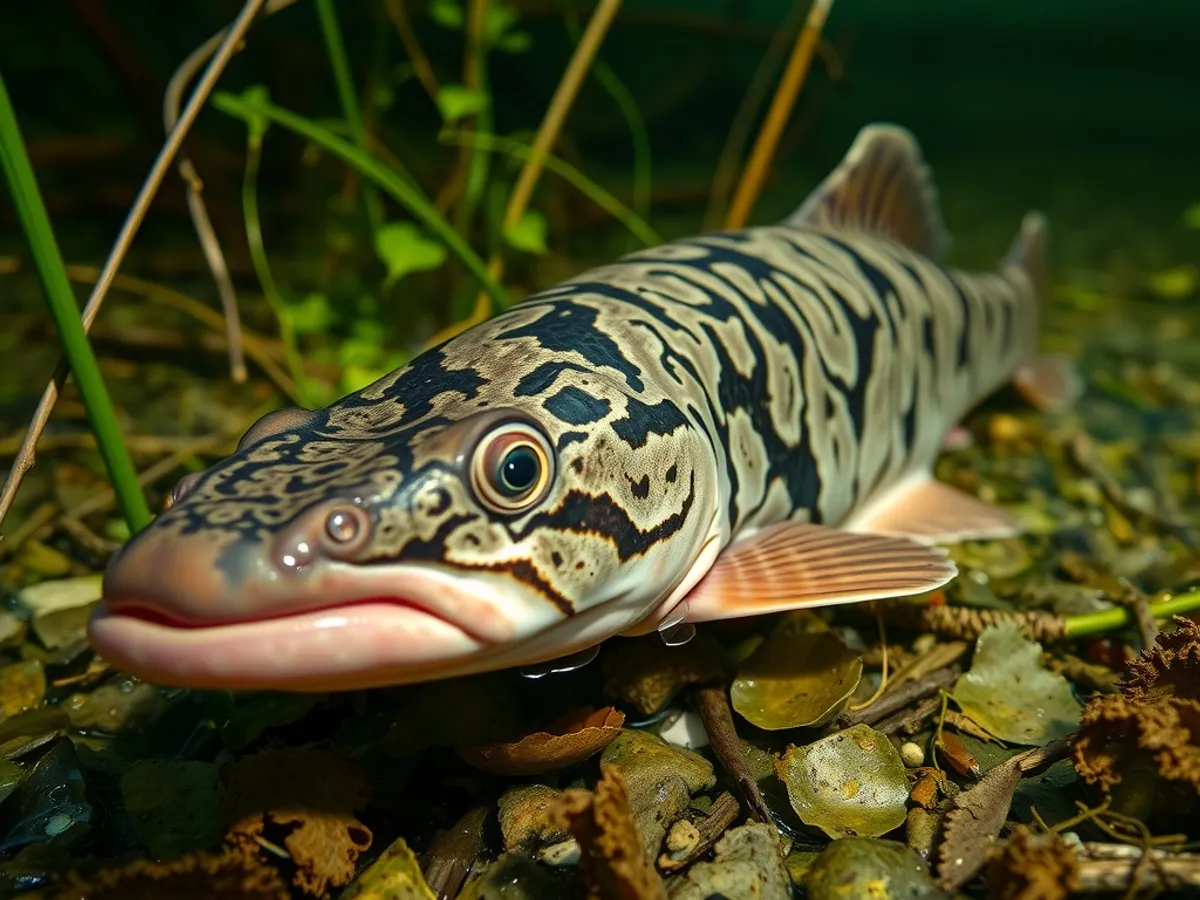
About the Marbled Lungfish
The Marbled Lungfish is a fascinating species of freshwater fish native to Central and East Africa. It is notable for its elongated, eel-like body covered in a marbled pattern of brown and gray, which offers excellent camouflage among muddy riverbeds and swamps. This fish is best known for its unique ability to breathe both in water and on land, thanks to its specialized lungs. During dry seasons, it can burrow into the mud and survive for months in a dormant state, a process called aestivation.
Fascinating facts
Breathes Air
Unlike most fish, the Marbled Lungfish possesses true lungs and can breathe atmospheric oxygen, allowing it to survive out of water.
Aestivation Expert
During droughts, this fish burrows and secretes a mucous cocoon to conserve moisture, entering a dormant state called aestivation.
Evolutionary Link
The Marbled Lungfish is an important evolutionary link between aquatic fish and terrestrial vertebrates due to its lung structure and limb-like fins.
Detailed description
The Marbled Lungfish (Protopterus aethiopicus) is a large, elongated freshwater fish, typically reaching lengths of 1 to 2 meters, though individuals up to 2 meters have been recorded, and can weigh up to 17 kg. Its body is cylindrical and eel-like, covered in small, cycloid scales and displaying a distinctive marbled or leopard-like pattern of brown, gray, and black, which provides effective camouflage in turbid, muddy waters. The head is broad and flattened, with small eyes and a terminal mouth equipped with robust, crushing tooth plates adapted for a varied diet. Unlike most fish, it possesses both gills and highly vascularized paired lungs, allowing it to extract oxygen from air—a crucial adaptation for surviving in oxygen-depleted waters. The pectoral and pelvic fins are filamentous and elongated, aiding in slow, undulating movement through dense aquatic vegetation. Marbled lungfish are primarily nocturnal and solitary, spending daylight hours buried in mud or concealed among submerged roots. During periods of drought, they are capable of aestivation: they burrow into the substrate, secrete a mucous cocoon, and reduce metabolic activity, surviving for months until water returns. This species is long-lived, with lifespans exceeding 20 years in the wild. Its physiology and behavior reflect an ancient lineage, retaining many primitive features shared with early lobe-finned fishes, making it a key species for understanding vertebrate evolution.
Did you know?
The Marbled Lungfish can slow its metabolism by up to 60% during aestivation, allowing it to survive long periods without food or water.
Research & sources
Wikipedia summary
The marbled lungfish is a lungfish of the family Protopteridae. Also known as the leopard lungfish, it is found in Eastern and Central Africa, as well as the Nile region. At 133 billion base pairs, it has the largest known genome of any animal and one of the largest of any organism, along with the flowering plant Paris japonica, the fern Tmesipteris oblanceolata and the protist Polychaos dubium at 150 billion, 160 billion and 670 billion, respectively.
Behaviour & social structure
Marbled lungfish are generally solitary and territorial, with individuals maintaining loosely defined home ranges. They are crepuscular to nocturnal, becoming most active at dusk and during the night. Feeding is opportunistic and omnivorous: their diet includes mollusks, crustaceans, insect larvae, small fish, detritus, and plant material. They use their strong tooth plates to crush hard-shelled prey. Foraging is typically slow and methodical, involving probing the substrate with their snouts. When threatened, they may burrow rapidly into mud or remain motionless, relying on camouflage. Social interactions are limited outside of the breeding season, though temporary aggregations can occur in shrinking pools during the dry season. Vocalizations are absent, but chemical cues may play a role in mate recognition and territory establishment.
Reproduction & life cycle
Breeding in Protopterus aethiopicus is closely linked to seasonal flooding. Spawning typically occurs at the onset of the rainy season, when rising water levels inundate floodplains and swamps. Males construct shallow, saucer-shaped nests in the substrate, often among aquatic vegetation. Females lay several thousand eggs in the nest, which are externally fertilized by the male. The male guards the nest and aerates the eggs by undulating his body and fanning the water with his fins. Incubation lasts about 7 to 10 days, depending on water temperature. Upon hatching, the larvae possess external gills, resembling amphibian tadpoles, and remain in the nest under paternal care for several weeks until they develop functional lungs and are capable of independent survival. Sexual maturity is reached at 3 to 4 years of age.
Adaptations & survival
The marbled lungfish exhibits several remarkable adaptations. Its paired lungs, derived from the swim bladder, allow it to breathe atmospheric oxygen, enabling survival in hypoxic or anoxic waters and during aestivation. The ability to aestivate in a mucous cocoon for up to 4 years (though typically several months) is a key adaptation to the unpredictable African climate. Its genome, at 133 billion base pairs, is the largest known among animals, possibly linked to the retention of ancestral genetic material and regulatory complexity. The robust, crushing tooth plates facilitate consumption of a wide range of prey, including hard-shelled invertebrates. Filamentous fins aid in maneuvering through dense aquatic vegetation. Its marbled coloration provides camouflage from predators and prey alike. The species can regulate metabolism and excrete nitrogenous waste as urea during aestivation, reducing water loss.
Cultural significance
The marbled lungfish holds significance in several African cultures, often regarded as a symbol of resilience and survival due to its ability to withstand drought. In some regions, it is consumed as a food source, particularly during dry seasons when other fish are scarce. Traditional beliefs sometimes attribute medicinal or mystical properties to the fish, and its unique biology has made it a subject of fascination in local folklore. In scientific circles, it is a model organism for studies of vertebrate evolution and physiology.
Recent research
Recent genomic studies have highlighted the marbled lungfish’s enormous genome, providing insights into vertebrate genome evolution, gene regulation, and the transition from aquatic to terrestrial life. Comparative studies with other lungfish and early tetrapods have elucidated the evolutionary origins of lungs and limb-like structures. Ongoing research examines the molecular mechanisms of aestivation, including metabolic suppression and urea cycle regulation. Conservation genetics projects are assessing population structure and connectivity across its range. The species is also used in developmental biology to study the evolution of vertebrate embryogenesis.
Videos
Habitat
Freshwater rivers, swamps, and floodplains

Conservation
The Marbled Lungfish is currently classified as Least Concern on the IUCN Red List.
Threats & challenges
Currently classified as Least Concern by the IUCN, the marbled lungfish faces localized threats from habitat loss due to wetland drainage, dam construction, and water pollution. Overfishing for local consumption and the aquarium trade may impact some populations. Invasive species and climate change, especially altered rainfall patterns, pose emerging risks. However, its wide distribution and tolerance for harsh conditions buffer it against immediate extinction risk. Population trends are generally stable, but ongoing monitoring is warranted in regions experiencing rapid environmental change.
Taxonomy
Scientific name
Protopterus aethiopicus
- Kingdom
- Animalia
- Phylum
- Chordata
- Class
- Sarcopterygii
- Order
- Lepidosireniformes
- Family
- Protopteridae
- Genus
- Protopterus
- Species
- aethiopicus
Community notes
Share your observations about the Marbled Lungfish.
No community notes yet. Be the first!
Discover more wildlife
More fascinating animals from the encyclopedia.