
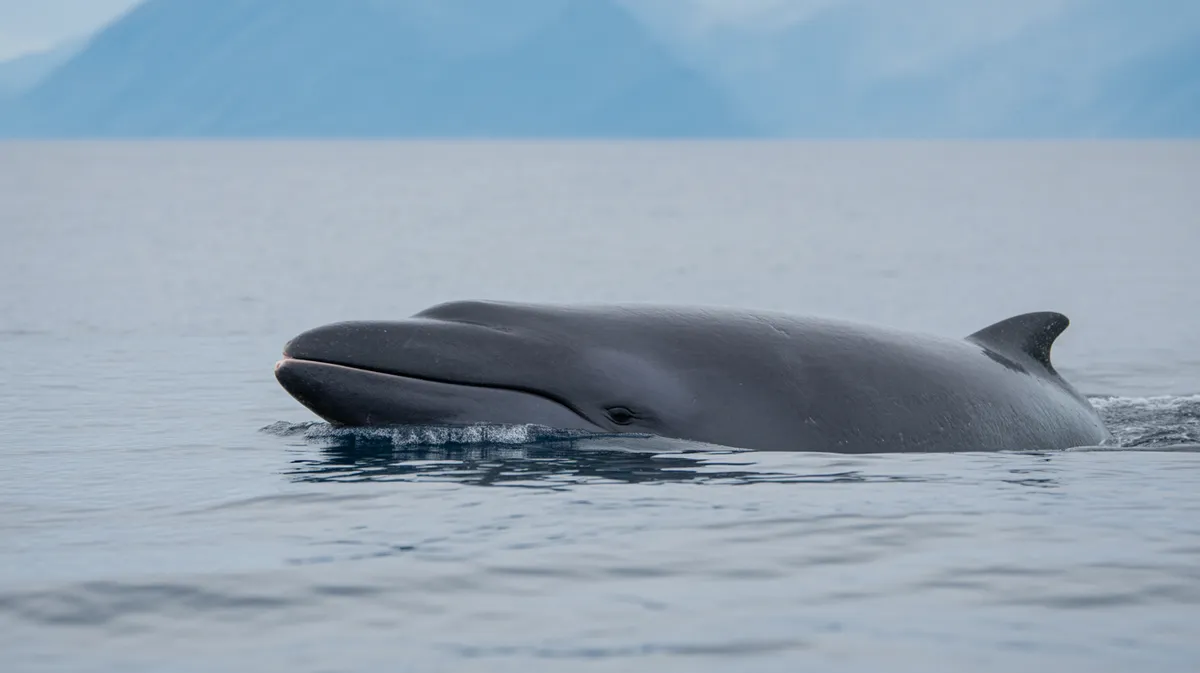
About the Common Minke Whale
The Common Minke Whale is the smallest and most widespread member of the rorqual family, found in oceans throughout the Northern Hemisphere. Characterized by its streamlined body, pointed snout, and distinct white bands on its flippers, this agile baleen whale is known for its speed and inquisitive nature. Minke whales primarily feed on small schooling fish and krill, using baleen plates to filter their prey from seawater. Although historically hunted, their populations have remained relatively stable compared to other large whales. They are frequently sighted near coastlines and are known for their occasional acrobatic breaches.
Fascinating facts
Widespread Distribution
Common Minke Whales inhabit a vast range of temperate and polar oceans in the Northern Hemisphere, including both coastal and offshore waters.
Efficient Feeders
They use baleen plates to filter tiny fish and krill from the water, sometimes employing a technique called 'lunge feeding.'
Unique Vocalizations
Minke whales produce an array of sounds, including clicks, grunts, and a distinctive 'boing' noise, which is often heard during the breeding season.
Detailed description
The common minke whale (Balaenoptera acutorostrata) is the smallest member of the rorqual family, typically reaching lengths of 7–10 meters (23–33 feet) and weighing between 5–10 metric tons. Its streamlined body is dark gray to black dorsally, with a lighter ventral side and distinctive white bands or 'mittens' on the pectoral flippers, especially prominent in North Atlantic individuals. The pointed, narrow rostrum and a single central ridge on the head aid in hydrodynamics. Minke whales possess 230–360 pairs of short, stiff baleen plates, which they use to filter-feed on small schooling fish (such as herring, capelin, and sand lance), krill, and other zooplankton. They are highly agile swimmers, capable of reaching speeds up to 30 km/h (18.6 mph), and are known for their sudden, low-arched surfacing and occasional breaching. Socially, common minke whales are generally solitary or found in small groups of 2–3, though aggregations may occur in rich feeding areas. Their vocalizations include a variety of low-frequency pulses and clicks, which are believed to play a role in communication and possibly echolocation. The species exhibits seasonal migrations, moving toward higher latitudes in summer to feed and returning to lower latitudes in winter for breeding. Lifespans typically range from 30 to 50 years, with some individuals recorded at over 60 years.
Did you know?
Despite their large size, minke whales can be extremely elusive and are often heard rather than seen, thanks to their low, inconspicuous blows.
Research & sources
Wikipedia summary
The common minke whale or northern minke whale is a species of minke whale within the suborder of baleen whales.
Behaviour & social structure
Common minke whales display a range of behaviors, including solitary foraging, surface lunge feeding, and occasional acrobatic breaching. They are diurnal feeders, often engaging in repeated dives lasting 2–20 minutes, with surface intervals of less than a minute. Their feeding strategy involves engulfing large volumes of water and prey, then expelling the water through their baleen plates. Minke whales are inquisitive and sometimes approach vessels, a behavior known as 'spyhopping.' Social interactions are generally limited outside of feeding or breeding contexts, but temporary associations may form in areas of high prey density. Communication is primarily acoustic, with distinct pulse trains and downsweeps, and there is evidence of individual variation in call types. They exhibit seasonal site fidelity to certain feeding grounds, and their daily activity patterns are closely tied to prey availability and environmental conditions.
Reproduction & life cycle
Breeding occurs primarily during the winter months in lower-latitude waters. Minke whales are thought to be polygynous, with males competing for access to receptive females. Females reach sexual maturity at 6–8 years of age, while males mature slightly earlier. Gestation lasts approximately 10–11 months, with calves typically born between December and May, depending on the hemisphere. At birth, calves measure 2.4–2.8 meters (7.9–9.2 feet) in length and weigh around 450 kg (990 lbs). Calves nurse for 4–6 months, during which time the mother provides rich milk and close protection. Interbirth intervals are generally 1–2 years, reflecting the energetic investment required for lactation and calf rearing. Parental care is provided solely by the mother, with no evidence of paternal involvement.
Adaptations & survival
The common minke whale exhibits several adaptations for survival in diverse marine environments. Its streamlined body and pointed rostrum minimize drag, enabling rapid swimming and agile maneuvering to evade predators or pursue prey. The baleen plates are specialized for filter-feeding on small, fast-moving prey, while expandable throat pleats allow the whale to engulf large volumes of water and prey. A thick blubber layer provides insulation in cold waters and serves as an energy reserve during migration and fasting. Minke whales have acute underwater hearing and produce a variety of vocalizations for communication and possibly prey detection. Their migratory behavior allows them to exploit seasonally abundant food resources and avoid harsh winter conditions.
Cultural significance
The common minke whale has played a modest role in human culture compared to larger baleen whales. In some indigenous Arctic and North Atlantic communities, minke whales have been traditionally hunted for meat and blubber. In modern times, the species is a focus of whale-watching tourism, particularly in regions such as Iceland, Norway, and Scotland, where their inquisitive nature and frequent surface activity make them popular with observers. Minke whales have also featured in debates over sustainable whaling and marine conservation policy, symbolizing the complex relationship between humans and marine megafauna.
Recent research
Recent research on common minke whales has focused on population genetics, revealing distinct North Atlantic and North Pacific subspecies, as well as a possible dwarf form in the Southern Hemisphere. Satellite tagging and photo-identification studies have improved understanding of migratory routes and site fidelity. Acoustic monitoring has documented a diverse repertoire of vocalizations, with regional variation suggesting potential for population differentiation. Stable isotope and fatty acid analyses have provided insights into diet and trophic ecology. Ongoing research addresses the impacts of climate change on prey availability and distribution, as well as the effects of anthropogenic noise on whale behavior and communication.
Videos
Habitat
Ocean

Conservation
The Common Minke Whale is currently classified as Least Concern on the IUCN Red List.
Threats & challenges
While the common minke whale is currently listed as Least Concern by the IUCN, several threats persist. Historically, the species was subject to commercial whaling, and limited hunting continues in some countries (notably Norway, Japan, and Iceland) under various quotas. Bycatch in fishing gear, ship strikes, and entanglement pose ongoing risks, particularly in coastal regions. Climate change and associated shifts in prey distribution may impact feeding success and reproductive rates. Ocean noise pollution from shipping and industrial activities can interfere with communication and navigation. Although populations are considered stable globally, some regional subpopulations may be more vulnerable due to localized pressures.
Taxonomy
Scientific name
Balaenoptera acutorostrata
- Kingdom
- Animalia
- Phylum
- Chordata
- Class
- Mammalia
- Order
- Cetacea
- Family
- Balaenopteridae
- Genus
- Balaenoptera
- Species
- acutorostrata
Community notes
Share your observations about the Common Minke Whale.
No community notes yet. Be the first!
Discover more wildlife
More fascinating animals from the encyclopedia.