
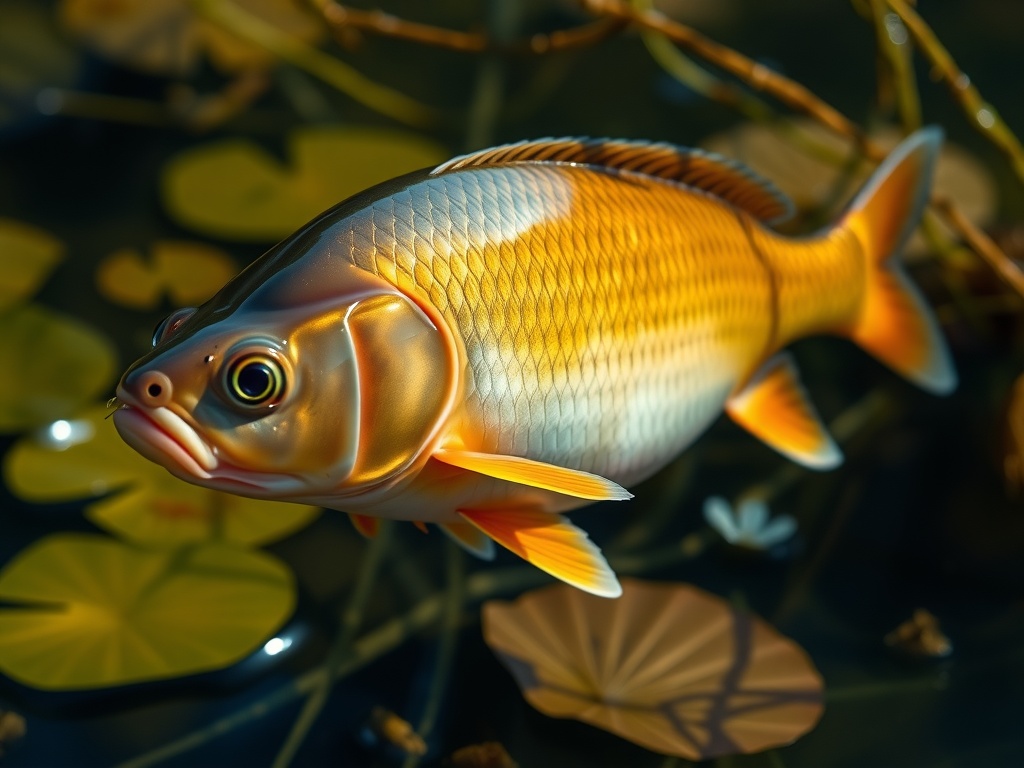
About the Mirror Carp
The Mirror Carp is a domesticated variety of the Common Carp known for its distinctive, irregular scales that resemble mirrors, giving it a unique appearance among freshwater fish. Originally bred in Europe for food, Mirror Carp are now popular with anglers due to their size and fighting strength. They are hardy, adaptable, and can thrive in a variety of freshwater habitats including lakes, ponds, and slow-moving rivers. Their body shape is generally deep and robust, with coloration ranging from golden-bronze to greyish hues. Mirror Carp play an important role in aquaculture and recreational fishing across many countries.
Fascinating facts
Unique Scales
Unlike the fully scaled Common Carp, Mirror Carp have large, irregular scales scattered across their bodies, sometimes with large bare patches of skin.
Angler's Favorite
Mirror Carp are highly prized by sport anglers for their size and their challenging, powerful fights when hooked.
Diet Diversity
They feed on a wide variety of food sources, including aquatic plants, insects, crustaceans, and even small fish.
Detailed description
The Mirror Carp (Cyprinus carpio) is a distinctive domesticated variety of the common carp, notable for its irregular, patchy scales that can be large and mirror-like, interspersed with areas of naked skin. Adult Mirror Carp typically reach lengths of 40–80 cm, but individuals exceeding 1 meter and weighing over 30 kg have been recorded, especially in managed fisheries. Their bodies are deep and laterally compressed, with a robust build and a slightly arched back. The coloration varies from golden-bronze to olive or grey, often influenced by habitat and diet. Mirror Carp possess a pair of barbels on each side of the upper jaw, which are sensory organs used to detect food in murky waters. Their mouths are protrusible and adapted for bottom-feeding, allowing them to root through sediment for plant material, invertebrates, and detritus. The lateral line is well-developed, aiding in navigation and detection of vibrations. Mirror Carp are highly adaptable to a range of environmental conditions, tolerating low oxygen, variable temperatures (from 3°C to 35°C), and even moderate salinity. Their digestive system is efficient at processing both animal and plant matter, contributing to their success in diverse freshwater habitats. The species exhibits notable longevity, with lifespans in the wild often exceeding 20 years, and some individuals in captivity living over 40 years.
Did you know?
Some Mirror Carp have been known to live for over 40 years in captivity, far exceeding their typical wild lifespan.
Research & sources
Wikipedia summary
The common carp, also known as European carp, Eurasian carp, or simply carp, is a widespread freshwater fish of eutrophic waters in lakes and large rivers in Europe and Asia. The native wild populations are considered vulnerable to extinction by the International Union for Conservation of Nature (IUCN), but the species has also been domesticated and introduced into environments worldwide, and is often considered a destructive invasive species, being included in the list of the world's 100 worst invasive species. It gives its name to the carp family, Cyprinidae.
Behaviour & social structure
Mirror Carp are primarily benthic feeders, spending much of their time foraging along the substrate for food. They display crepuscular activity patterns, with peak feeding occurring at dawn and dusk. Their omnivorous diet includes aquatic plants, algae, insect larvae, crustaceans, mollusks, and detritus. Carp use their sensitive barbels and taste buds to locate food, often stirring up sediment and increasing water turbidity. Socially, Mirror Carp are gregarious, forming loose shoals, especially when young or in the presence of abundant food. However, larger adults may become more solitary. They exhibit complex social behaviors, including dominance hierarchies and cooperative foraging. During periods of high temperature or low oxygen, carp may exhibit surface gulping behavior to supplement oxygen intake. Mirror Carp are also known for their strong escape responses and can leap from the water when startled.
Reproduction & life cycle
Mirror Carp are highly fecund broadcast spawners, typically breeding in late spring to early summer when water temperatures reach 17–20°C. Spawning occurs in shallow, vegetated areas of lakes or rivers, where females release between 100,000 and 500,000 adhesive eggs per kilogram of body weight. Males follow closely, fertilizing the eggs externally. There is no parental care; eggs adhere to submerged vegetation and hatch after 3–8 days, depending on temperature. Larvae are initially planktonic, feeding on microscopic organisms before transitioning to benthic feeding as juveniles. Sexual maturity is reached at 2–4 years, with growth rates influenced by food availability and environmental conditions. In aquaculture, selective breeding has enhanced growth rates and disease resistance.
Adaptations & survival
Mirror Carp have evolved several adaptations for survival in variable freshwater environments. Their irregular scale pattern, a result of selective breeding, offers some protection against parasites and physical injury. The protrusible mouth and sensitive barbels allow efficient foraging in turbid or low-visibility waters. Physiologically, carp can tolerate hypoxic conditions by increasing gill ventilation and utilizing anaerobic metabolism. They possess a highly flexible diet, enabling them to exploit a wide range of food sources. Mirror Carp can also withstand significant fluctuations in temperature and water chemistry, making them resilient to environmental changes. Their reproductive strategy of high fecundity and rapid early growth enhances population persistence even in disturbed habitats.
Cultural significance
Mirror Carp have played a significant role in European aquaculture since the Middle Ages, valued for their rapid growth and adaptability. They are a staple in traditional cuisines, particularly in Central and Eastern Europe, where carp dishes are integral to festive occasions such as Christmas. In East Asian cultures, carp symbolize perseverance and good fortune, though the Mirror Carp variety is less common than koi. Recreational angling for Mirror Carp is a major pastime in many countries, with specialized fisheries and catch-and-release practices. The species has also been featured in folklore, art, and literature, reflecting its longstanding association with human societies.
Recent research
Recent research on Mirror Carp has focused on genetic diversity, selective breeding for disease resistance, and ecological impacts in non-native habitats. Studies have examined the effects of carp bioturbation on aquatic ecosystems, revealing significant alterations to nutrient cycling and plant communities. Advances in molecular genetics have enabled the identification of strains with enhanced growth or resilience to pathogens such as KHV. Ongoing research also explores the use of environmental DNA (eDNA) for monitoring carp populations and assessing invasion risks. Conservation genetics is a growing field, aiming to preserve the genetic integrity of wild populations amid widespread hybridization.
Videos
Habitat
Freshwater lakes, ponds, and slow-moving rivers

Conservation
The Mirror Carp is currently classified as Least Concern on the IUCN Red List.
Threats & challenges
While domesticated and feral populations of Mirror Carp are abundant and widespread, native wild populations of Cyprinus carpio are considered vulnerable due to habitat loss, water pollution, overfishing, and genetic introgression from domesticated strains. Invasive populations can disrupt local ecosystems by uprooting vegetation, increasing turbidity, and outcompeting native species. In some regions, management efforts focus on controlling carp numbers to protect biodiversity. Disease outbreaks, such as koi herpesvirus (KHV), can also pose significant threats to both wild and cultured stocks. Climate change and water resource development further challenge the persistence of native populations.
Taxonomy
Scientific name
Cyprinus carpio
- Kingdom
- Animalia
- Phylum
- Chordata
- Class
- Actinopterygii
- Order
- Cypriniformes
- Family
- Cyprinidae
- Genus
- Cyprinus
- Species
- carpio
Where to see a mirror carp
1 zoo and aquarium in 1 country are recorded as keeping this species.

Community notes
Share your observations about the Mirror Carp.
No community notes yet. Be the first!
Discover more wildlife
More fascinating animals from the encyclopedia.