
About the Orange Spotted Sea Cucumber
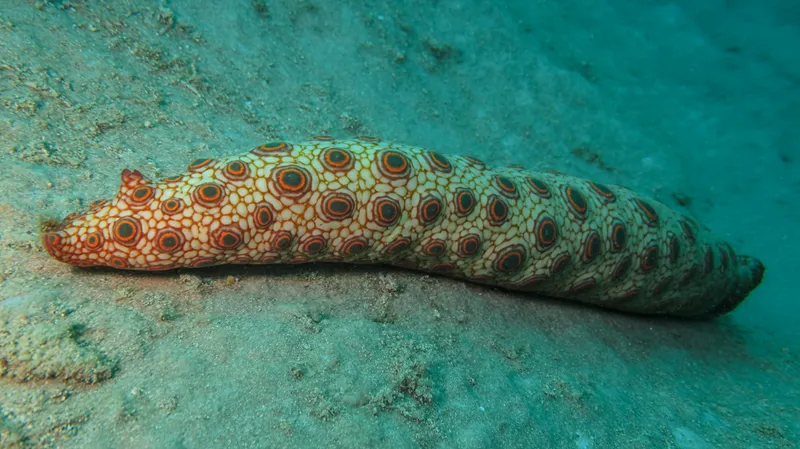
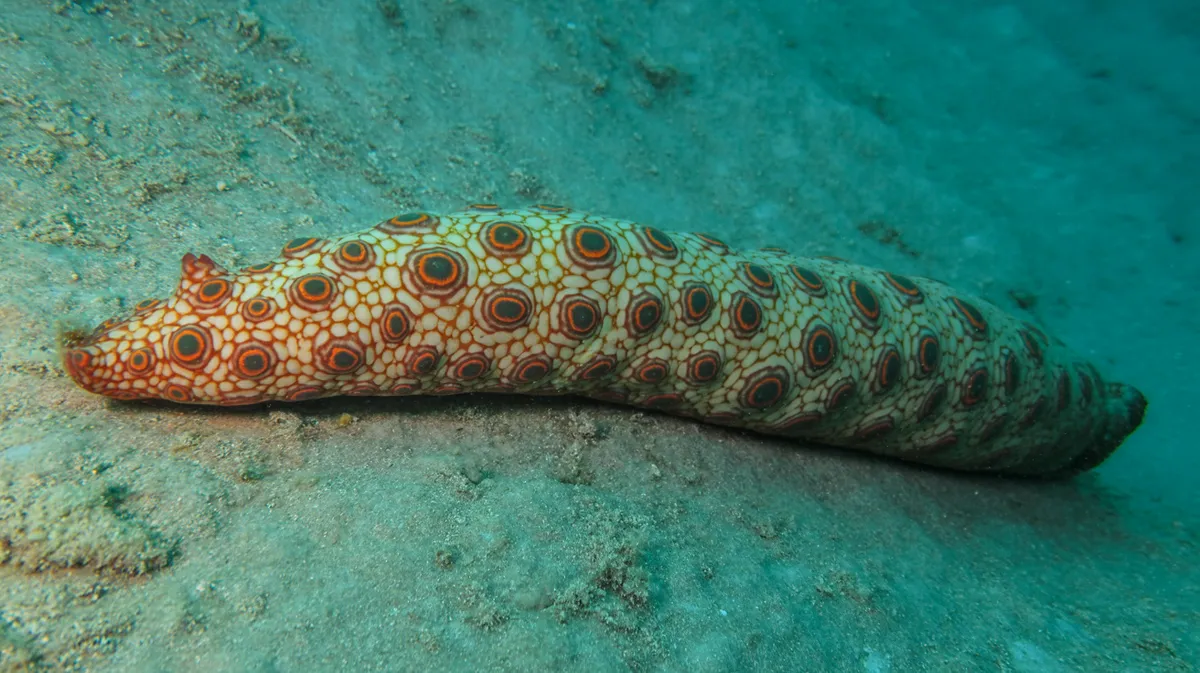
The orange spotted sea cucumber is a striking marine invertebrate known for its elongated, leathery body adorned with bold orange to yellowish spots against a dark brown or gray background. This species can be found crawling along sandy or muddy sea floors in tropical and subtropical waters, where it plays a vital role in recycling nutrients. It is a deposit feeder, consuming organic matter found in sediments and helping to maintain healthy ocean ecosystems. The orange spotted sea cucumber is notable for its ability to expel sticky Cuvierian tubules as a defense mechanism when threatened.
Fascinating facts
Ecosystem Cleaners
Orange spotted sea cucumbers help maintain ocean health by processing and recycling organic material from sea floor sediments.
Chemical Defenses
They produce toxins known as holothurin, making them unpalatable or even harmful to many marine predators.
Regeneration Powers
If threatened or injured, they can regenerate lost body parts, including their respiratory trees and sections of their digestive tract.
Detailed description
The Orange Spotted Sea Cucumber (Bohadschia argus) is a large holothurian, typically reaching lengths of 20–35 cm, though some individuals may grow up to 50 cm. Its body is cylindrical, robust, and covered in a tough, leathery dermis embedded with calcareous sclerites, providing both flexibility and protection. The dorsal surface is characterized by conspicuous orange to yellowish ocelli-like spots, which are ringed and distributed irregularly against a dark brown, gray, or black background, serving as a form of disruptive camouflage. The ventral surface is paler and equipped with three distinct rows of tube feet, which allow for slow but steady locomotion across the substrate. Around the mouth, located at the anterior end, are 20 bushy, retractable feeding tentacles used to collect organic-rich detritus from the sediment. Bohadschia argus is primarily nocturnal, spending daylight hours partially buried or concealed and emerging at dusk to feed. It possesses a unique defense mechanism: when threatened, it can expel sticky, white Cuvierian tubules from its posterior, which entangle and deter predators. Internally, it has a simple digestive tract adapted for processing large volumes of sediment. The species is solitary but may be found in loose aggregations in areas of high food availability. Its ecological role as a bioturbator is crucial, as it recycles nutrients and oxygenates the sediment, supporting benthic community health.
Did you know?
Despite their soft, unassuming appearance, orange spotted sea cucumbers can regenerate lost body parts, including sections of their internal organs.
Research & sources
Behaviour & social structure
Bohadschia argus is a deposit feeder, methodically ingesting sediment with its tentacles and extracting organic matter, microalgae, and bacteria. Feeding activity peaks at night, reducing predation risk and competition. The species is generally solitary, exhibiting little direct social interaction, though multiple individuals may be found in productive feeding grounds. Locomotion is slow and deliberate, with the animal using its tube feet to move and occasionally burrow shallowly into the substrate for protection. When disturbed, it may contract its body and release Cuvierian tubules, which are toxic and adhesive due to saponins, deterring fish and crustacean predators. Bohadschia argus does not exhibit territoriality or complex social hierarchies. It is sensitive to environmental changes, often retreating deeper into the substrate during periods of disturbance or low water quality.
Reproduction & life cycle
Reproduction in Bohadschia argus is primarily sexual and occurs via broadcast spawning, typically synchronized with lunar cycles and seasonal temperature changes. Spawning events are most common during the warmer months, often between late spring and early autumn. Males and females release sperm and eggs into the water column, where external fertilization occurs. The planktonic larvae, called auricularia, drift with currents for several weeks before settling and metamorphosing into juvenile sea cucumbers. There is no parental care; survival of offspring is dependent on environmental conditions and predation rates. Some evidence suggests that populations may also reproduce asexually via transverse fission, though this is less common in Bohadschia argus compared to other holothurians.
Adaptations & survival
Bohadschia argus has evolved several adaptations for survival in dynamic coastal environments. Its thick, leathery skin and embedded sclerites provide defense against abrasion and predation. The striking orange spots may serve as aposematic signals, warning potential predators of its toxic saponins. The ability to expel Cuvierian tubules is a specialized defense unique to some holothurians, effectively deterring predators through both mechanical entanglement and chemical toxicity. Its tube feet and muscular body wall facilitate movement and shallow burrowing, while the highly branched feeding tentacles maximize surface area for efficient detritus collection. Physiologically, it can tolerate fluctuations in salinity and temperature, allowing it to inhabit a range of shallow marine environments.
Cultural significance
Sea cucumbers, including Bohadschia argus, are valued in traditional Asian medicine and cuisine, particularly in China, where they are believed to have health-promoting properties. However, this species is less commonly harvested than others due to its toxicity and the difficulty of processing its saponin-rich tissues. In some Pacific Island cultures, sea cucumbers are considered important for their ecological role in maintaining healthy reefs and are protected by local management practices. There is little evidence of specific mythological or symbolic significance attached to this species.
Recent research
Recent research on Bohadschia argus has focused on its chemical defenses, particularly the structure and ecological role of saponins, which have shown potential for pharmaceutical applications due to their cytotoxic and antimicrobial properties. Studies on its role in sediment bioturbation have highlighted its importance in nutrient cycling and benthic habitat maintenance. Genetic analyses are ongoing to clarify species boundaries within the Bohadschia genus, as morphological variation can be significant. There is also interest in the impact of fisheries and climate change on population dynamics, with several ongoing monitoring programs in the Indo-Pacific region.
Sources
The genus Bohadschia: Holothuriidae of the Indo-Pacific with special reference to Bohadschia argus
Massin, C. (1999)
scientificChemical defense in Bohadschia argus: Saponins and Cuvierian tubules
Van Dyck, S. et al. (2010)
scientificVideos
Habitat
Shallow tropical and subtropical coastal ocean floors, especially sandy or silty substrates

Conservation
The Orange Spotted Sea Cucumber is currently classified as Least Concern on the IUCN Red List.
Threats & challenges
Currently classified as Least Concern by the IUCN, Bohadschia argus faces localized threats from overharvesting for the bêche-de-mer (sea cucumber) trade, habitat degradation due to coastal development, pollution, and destructive fishing practices such as trawling. While not as heavily targeted as some other holothurian species, increased demand in Asian markets poses a potential risk. Population trends are generally stable, but monitoring is needed in regions with intensive harvesting. Climate change and ocean acidification may also impact larval survival and habitat quality in the future.
Taxonomy
Scientific name
Bohadschia argus
- Kingdom
- Animalia
- Phylum
- Echinodermata
- Class
- Holothuroidea
- Order
- Aspidochirotida
- Family
- Holothuriidae
- Genus
- Bohadschia
- Species
- argus
Community notes
Share your observations about the Orange Spotted Sea Cucumber.
No community notes yet. Be the first!
Discover more wildlife
More fascinating animals from the encyclopedia.