
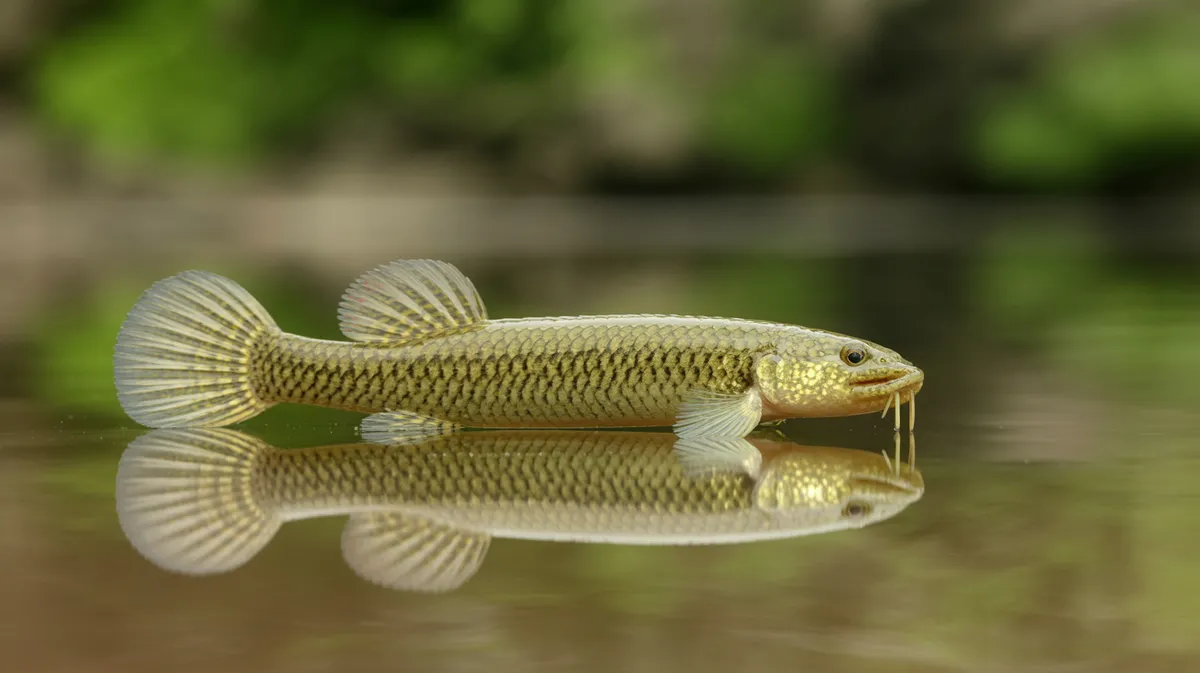
About the Ornate bichir
The ornate bichir is a striking, primitive freshwater fish native to central and eastern Africa. Recognizable by its elongated body, thick armor-like scales, and dramatic black-and-yellow patterning, it is one of the most visually distinctive members of the Polypteridae family. This species is a nocturnal predator, spending much of its time near the substrate, slowly hunting for prey. Remarkably, the ornate bichir is capable of breathing atmospheric air thanks to a specialized lung-like structure, allowing it to survive in poorly oxygenated waters.
Fascinating facts
Ancient Lineage
The ornate bichir belongs to one of the oldest lineages of ray-finned fishes, with fossil records dating back to the Cretaceous period.
Air Breather
This species can gulp air at the surface, using a modified swim bladder that functions as a lung, enabling it to survive in oxygen-poor environments.
Nocturnal Hunter
Ornate bichirs are most active at night, using their keen sense of smell to locate prey such as insects, crustaceans, and small fish.
Detailed description
The ornate bichir (Polypterus ornatipinnis) is a large, primitive ray-finned fish, typically reaching lengths of 40–60 cm (16–24 in), with some individuals recorded up to 60 cm in the wild. Its body is elongated and cylindrical, covered in thick, rhomboid ganoid scales that provide substantial protection against predators and environmental hazards. The dorsal fin is divided into 9–11 separate finlets, each with a rigid spine, a distinctive feature among bichirs. The coloration is striking: a creamy or yellow base marked with intricate black bands, blotches, and reticulations, providing camouflage among submerged roots and leaf litter. The head is broad and flattened, with a terminal mouth equipped with multiple rows of sharp, conical teeth adapted for grasping prey. The pectoral fins are muscular and positioned low on the body, enabling the fish to 'walk' along the substrate. Polypterus ornatipinnis possesses a unique paired lung-like organ, allowing facultative air-breathing via a spiracle on top of the head, an adaptation to hypoxic (low-oxygen) environments. Sensory adaptations include well-developed olfactory organs and a lateral line system for detecting water movement. The species is primarily nocturnal and exhibits solitary behavior, although juveniles may be seen in loose aggregations. In captivity and the wild, ornate bichirs are known for their slow, deliberate movements and cryptic lifestyle, often remaining motionless for extended periods.
Did you know?
The ornate bichir can survive out of water for hours, as long as its skin stays moist.
Research & sources
Wikipedia summary
Polypterus ornatipinnis, the ornate bichir, is a bony fish of the family Polypteridae found in Lake Tanganyika and the Congo River basin in Central and East Africa. It is known from the Central African Republic, the Democratic Republic of the Congo, and Tanzania.
Behaviour & social structure
Ornate bichirs are crepuscular to nocturnal, becoming most active during dusk and night. They are ambush predators, lying in wait near submerged structures or dense vegetation before lunging at unsuspecting prey. Their diet consists mainly of small fish, crustaceans, aquatic insects, and occasionally amphibians. Feeding is characterized by a rapid sideways snap of the head, using their powerful jaws to seize and swallow prey whole. Social interactions are minimal; adults are territorial and may display aggression toward conspecifics, especially in confined spaces. In the wild, they maintain defined home ranges and exhibit site fidelity. During daylight hours, they rest among roots, rocks, or dense aquatic plants, relying on their cryptic coloration for concealment. Ornate bichirs are capable of short terrestrial excursions if water levels drop, using their pectoral fins to move across damp substrates.
Reproduction & life cycle
Breeding in Polypterus ornatipinnis is seasonal, typically coinciding with the onset of the rainy season (November to March) when water levels rise and floodplains expand. Courtship involves the male pursuing the female, displaying fin flaring and body undulations. Fertilization is external: the male wraps his anal fin around the female's genital opening, collecting eggs as they are released and simultaneously fertilizing them. Females lay between 100 and 300 eggs per spawning event, which are scattered among aquatic vegetation or substrate. There is no parental care post-spawning; eggs hatch within 3–4 days at 25–28°C (77–82°F). Larvae possess external gills reminiscent of amphibian larvae, which are gradually resorbed as the fish matures. Juveniles are highly secretive and remain hidden until they reach a size less vulnerable to predation.
Adaptations & survival
The ornate bichir's most notable adaptation is its paired ventral lung-like organs, enabling it to breathe atmospheric air and survive in hypoxic waters or even out of water for short periods. Its ganoid scales are among the toughest in the animal kingdom, offering protection from predators and abrasive environments. The separate dorsal finlets and robust pectoral fins provide enhanced maneuverability and stability in complex habitats. A highly developed sense of smell compensates for poor vision, aiding in nocturnal hunting. The lateral line system is sensitive to vibrations, allowing detection of prey and predators in turbid waters. Juvenile external gills facilitate respiration in oxygen-poor environments, a trait lost as they mature.
Cultural significance
While not a major figure in traditional folklore, Polypterus ornatipinnis has gained cultural significance in the aquarium hobby, where it is admired for its prehistoric appearance and unique behaviors. In some Central African communities, bichirs are occasionally caught for food, though they are not a staple. Their ancient lineage and 'living fossil' status have made them subjects of scientific fascination and educational displays in public aquaria.
Recent research
Recent research has focused on the evolutionary biology of Polypteridae, with genomic studies revealing their position as one of the most basal lineages of extant ray-finned fishes. Studies on their unique respiratory system have provided insights into the evolution of air-breathing in vertebrates. Behavioral research in both wild and captive settings has documented their complex locomotion and sensory adaptations. Conservation genetics is an emerging field, with ongoing work to assess population structure and genetic diversity across their range, important for managing both wild populations and the aquarium trade.
Sources
Polypterus ornatipinnis (Boulenger, 1902): Taxonomy, Anatomy, and Ecology
Hanssens, M. & Moelants, T. (2010)
scientificFunctional Morphology and Evolution of Air-Breathing in Polypteridae
Graham, J.B. et al. (2014)
scientificVideos
Habitat
Freshwater rivers, lakes, and floodplains

Conservation
The Ornate bichir is currently classified as Least Concern on the IUCN Red List.
Threats & challenges
Currently assessed as Least Concern by the IUCN, the ornate bichir faces localized threats such as habitat degradation from deforestation, water pollution, and dam construction, which alter natural flooding regimes essential for breeding. Overfishing for the aquarium trade is a minor but growing concern, as wild-caught specimens are prized for their striking appearance. Despite these pressures, the species remains widespread and relatively abundant in suitable habitats. Climate change and increased human encroachment may pose future risks by altering hydrological cycles and reducing habitat connectivity.
Taxonomy
Scientific name
Polypterus ornatipinnis
- Kingdom
- Animalia
- Phylum
- Chordata
- Class
- Actinopterygii
- Order
- Polypteriformes
- Family
- Polypteridae
- Genus
- Polypterus
- Species
- ornatipinnis
Community notes
Share your observations about the Ornate bichir.
No community notes yet. Be the first!
Discover more wildlife
More fascinating animals from the encyclopedia.