
About the Ornate Box Turtle
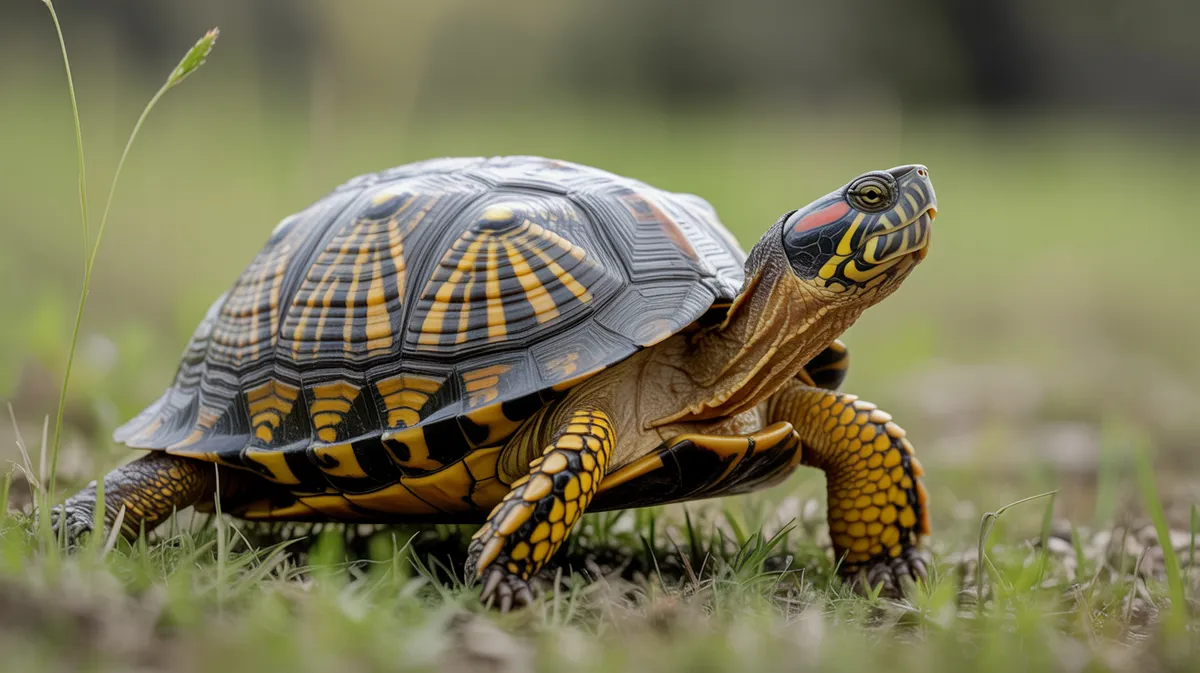
The Ornate Box Turtle is a small, terrestrial turtle native to the central United States, easily recognized by its domed shell adorned with yellow lines radiating from the center of each dark brown scute. Adapted to life on land, this species prefers open grasslands and prairies, using its strong forelimbs to dig burrows for shelter and thermoregulation. Ornate Box Turtles are omnivorous, feeding on a wide variety of insects, plants, and fruits. Their populations are declining due to habitat loss, road mortality, and collection for the pet trade.
Fascinating facts
Hinged Shell
The Ornate Box Turtle has a hinged plastron (the underside of its shell) that allows it to completely close its shell, sealing itself off from danger.
Prairie Specialist
This species is highly adapted to life in open prairies and grasslands, making it one of the few terrestrial turtles in the United States.
Temperature Regulation
Ornate Box Turtles dig burrows to escape extreme temperatures, helping them avoid both the summer heat and winter cold.
Detailed description
The Ornate Box Turtle (Terrapene ornata ornata) is a small, terrestrial turtle distinguished by its highly domed carapace, which typically measures 10–15 cm (4–6 in) in length. The carapace is dark brown to black with vivid yellow or orange radiating lines on each scute, providing effective camouflage among prairie grasses. The plastron is hinged, allowing the turtle to close its shell tightly for protection against predators and desiccation. The head is relatively small with a hooked upper jaw, and the limbs are robust with sharp claws adapted for digging. Sexual dimorphism is present: males generally have red eyes, a concave plastron, and longer, thicker tails, while females have brown eyes and a flat plastron. The skin is olive to brown, often with yellow or orange spots. Ornate Box Turtles are primarily diurnal, becoming most active during warm, humid conditions, and they spend much of their time burrowed underground to avoid extreme temperatures. Their lifespan in the wild can exceed 30 years, with some individuals documented at over 40 years. They are solitary outside the breeding season, exhibiting strong site fidelity to home ranges that may span several hectares.
Did you know?
Ornate Box Turtles can survive periods of drought by burrowing underground and entering a state of dormancy called estivation.
Research & sources
Wikipedia summary
The ornate box turtle is one of only two terrestrial species of turtles native to the Great Plains of the United States. It is one of the two different subspecies of Terrapene ornata. It is the state reptile of Kansas and Nebraska. It is currently listed as threatened in Illinois and is of concern and protected in six Midwestern states.
Behaviour & social structure
Ornate Box Turtles are largely solitary and exhibit territorial behavior, especially during the breeding season. They are most active in the morning and late afternoon, retreating to self-dug burrows or shallow scrapes during the hottest parts of the day. Their omnivorous diet includes insects (beetles, grasshoppers, caterpillars), earthworms, carrion, berries, grasses, and flowers. Foraging is primarily opportunistic and visually guided. They use their strong forelimbs to dig for food and shelter, and may soak in shallow puddles for hydration and thermoregulation. Social interactions are limited, with occasional aggressive encounters between males. During drought or extreme heat, they may enter aestivation, reducing activity and metabolic rate to conserve water.
Reproduction & life cycle
Breeding occurs from late spring through early summer (May–July), triggered by rising temperatures and increased rainfall. Males pursue females and engage in courtship behaviors such as circling, biting, and nudging. Copulation can last several hours. Females may store sperm for up to four years, allowing for delayed fertilization. Nesting typically occurs in June or July, with females excavating flask-shaped nests 8–12 cm (3–5 in) deep in sandy or loose soil. Clutch size ranges from 2 to 8 eggs, with an average of 4–6. Incubation lasts 50–70 days, and sex determination is temperature-dependent: warmer nests produce females, cooler nests yield males. Hatchlings emerge in late summer or early fall, measuring about 3 cm (1.2 in) in length, and receive no parental care.
Adaptations & survival
The Ornate Box Turtle's hinged plastron is a key adaptation, enabling it to close its shell completely and protect itself from predators such as raccoons, skunks, and birds of prey. Its cryptic coloration blends with prairie vegetation, reducing predation risk. The robust, clawed forelimbs are specialized for digging burrows, which provide refuge from temperature extremes and predators. Physiologically, they can tolerate dehydration and have a low metabolic rate, aiding survival during drought. Behavioral adaptations include aestivation during hot, dry periods and hibernation in winter, often in burrows up to 50 cm (20 in) deep.
Cultural significance
The Ornate Box Turtle holds symbolic value as the state reptile of Kansas and Nebraska, reflecting its historical abundance and ecological importance in the Great Plains. In some Native American cultures, turtles are revered as symbols of longevity, stability, and the earth itself. The species occasionally appears in local folklore and educational programs, promoting conservation awareness. There are no significant traditional uses reported, but its distinctive appearance makes it a subject of interest for naturalists and wildlife enthusiasts.
Recent research
Recent research has focused on population genetics, revealing significant genetic structuring among fragmented populations, which has implications for conservation management. Studies on movement ecology using radio telemetry have documented strong site fidelity and limited dispersal, emphasizing the need for habitat connectivity. Investigations into temperature-dependent sex determination are ongoing, particularly in the context of climate change and its potential to skew sex ratios. Ongoing monitoring programs are assessing the effectiveness of road mitigation structures and habitat restoration efforts. Disease surveillance, especially for ranavirus and mycoplasma infections, is an emerging area of concern.
Videos
Habitat
Grasslands and prairies

Conservation
The Ornate Box Turtle is currently classified as Near Threatened on the IUCN Red List.
Threats & challenges
Major threats include habitat loss and fragmentation due to agriculture, urbanization, and road construction. Road mortality is significant, especially during seasonal movements. Collection for the pet trade, both legal and illegal, has contributed to local declines. Pesticide exposure and altered fire regimes further degrade habitat quality. Populations are declining across much of their range, with the species listed as Near Threatened by the IUCN and protected or of concern in several states. Small, isolated populations are vulnerable to genetic bottlenecks and reduced reproductive success.
Taxonomy
Scientific name
Terrapene ornata
- Kingdom
- Animalia
- Phylum
- Chordata
- Class
- Reptilia
- Order
- Testudines
- Family
- Emydidae
- Genus
- Terrapene
- Species
- ornata
Where to see an ornate box turtle
3 zoos and aquariums in 1 country are recorded as keeping this species.
- 🦁Topeka Zoo🇺🇸 Topeka, United States
- 🦁Cheyenne Mountain Zoo🇺🇸 United States
- 🦁Salisbury Zoo🇺🇸 United States
Community notes
Share your observations about the Ornate Box Turtle.
No community notes yet. Be the first!
Discover more wildlife
More fascinating animals from the encyclopedia.