
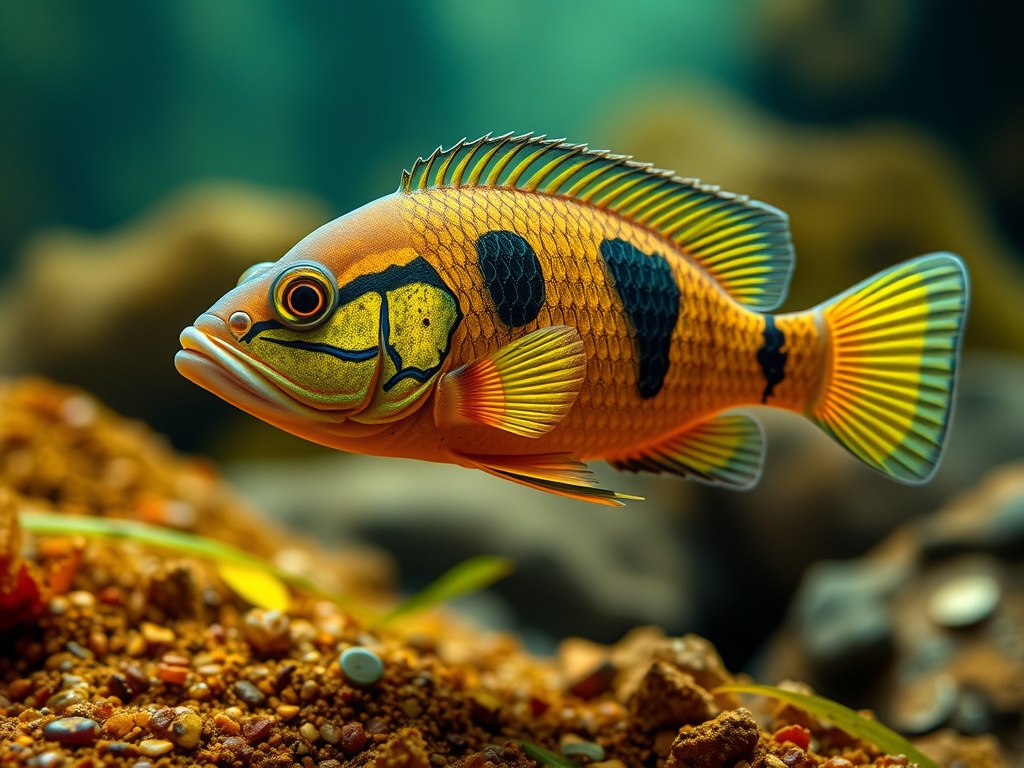
About the Oscar cichlid
The Oscar cichlid is a striking freshwater fish native to South America, particularly the Amazon River basin. Known for its vibrant coloration, which often includes patterns of orange, red, and black, the Oscar cichlid is a popular choice among aquarium enthusiasts due to its intelligence and interactive behavior. These fish are territorial and can grow quite large, requiring spacious tanks and careful management in captivity. In the wild, they inhabit slow-moving waters with abundant cover and are known for their problem-solving abilities and complex social interactions. Oscars are hardy but can be sensitive to water quality and stress.
Fascinating facts
Smart Swimmer
Oscar cichlids have demonstrated the ability to learn simple tricks and recognize individual humans, showcasing impressive intelligence for a fish.
Dedicated Parents
Both male and female Oscars take part in cleaning, guarding, and fanning their eggs to ensure the health and survival of their offspring.
Color Chameleons
Oscars can shift their coloration in response to mood, environment, or health, making them visually dynamic aquarium residents.
Detailed description
The Oscar cichlid (Astronotus ocellatus) is a robust, laterally compressed fish reaching up to 45 cm (18 in) in length and weighing as much as 1.6 kg (3.5 lbs), though most aquarium specimens are smaller. Its body is adorned with striking color patterns, typically a dark base with vivid orange-red blotches and an eye-like ocellus (spot) on the caudal peduncle, which is thought to deter fin-nipping predators. The species exhibits sexual monomorphism, making males and females difficult to distinguish externally. Oscars possess a large, terminal mouth with thick lips and strong pharyngeal teeth, adaptations for their omnivorous diet. Their lateral line is well-developed, aiding in navigation and prey detection in turbid waters. Oscars are known for their intelligence, displaying complex behaviors such as object manipulation, individual recognition, and even learning to associate their keepers with food. In their native range, they inhabit slow-moving rivers, floodplains, and oxbow lakes, often seeking shelter among submerged roots and debris. Oscars are territorial and form dominance hierarchies, especially during breeding. Their ability to rapidly change coloration in response to mood or environmental stimuli is a notable adaptation, used in communication and camouflage.
Did you know?
Oscars can rapidly change their coloration when stressed, excited, or during social interactions, often displaying more vivid or contrasting patterns.
Research & sources
Wikipedia summary
The oscar is a species of fish from the cichlid family known under a variety of common names, including tiger oscar, velvet cichlid, and marble cichlid. In tropical South America, where the species naturally resides, A. ocellatus specimens are often found for sale as a food fish in the local markets. The fish has been introduced to other areas, including India, China, Australia, and the United States. It is considered a popular aquarium fish in Europe and the U.S.
Behaviour & social structure
Oscars are diurnal and exhibit pronounced territoriality, especially during the breeding season. They are opportunistic feeders, employing both active hunting and ambush strategies. In the wild, their diet includes insects, crustaceans, smaller fish, mollusks, and plant matter; in captivity, they readily accept a variety of foods but require a balanced diet to prevent nutritional deficiencies. Oscars are known for their inquisitive nature, often rearranging tank decor and interacting with objects. Socially, they may form loose aggregations as juveniles but become more solitary or pair-bonded as adults. Aggression is common, particularly between individuals of similar size or during territory defense. They communicate through body postures, fin displays, and rapid color changes. Oscars also exhibit a unique 'jaw-locking' behavior during disputes or courtship, and may produce audible sounds by grinding their pharyngeal teeth.
Reproduction & life cycle
Oscar cichlids are biparental substrate spawners, forming monogamous pairs that jointly defend their territory and offspring. Spawning typically occurs during the rainy season in their native habitat, triggered by changes in water temperature and chemistry. The female lays between 1,000 and 3,000 adhesive eggs on a cleaned, flat surface such as a rock or submerged log. Both parents guard and fan the eggs, which hatch after 2-3 days at 26–28°C (79–82°F). The fry become free-swimming within a week and remain under parental protection for several weeks, with adults exhibiting vigorous defense against potential threats. Oscars are known for their high level of parental care, including mouthbrooding of fry in some cases when danger is perceived. Sexual maturity is reached at approximately 12–15 months of age.
Adaptations & survival
Oscars have evolved several adaptations for survival in dynamic floodplain environments. Their cryptic coloration and rapid color change abilities provide camouflage and facilitate social signaling. The prominent ocellus near the tail confuses predators and reduces attacks on vital body parts. Their robust jaws and pharyngeal teeth allow them to process a wide variety of prey, while a well-developed lateral line system enhances their ability to detect vibrations and movement in murky waters. Behavioral flexibility, including problem-solving and learning, enables them to exploit new food sources and adapt to changing conditions. Their tolerance for low-oxygen environments, aided by facultative air breathing (gulping air at the surface), helps them survive in hypoxic waters.
Cultural significance
In South America, Oscars are valued as both a food source and a game fish, commonly sold in local markets. Their striking appearance and engaging behavior have made them one of the most popular cichlids in the global aquarium trade, symbolizing intelligence and personality among fish keepers. In some regions, they are believed to bring good luck or serve as status symbols. There is no significant mythology associated with the species, but their popularity has influenced ornamental fish breeding and trade practices worldwide.
Recent research
Recent studies have focused on the cognitive abilities of Oscars, demonstrating advanced learning, memory, and problem-solving skills uncommon among fish. Research into their social behavior has revealed complex communication and recognition of individual conspecifics. Genetic studies are exploring population structure and the impact of introduced populations on native biodiversity. Ongoing research also examines the effects of environmental stressors, such as temperature fluctuations and water quality, on Oscar health and reproduction. Studies on their role as invasive species are informing management strategies in affected regions.
Videos
Habitat
Freshwater rivers and floodplains


Conservation
The Oscar cichlid is currently classified as Least Concern on the IUCN Red List.
Threats & challenges
Currently, Astronotus ocellatus is classified as Least Concern by the IUCN, with stable populations throughout its native range. However, localized threats include habitat degradation from deforestation, pollution, and dam construction, which alter floodplain dynamics. Overfishing for food and the aquarium trade is not considered a major threat at present, but unregulated collection could impact wild stocks. Introduced populations in non-native regions have raised ecological concerns, as Oscars can become invasive, outcompeting native species and altering local ecosystems. Disease outbreaks, particularly in captive populations, pose additional challenges.
Taxonomy
Scientific name
Astronotus ocellatus
- Kingdom
- Animalia
- Phylum
- Chordata
- Class
- Actinopterygii
- Order
- Cichliformes
- Family
- Cichlidae
- Genus
- Astronotus
- Species
- ocellatus
Community notes
Share your observations about the Oscar cichlid.
No community notes yet. Be the first!
Discover more wildlife
More fascinating animals from the encyclopedia.