
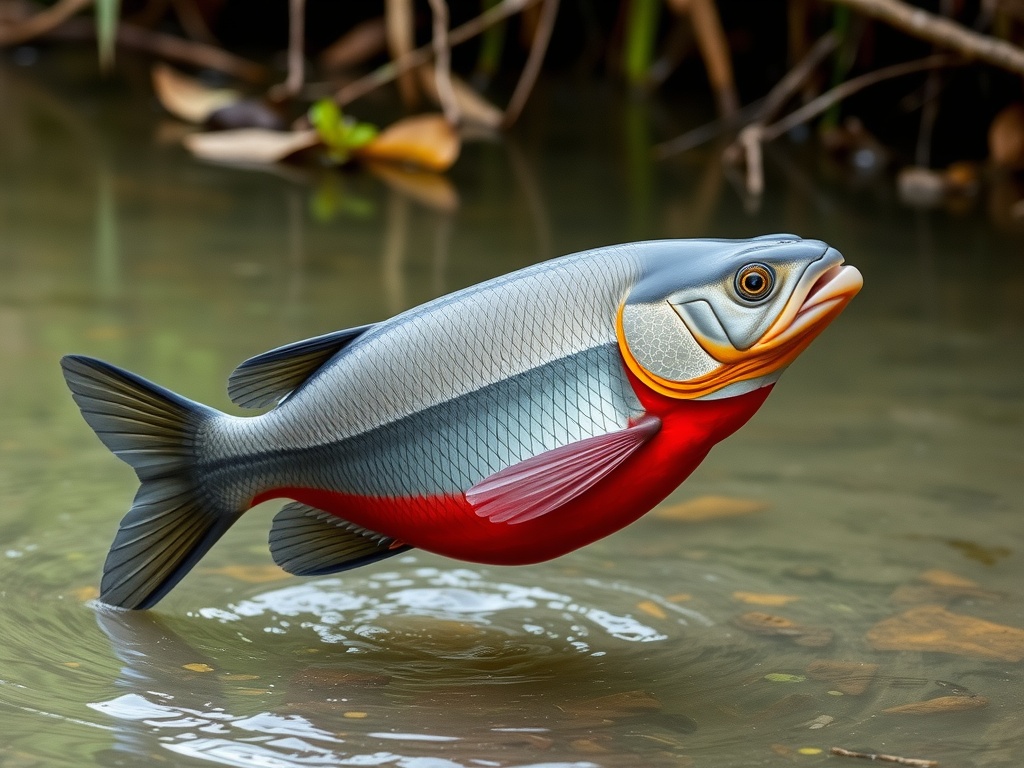
About the Red-bellied pacu
The red-bellied pacu is a large, robust freshwater fish native to the rivers and floodplains of South America, particularly within the Amazon and Orinoco basins. It is recognized for its deep, laterally compressed body and the characteristic reddish coloration on its belly, especially prominent in juveniles. Unlike its close relatives, the piranhas, the pacu has squarer, human-like teeth adapted for grinding plant material rather than flesh. The species is omnivorous, feeding on fruits, nuts, seeds, and occasionally small invertebrates. Red-bellied pacus are popular in the aquarium trade, though they require large tanks due to their potential adult size.
Fascinating facts
Human-like Teeth
Red-bellied pacus have distinctive square, flat teeth that resemble human molars, perfect for crushing plant material.
Fruit and Nut Eaters
Their diet is largely herbivorous, feeding on fruits, seeds, and nuts that fall into the water from overhanging trees.
Impressive Growth
Pacus can grow quite large, often reaching up to 90 centimeters in length and weighing over 25 kilograms in the wild.
Detailed description
The red-bellied pacu (Piaractus brachypomus) is a large, laterally compressed freshwater fish, typically reaching lengths of 50–70 cm (20–28 in) and weights up to 25 kg (55 lbs), though most individuals are smaller in the wild. Its body is deep and robust, with a gently arched dorsal profile and a slightly forked caudal fin. Juveniles display a vivid reddish-orange coloration on their ventral surfaces, which fades as they mature. The species is characterized by its unique dentition: broad, molariform teeth arranged in a single row on each jaw, well-adapted for crushing hard-shelled fruits and seeds. The eyes are relatively large, aiding in navigation through turbid floodwaters. Red-bellied pacus are primarily crepuscular, being most active during dawn and dusk. They are known for their strong schooling tendencies, especially as juveniles, which provides protection from predators. Adults may become more solitary or form loose aggregations. The species exhibits seasonal migratory behavior, moving into flooded forests during the wet season to exploit abundant food resources. Their digestive tract is elongated, reflecting their adaptation to a diet rich in plant material. Sexual dimorphism is subtle, with mature females generally being larger and rounder during the breeding season due to egg development.
Did you know?
Despite their close relation to piranhas, red-bellied pacus are generally peaceful and pose little danger to humans.
Research & sources
Wikipedia summary
Red-bellied pacu can refer to the following species of fish of the subfamily Serrasalminae:Colossoma macropomum or tambaqui Piaractus brachypomus or pirapitinga
Behaviour & social structure
Red-bellied pacus are omnivorous generalists, with a diet that shifts seasonally and ontogenetically. In the wild, they primarily consume fallen fruits, seeds, nuts, and aquatic vegetation during the flood season, taking advantage of the inundated forest floor. They also ingest insects, small crustaceans, and detritus, especially when plant material is scarce. Pacus use their strong jaws and molariform teeth to crack open tough-shelled nuts and seeds, playing a significant role in seed dispersal within their ecosystem. Socially, juveniles form tight schools for protection, while adults may be more solitary but sometimes aggregate in feeding areas. They exhibit exploratory and opportunistic foraging behavior, often following seasonal migrations of fruiting trees. Pacus are generally non-aggressive, but may become territorial or display dominance behaviors in confined spaces, such as aquaria. Their daily activity patterns are influenced by light levels and food availability, with increased activity during dawn and dusk.
Reproduction & life cycle
Piaractus brachypomus exhibits seasonal breeding, typically synchronized with the onset of the rainy season (November to March) when rivers flood and access to spawning grounds increases. Spawning occurs in shallow, vegetated floodplains, where females release thousands of pelagic eggs into the water column. Fertilization is external, and there is no parental care after spawning. The eggs are buoyant and hatch within 2–3 days, depending on water temperature (optimal range: 26–28°C). Larvae are planktonic and feed on zooplankton and detritus before transitioning to a more omnivorous diet as they grow. Sexual maturity is generally reached at 3–4 years of age, with females producing large numbers of eggs (up to 200,000 per spawning event), reflecting a reproductive strategy adapted to high predation rates on eggs and larvae.
Adaptations & survival
Red-bellied pacus possess several adaptations for survival in dynamic floodplain environments. Their molariform teeth and powerful jaws allow them to exploit hard-shelled fruits and nuts, a niche less accessible to many other fish. Their elongated digestive tract is specialized for processing fibrous plant material. The species' ability to tolerate variable water conditions, including low dissolved oxygen, is facilitated by efficient gill structures and behavioral adaptations such as surface respiration. Seasonal migratory behavior enables them to exploit ephemeral food resources and suitable spawning habitats. Their coloration provides camouflage among submerged vegetation, and their schooling behavior as juveniles reduces predation risk. Additionally, their role as seed dispersers is a key ecological adaptation, promoting forest regeneration.
Cultural significance
The red-bellied pacu holds economic and cultural importance in its native range. It is a valued food fish, prized for its mild-flavored flesh and often featured in local markets and traditional cuisine. In some Amazonian communities, pacus are associated with seasonal abundance and are integral to subsistence fishing practices. The species is also popular in recreational fishing and the ornamental fish trade, though its large adult size often leads to challenges for aquarium hobbyists. While not as mythologized as the piranha, pacus are sometimes referenced in local folklore, particularly regarding their impressive teeth and feeding habits.
Recent research
Recent research has focused on the ecological role of Piaractus brachypomus as a keystone seed disperser in Amazonian floodplain forests, highlighting its contribution to forest regeneration and plant diversity. Studies on its digestive physiology have revealed adaptations for processing high-fiber diets, including specialized gut microbiota. Genetic research has clarified its relationships within the Serrasalminae subfamily and informed aquaculture practices aimed at improving growth rates and disease resistance. Ongoing studies are assessing the impacts of habitat modification and climate change on population dynamics, as well as the ecological consequences of non-native introductions. Advances in telemetry have provided new insights into their migratory patterns and habitat use.
Videos
Habitat
Freshwater rivers and floodplains


Conservation
The Red-bellied pacu is currently classified as Least Concern on the IUCN Red List.
Threats & challenges
While currently listed as Least Concern by the IUCN, red-bellied pacus face localized threats from overfishing, habitat fragmentation, and pollution. Deforestation and dam construction in the Amazon and Orinoco basins disrupt migratory routes and alter flood regimes critical for spawning. Overharvesting for food and the aquarium trade can impact local populations, particularly where fishing pressure is high. Invasive populations have been reported outside their native range, resulting from aquarium releases, which can disrupt local ecosystems. Climate change poses a long-term threat by altering rainfall patterns and floodplain dynamics, potentially impacting breeding and feeding habitats. Despite these challenges, the species remains widespread and resilient in much of its range.
Taxonomy
Scientific name
Piaractus brachypomus
- Kingdom
- Animalia
- Phylum
- Chordata
- Class
- Actinopterygii
- Order
- Characiformes
- Family
- Serrasalmidae
- Genus
- Piaractus
- Species
- brachypomus
Community notes
Share your observations about the Red-bellied pacu.
No community notes yet. Be the first!
Discover more wildlife
More fascinating animals from the encyclopedia.