
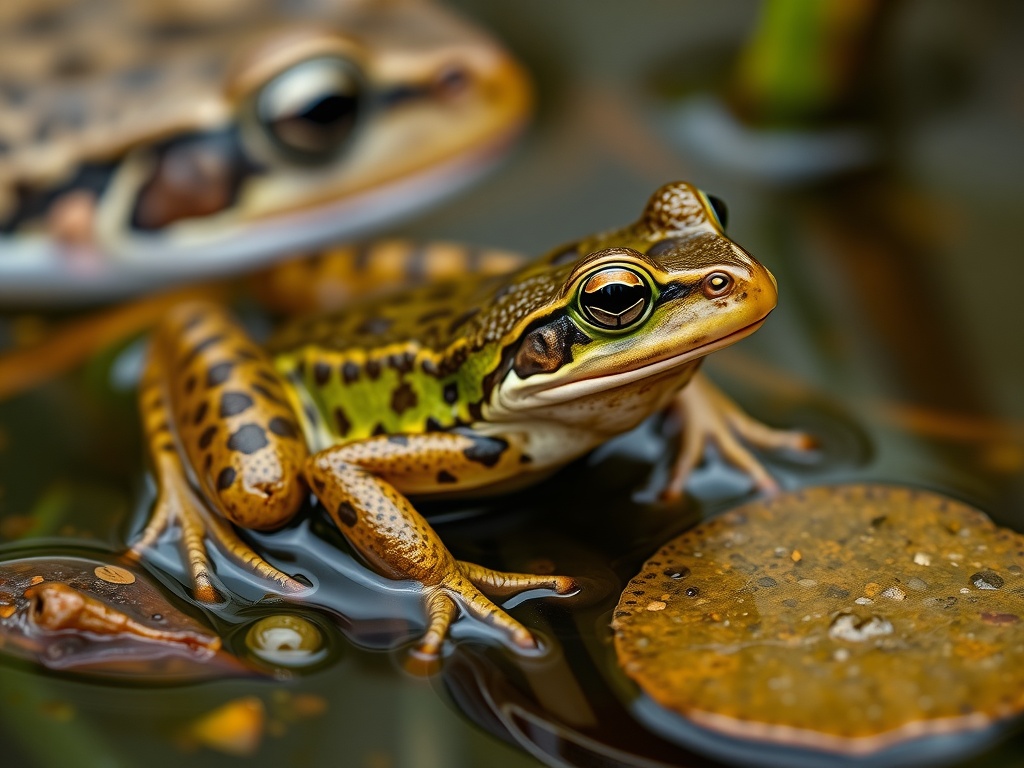
About the Perez's Frog
Perez's Frog, also known as the Iberian Green Frog, is a medium-sized amphibian native to the Iberian Peninsula and southern France. It is characterized by its green to olive coloration with dark spots and a sleek, streamlined body adapted for aquatic life. This species thrives in a variety of freshwater habitats such as ponds, lakes, rivers, and marshes, where it is often seen basking at the water's edge. Perez's Frog is notable for its loud, melodic croak, especially during the breeding season, and plays an important role in its ecosystem as both predator and prey.
Fascinating facts
Vocal Performer
Male Perez's Frogs use their vocal sacs to produce loud croaks that can be heard from considerable distances, especially during the breeding season.
Aquatic Adaptation
This species is highly aquatic, rarely straying far from water, and is an excellent swimmer thanks to its long, webbed hind feet.
Wide Distribution
While native to the Iberian Peninsula and southern France, Perez's Frog has also been introduced to several Atlantic islands, expanding its range.
Detailed description
Perez's Frog (Pelophylax perezi) is a medium-sized ranid amphibian, typically measuring 5–10 cm in snout-vent length, with females generally larger than males. Its dorsal coloration ranges from bright green to olive or brownish, often marked with irregular dark spots and a distinctive light vertebral stripe. The ventral surface is pale, sometimes with faint mottling. Adapted for an aquatic lifestyle, Perez's Frog has long, powerful hind limbs with extensive webbing between the toes, facilitating efficient swimming and rapid escape from predators. The tympanum (external eardrum) is prominent, and males possess paired vocal sacs that inflate during calling. This species is highly adaptable, thriving in a variety of freshwater habitats, from slow-moving rivers and lakes to temporary ponds and irrigation canals, and can tolerate moderate levels of pollution. Perez's Frog is primarily diurnal but may also be active at night, especially during the breeding season. It is an opportunistic predator, feeding on a wide range of invertebrates and occasionally small vertebrates. The species exhibits both solitary and loosely gregarious behavior, particularly during breeding aggregations. Its loud, melodious croak is a key feature of spring and early summer soundscapes in its native range. The species plays a crucial ecological role as both predator and prey, contributing to the regulation of aquatic invertebrate populations and serving as food for birds, reptiles, and mammals.
Did you know?
Perez's Frog has been introduced to the Canary Islands, Madeira, and parts of the Balearic Islands, where it has established thriving populations outside its native range.
Research & sources
Wikipedia summary
The Perez's frog, also known as Iberian waterfrog, Iberian green frog or Coruna frog, is a species of frog in the family Ranidae. It is native to southern France, Portugal, Spain, and has been introduced to the Canary and Balearic Islands, Madeira, the United Kingdom, and the Azores. In the Iberian Peninsula it is widespread and common.
Behaviour & social structure
Perez's Frog is generally active during the warmer months, with peak activity from March to October. It spends much of its time at the water's edge or floating among aquatic vegetation, ready to dive at the slightest disturbance. Feeding occurs primarily at dusk and dawn (crepuscular), but individuals may hunt throughout the day in shaded or cooler conditions. The diet consists mainly of insects (such as beetles, flies, and aquatic larvae), spiders, crustaceans, and occasionally small fish or amphibians. Hunting is typically sit-and-wait, with the frog lunging at passing prey. Social interactions are most pronounced during the breeding season, when males congregate in choruses and establish loose territories. Outside of breeding, Perez's Frog is less social, though multiple individuals may share favorable basking or feeding sites. The species exhibits a high degree of site fidelity, often returning to the same breeding ponds year after year.
Reproduction & life cycle
Breeding in Perez's Frog occurs from late winter to early summer (February to July), depending on local climate and water availability. Males call from the water's edge or floating vegetation to attract females, producing a series of resonant, melodious croaks. Amplexus (the mating embrace) is axillary, with the male grasping the female behind her forelimbs. Females lay between 800 and 4,000 eggs per clutch, attaching gelatinous egg masses to submerged vegetation. Embryonic development is temperature-dependent, with hatching occurring within 7–14 days. Larval (tadpole) development typically lasts 2–3 months, though this can be extended in cooler or high-altitude environments. Metamorphosis into juvenile frogs occurs in late spring to early autumn. There is no parental care after egg-laying; tadpoles are left to develop independently. Sexual maturity is usually reached within 1–2 years.
Adaptations & survival
Perez's Frog exhibits several adaptations for aquatic life, including streamlined bodies, webbed hind feet, and a mucous-covered skin that facilitates cutaneous respiration and moisture retention. The species can tolerate a wide range of water conditions, including moderate salinity and pollution, which has enabled it to colonize diverse habitats, including artificial water bodies. Its cryptic coloration and rapid escape response reduce predation risk. Males have well-developed vocal sacs for effective acoustic communication in noisy aquatic environments. Tadpoles possess keratinized mouthparts for grazing on algae and detritus, and can adjust their growth rates in response to environmental conditions. The species' broad ecological tolerance and flexible breeding strategies are key evolutionary specializations that have facilitated its success and expansion, including in introduced regions.
Cultural significance
Perez's Frog is a familiar presence in rural and agricultural landscapes of the Iberian Peninsula, where its calls are a traditional sound of spring and summer. While not a major figure in folklore or mythology, it is sometimes referenced in local proverbs and children's stories. The species is occasionally used in educational settings and biological research due to its abundance and ease of observation. In some regions, it is considered a bioindicator of freshwater ecosystem health.
Recent research
Recent genetic studies have clarified the taxonomic status of Pelophylax perezi and its relationships within the Pelophylax esculentus complex. Ongoing research focuses on its adaptability to anthropogenic environments, hybridization with other water frog species, and its potential role in the spread of amphibian pathogens such as Batrachochytrium dendrobatidis (chytrid fungus). Studies on its vocalizations have provided insights into acoustic communication and mate choice. The species is also being monitored in introduced regions to assess its ecological impact and potential invasiveness.
Videos
Habitat
Freshwater bodies such as ponds, lakes, rivers, and marshes

Conservation
The Perez's Frog is currently classified as Least Concern on the IUCN Red List.
Threats & challenges
While Perez's Frog is currently classified as Least Concern by the IUCN, localized threats include habitat degradation, water pollution, drainage of wetlands, introduction of predatory fish, and competition or hybridization with other Pelophylax species. Invasive species, such as the American crayfish (Procambarus clarkii), can negatively impact tadpole survival. Climate change poses a long-term risk by altering hydrological regimes and reducing suitable breeding sites. In some introduced regions, Perez's Frog may become invasive, potentially impacting native amphibian communities. Despite these challenges, the species remains widespread and abundant in its native range, with stable or increasing populations in many areas.
Taxonomy
Scientific name
Pelophylax perezi
- Kingdom
- Animalia
- Phylum
- Chordata
- Class
- Amphibia
- Order
- Anura
- Family
- Ranidae
- Genus
- Pelophylax
- Species
- perezi
Community notes
Share your observations about the Perez's Frog.
No community notes yet. Be the first!
Discover more wildlife
More fascinating animals from the encyclopedia.