
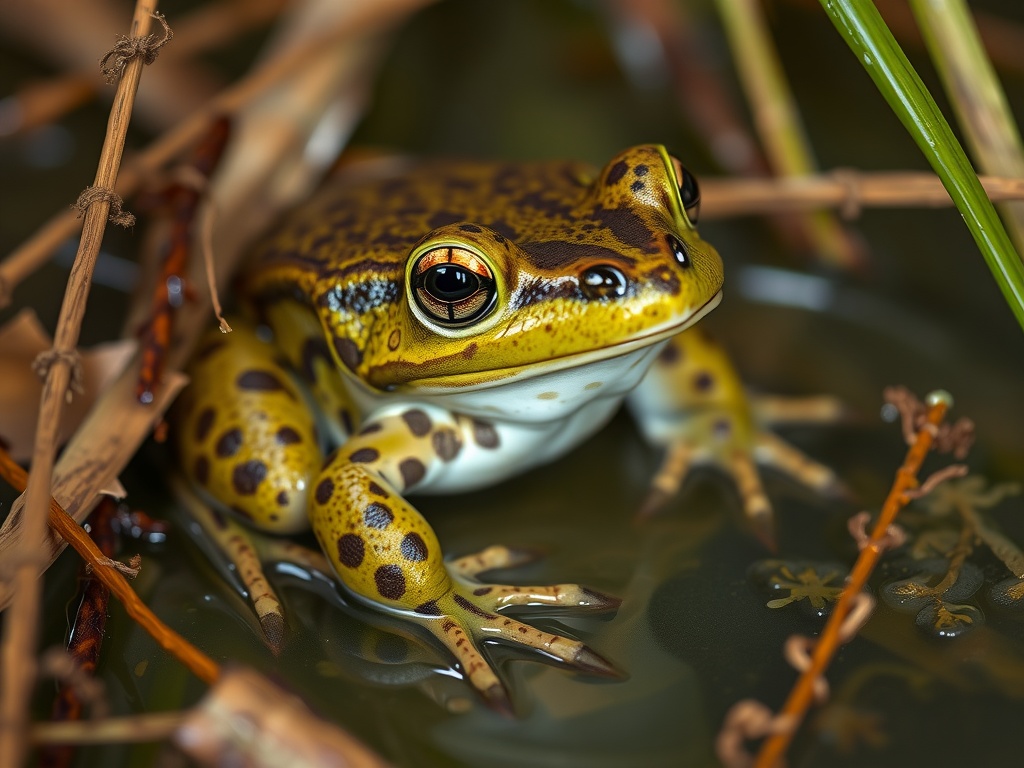
About the Pickersgill’s Reed Frog
Pickersgill’s Reed Frog is a small, delicate amphibian endemic to a narrow coastal region of KwaZulu-Natal, South Africa. Its smooth skin is usually pale green to brown with distinctive pale lateral stripes, allowing it to blend seamlessly with reed beds and wetland grasses. The species is strictly associated with threatened coastal wetlands and marshes, making it highly sensitive to habitat loss and degradation. Due to its restricted range and specialized habitat, Pickersgill’s Reed Frog is considered one of South Africa’s most endangered amphibians.
Fascinating facts
Endemic Range
This frog is found only in a narrow strip of coastal wetlands in KwaZulu-Natal, South Africa, making it highly vulnerable to habitat changes.
Unique Call
Males emit a soft, insect-like call from concealed positions in dense grasses to attract mates during the rainy season.
Conservation Focus
Conservationists have established intensive management programs, including captive breeding and habitat restoration, to prevent the extinction of this species.
Detailed description
Pickersgill’s Reed Frog (Hyperolius pickersgilli) is a diminutive amphibian, with adult males typically measuring 18–23 mm and females slightly larger, up to 25 mm in snout-vent length. The species is characterized by its slender body, long limbs, and smooth, moist skin, which ranges from pale green to olive-brown, often with a subtle golden sheen. Distinctive pale dorsolateral stripes run from the snout along the flanks, aiding in camouflage among reeds and sedges. The ventral surface is usually white or pale yellow. The toes are extensively webbed and tipped with adhesive discs, adaptations for an arboreal and semi-aquatic lifestyle. The eyes are relatively large, providing excellent night vision, as the species is primarily nocturnal. Males possess a single subgular vocal sac, which inflates during calling to produce a soft, high-pitched 'tinkling' call, especially during the breeding season. The species is highly secretive, spending daylight hours hidden in dense vegetation and emerging at dusk to forage and breed. Its delicate build and cryptic coloration make it challenging to detect in its natural habitat.
Did you know?
Pickersgill’s Reed Frog was once thought to be extinct in the wild until several small populations were rediscovered in protected wetlands.
Research & sources
Behaviour & social structure
Pickersgill’s Reed Frog is a nocturnal and predominantly solitary species, with peak activity occurring after sunset. During the day, individuals remain concealed within dense reed beds or under leaves to avoid desiccation and predation. At night, they become active, moving through emergent vegetation in search of small invertebrates such as mosquitoes, flies, and other arthropods. Feeding is primarily opportunistic, with frogs employing a sit-and-wait strategy, using their sticky tongues to capture prey. Social interactions are most pronounced during the breeding season, when males congregate at the edges of shallow pools or flooded grasslands to call and attract females. Territorial disputes between males are rare but may involve vocal competition and occasional physical displays. Outside of breeding, individuals maintain small, overlapping home ranges and show little aggression towards conspecifics.
Reproduction & life cycle
Breeding is closely tied to seasonal rainfall, typically occurring from October to March, coinciding with the austral summer. Males establish calling sites on emergent vegetation above shallow, still water. The advertisement call is a soft, metallic 'ting' repeated at intervals, which attracts gravid females. Amplexus is axillary, with the male clasping the female behind the forelimbs. Females lay small clutches of 20–50 eggs, attaching them to submerged or partially submerged vegetation. Embryonic development is rapid, with hatching occurring within 7–10 days, depending on temperature. Tadpoles are free-swimming and feed on algae and detritus, undergoing metamorphosis after 6–8 weeks. There is no parental care beyond egg deposition, and survival rates are heavily influenced by water quality and predation pressure.
Adaptations & survival
Hyperolius pickersgilli exhibits several adaptations for life in ephemeral wetlands. Its cryptic coloration and lateral stripes provide effective camouflage among reeds, reducing predation risk. The expanded toe pads facilitate climbing and adherence to smooth, wet surfaces, while extensive webbing aids in swimming. The species’ nocturnality minimizes water loss and exposure to diurnal predators. Vocal sac morphology is specialized for producing calls that travel efficiently through dense vegetation and humid air. Rapid larval development is an adaptation to the unpredictable nature of temporary wetlands, allowing the species to exploit breeding sites before they dry up. Additionally, the frog’s skin contains antimicrobial peptides, offering protection against pathogens in the aquatic environment.
Cultural significance
Due to its cryptic nature and restricted range, Pickersgill’s Reed Frog has limited direct cultural significance. However, it has become a flagship species for wetland conservation in KwaZulu-Natal, symbolizing the fragility and importance of South Africa’s coastal wetlands. The species is named in honor of Martin Pickersgill, a South African herpetologist who contributed significantly to the study and conservation of local amphibians. Educational programs and conservation campaigns frequently use the frog’s plight to raise awareness about broader environmental issues affecting amphibians and wetlands.
Recent research
Recent research has focused on the species’ microhabitat preferences, breeding ecology, and population genetics to inform conservation strategies. Studies have highlighted the importance of maintaining hydrological regimes and native vegetation structure for successful breeding. Genetic analyses suggest low genetic diversity, likely due to population isolation, emphasizing the need for habitat corridors. Ongoing monitoring projects employ acoustic surveys and environmental DNA (eDNA) sampling to detect populations and assess trends. Research into the impacts of chytrid fungus (Batrachochytrium dendrobatidis) has so far found no major outbreaks in this species, but ongoing vigilance is recommended given global amphibian declines.
Sources
A Review of the Hyperolius nasutus Complex in Southern Africa, with the Description of a New Species (Anura: Hyperoliidae)
Poynton, J.C. & Broadley, D.G. (1987)
scientificHyperolius pickersgilli: The IUCN Red List of Threatened Species 2016
IUCN SSC Amphibian Specialist Group
conservationVideos
Habitat
Coastal wetlands and marshes

Conservation
The Pickersgill’s Reed Frog is currently classified as Critically Endangered on the IUCN Red List.
Threats & challenges
Pickersgill’s Reed Frog faces severe threats from habitat loss, fragmentation, and degradation, primarily due to urban expansion, agriculture, drainage of wetlands, and invasive plant species. Pollution from pesticides and fertilizers further degrades water quality, impacting both adults and larvae. The species’ extremely limited distribution—restricted to fewer than 20 known localities within a 50 km coastal strip—makes it highly vulnerable to stochastic events and climate change. Population trends indicate ongoing declines, with some subpopulations extirpated in recent decades. Conservation challenges include securing and restoring suitable wetland habitats, mitigating pollution, and managing invasive species. The species is listed as Critically Endangered on the IUCN Red List, and ongoing monitoring and habitat protection are critical for its survival.
Taxonomy
Scientific name
Hyperolius pickersgilli
- Kingdom
- Animalia
- Phylum
- Chordata
- Class
- Amphibia
- Order
- Anura
- Family
- Hyperoliidae
- Genus
- Hyperolius
- Species
- pickersgilli
Community notes
Share your observations about the Pickersgill’s Reed Frog.
No community notes yet. Be the first!
Discover more wildlife
More fascinating animals from the encyclopedia.