
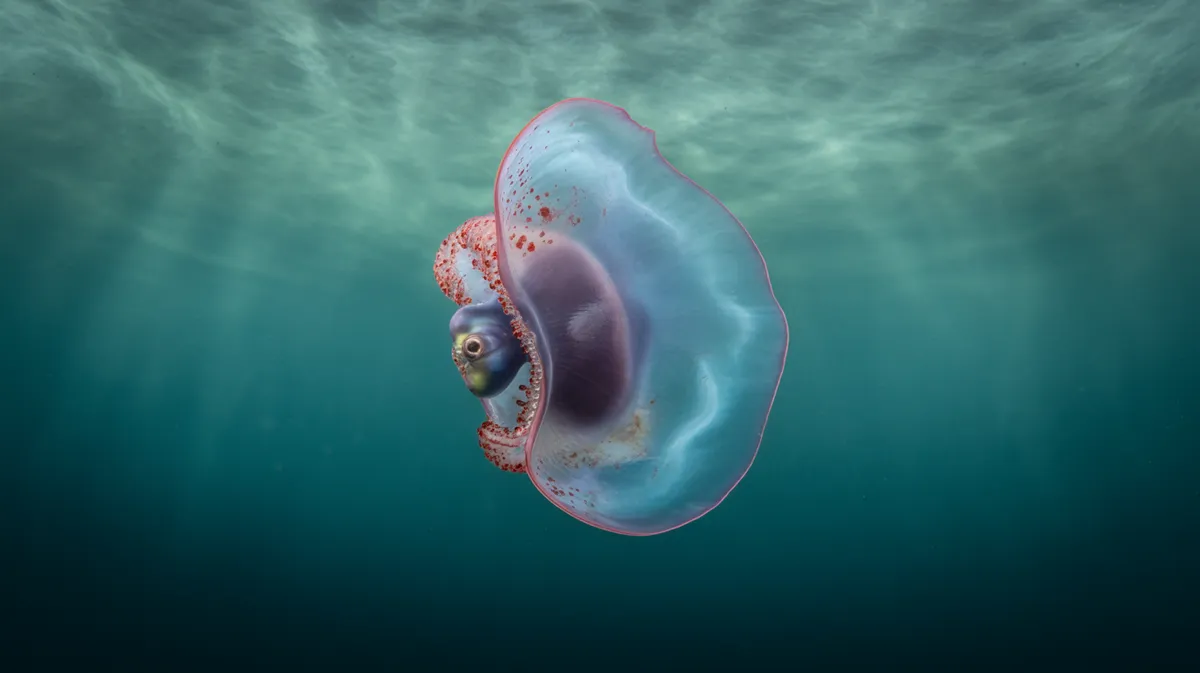
About the Portuguese Man o' War
The Portuguese Man o' War is a marine hydrozoan known for its striking appearance and potent venomous tentacles. Contrary to popular belief, it is not a single organism, but a colonial siphonophore composed of specialized polyps working together. Its gas-filled, balloon-like float sits atop the water, while long tentacles can extend up to 30 meters, trailing beneath to capture prey. Found in warm ocean waters, its sting can be extremely painful to humans and is used to subdue fish and other small marine animals.
Fascinating facts
Colonial Creature
The Portuguese Man o' War is made up of four specialized polyps, each performing a unique function like floating, feeding, capturing prey, or reproduction.
Powerful Sting
Its tentacles contain venom-filled nematocysts that can deliver painful stings to humans and easily paralyze small marine animals.
Ocean Drifter
It cannot swim; instead, it relies on wind and ocean currents to move, sometimes forming large groups called 'armadas' on the sea surface.
Detailed description
The Portuguese Man o' War (Physalia physalis) is a colonial marine organism belonging to the order Siphonophorae, notable for its striking appearance and complex anatomy. Unlike true jellyfish, it is composed of a colony of genetically identical but morphologically specialized polyps, known as zooids, each performing distinct functions such as flotation, feeding, defense, and reproduction. Its most visible feature is the pneumatophore, a gas-filled, iridescent float that can reach up to 30 cm in length and 13 cm in width, allowing it to drift on the ocean surface, propelled by wind and currents. Below the float, long tentacles—sometimes extending over 30 meters—are lined with venomous nematocysts capable of delivering painful stings to prey and humans alike. The tentacles are specialized dactylozooids for prey capture, while gastrozooids handle digestion. The colony also includes gonozooids, responsible for reproduction. The Man o' War lacks active propulsion and relies on its float and a crest-like sail for movement. It is predominantly found in warm tropical and subtropical waters of the Atlantic, Indian, and Pacific Oceans, often forming large aggregations. Its vivid blue, purple, or pink coloration serves as a warning to potential predators. Despite its delicate appearance, Physalia physalis is a formidable predator, feeding on small fish, plankton, and other marine organisms. The species exhibits a high degree of polymorphism among its zooids, reflecting a sophisticated division of labor within the colony.
Did you know?
A beached Portuguese Man o' War can still sting long after it has died, so care should always be taken around washed-up specimens.
Research & sources
Wikipedia summary
The Portuguese man o' war, also known as the man-of-war or bluebottle, is a marine hydrozoan found in the Atlantic Ocean and the Indian Ocean. It is considered to be the same species as the Pacific man o' war or bluebottle, which is found mainly in the Pacific Ocean. The Portuguese man o' war is the only species in the genus Physalia, which in turn is the only genus in the family Physaliidae.
Behaviour & social structure
The Portuguese Man o' War is a passive drifter, relying on wind, currents, and its pneumatophore's sail to navigate the open ocean. It is primarily a solitary organism, but can form large aggregations, sometimes numbering in the thousands, especially after storms or strong winds. Its tentacles trail beneath the float, creating an extensive net to ensnare prey. When a tentacle contacts a fish or crustacean, thousands of nematocysts fire, injecting venom that paralyzes the victim. The prey is then transported to the gastrozooids for digestion. Feeding occurs both day and night, depending on prey availability. The Man o' War exhibits minimal social interaction beyond aggregation, as each colony is an independent entity. Predators include the loggerhead turtle (Caretta caretta), the ocean sunfish (Mola mola), and the violet snail (Janthina janthina), all of which have adaptations to resist its venom. The organism is highly sensitive to environmental changes and often washes ashore in large numbers, posing a hazard to beachgoers.
Reproduction & life cycle
Reproduction in Physalia physalis is sexual and occurs through specialized reproductive zooids called gonozooids. The species is dioecious, meaning colonies are either male or female. During spawning events, gonozooids release gametes into the water column for external fertilization. Fertilized eggs develop into free-swimming planula larvae, which eventually settle and differentiate into new colonies. There is no parental care; the planktonic larvae are subject to predation and environmental hazards. The timing and triggers for spawning are not fully understood, but are believed to be influenced by seasonal changes in water temperature and currents. Breeding can occur year-round in tropical regions, with possible peaks in spring and summer. The life cycle from larva to mature colony is not fully documented, but growth rates are rapid under favorable conditions.
Adaptations & survival
The Portuguese Man o' War exhibits several unique adaptations for survival in the pelagic zone. Its pneumatophore is filled with a mixture of gases, including carbon monoxide, produced by a specialized gas gland, providing buoyancy and allowing it to float at the water's surface. The float's crest can be oriented left or right, a polymorphism that helps populations disperse over wide areas and reduces mass strandings. Its tentacles are equipped with potent nematocysts capable of delivering neurotoxic and cytotoxic venom, effective against both prey and predators. The vivid coloration serves as aposematic (warning) signaling. The division of labor among zooids allows for efficient feeding, defense, and reproduction. The lack of active locomotion is compensated by the ability to harness wind and currents, while the colony structure enables rapid response to environmental changes. Some predators, such as the blanket octopus (Tremoctopus violaceus), have evolved resistance to the venom and even use detached tentacles as weapons.
Cultural significance
The Portuguese Man o' War has a prominent place in maritime folklore and is often referenced in literature and art due to its striking appearance and dangerous sting. Its name derives from its resemblance to 18th-century Portuguese warships under full sail. In some cultures, it is a symbol of the ocean's beauty and peril. The organism has been featured in educational materials, documentaries, and as a cautionary figure in beach safety campaigns. There are no known traditional medicinal or culinary uses, due to its venomous nature. Its image is sometimes used in logos and mascots, representing resilience and adaptability.
Recent research
Recent research has focused on the molecular composition of Physalia venom, revealing complex mixtures of proteins and peptides with potential biomedical applications, including analgesics and anti-cancer agents. Advances in genetic sequencing have clarified its evolutionary relationships within Siphonophorae. Studies using satellite tracking and citizen science have improved understanding of distribution patterns and responses to climate variability. Ongoing research examines the biomechanics of the pneumatophore and the ecological role of Physalia in pelagic food webs. There is increasing interest in its interactions with symbiotic organisms, such as the fish Nomeus gronovii, which can shelter among the tentacles with partial immunity to the venom.
Sources
Videos
Habitat
Open ocean (pelagic zone)

Conservation
The Portuguese Man o' War is currently classified as Least Concern on the IUCN Red List.
Threats & challenges
Currently, Physalia physalis is not considered threatened and is classified as Least Concern. However, it faces challenges from climate change, which may alter ocean currents and temperatures, potentially affecting distribution and aggregation patterns. Pollution, particularly plastic debris, can entangle colonies and disrupt feeding. Mass strandings on beaches can lead to high mortality, especially during storms or unusual wind events. Human activities, such as coastal development and increased tourism, can result in more frequent encounters and negative perceptions, sometimes leading to intentional removal. Despite these challenges, the species remains widespread and abundant, with no evidence of significant population decline. Monitoring is limited, and long-term impacts of ocean acidification and ecosystem shifts remain uncertain.
Taxonomy
Scientific name
Physalia physalis
- Kingdom
- Animalia
- Phylum
- Cnidaria
- Class
- Hydrozoa
- Order
- Siphonophorae
- Family
- Physaliidae
- Genus
- Physalia
- Species
- physalis
Community notes
Share your observations about the Portuguese Man o' War.
No community notes yet. Be the first!
Discover more wildlife
More fascinating animals from the encyclopedia.