
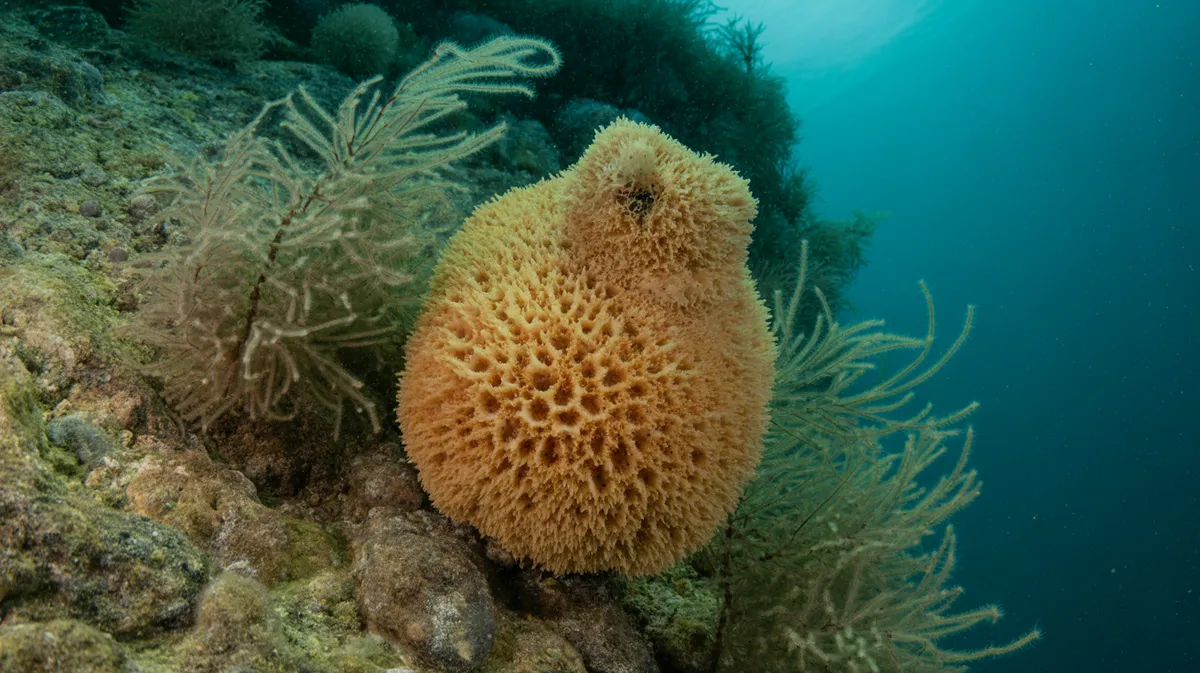
About the Purse Sponge
The purse sponge is a small, sac-like marine sponge found along the northeastern Atlantic coasts and the Mediterranean Sea. Its body is typically slender, tubular, and can reach lengths up to 5 centimeters, resembling a tiny purse or bag. The sponge has a rough, leathery surface and is usually white or pale yellow in color. It anchors itself to rocks or other hard substrates in shallow, sheltered waters, where it filters microscopic food particles from the water. As a simple invertebrate, the purse sponge plays an important role in maintaining water quality and providing habitat for small marine organisms.
Fascinating facts
Filter Feeding
Purse sponges filter thousands of liters of seawater daily to extract tiny plankton and organic matter for food.
Regeneration
These sponges have remarkable regenerative abilities, allowing them to recover from injury and even reassemble from separated cells.
Habitat Preference
They are most commonly found attached to rocky substrates in sheltered bays and undersea caves, often in dense colonies.
Detailed description
Grantia compressa, commonly known as the purse sponge, is a small calcareous sponge belonging to the family Grantiidae. Its body is typically slender, tubular, and sac-like, ranging from 2 to 5 centimeters in length and about 1 centimeter in diameter. The sponge’s surface is rough and leathery due to the presence of calcareous spicules, which provide structural support and deter predation. The body wall is perforated with numerous small pores (ostia) that allow water to flow into the central cavity (spongocoel), which opens to the exterior via a single large osculum at the apex. Internally, Grantia compressa exhibits a syconoid canal system, characterized by folded walls lined with choanocyte chambers that maximize surface area for efficient water filtration. The sponge is sessile, attaching firmly to hard substrates such as rocks, shells, and seaweed holdfasts in sheltered, shallow marine environments up to 30 meters deep. Its coloration varies from white to pale yellow, sometimes appearing slightly translucent when submerged. The purse sponge is an important benthic organism, contributing to nutrient cycling and providing microhabitats for small invertebrates. It lacks true tissues and organs, relying on a simple cellular organization and totipotent cells for regeneration and repair. Despite its simplicity, Grantia compressa demonstrates remarkable adaptability to varying water conditions and plays a significant ecological role in coastal ecosystems.
Did you know?
Despite their simple appearance, purse sponges can regenerate lost parts and even re-form after being broken into pieces.
Research & sources
Behaviour & social structure
Grantia compressa is a sessile, non-motile organism that exhibits passive filter-feeding behavior. It relies on the continuous flow of water through its body, driven by the coordinated beating of flagella on choanocytes (collar cells), to capture suspended organic particles, bacteria, and plankton. The sponge can regulate the diameter of its osculum to control water flow, closing it in response to excessive sedimentation or poor water quality. Although lacking a nervous system, Grantia compressa can exhibit coordinated cellular responses to environmental stimuli, such as contraction of the body to expel debris. There is no evidence of social structure or inter-individual communication, as each sponge functions independently. However, purse sponges often occur in dense aggregations, forming small clusters or colonies that may enhance local water filtration and provide mutual protection from predators and strong currents. Daily routines are dictated by ambient water movement and the availability of suspended food particles.
Reproduction & life cycle
Grantia compressa is capable of both sexual and asexual reproduction. Sexual reproduction is typically hermaphroditic, with individuals producing both eggs and sperm, though not simultaneously to avoid self-fertilization. Sperm are released into the water column and taken up by neighboring sponges, where internal fertilization occurs. Embryos develop within the parent’s body and are eventually released as free-swimming ciliated larvae (amphiblastula), which disperse in the plankton before settling and metamorphosing into juvenile sponges. Breeding is generally seasonal, often peaking in spring and early summer when water temperatures rise and food availability increases. Asexual reproduction occurs via budding or fragmentation, allowing rapid colonization of suitable substrates. There is no parental care after larval release, and survival is dependent on successful settlement and attachment.
Adaptations & survival
Grantia compressa possesses several adaptations for survival in dynamic coastal environments. Its calcareous spicules provide structural rigidity and deter many potential predators. The syconoid canal system, with its folded walls and numerous choanocyte chambers, maximizes filtration efficiency while maintaining a compact body form. The ability to regulate osculum size helps prevent clogging by sediments and allows the sponge to respond to changes in water quality. Totipotent archaeocytes enable rapid regeneration from injury or fragmentation, a key adaptation in high-energy habitats where physical disturbance is common. The sponge’s small size and tubular shape minimize resistance to water flow, reducing the risk of dislodgement. Additionally, Grantia compressa can tolerate a range of salinities and temperatures, enhancing its ecological plasticity.
Cultural significance
Grantia compressa has limited direct cultural significance and is not traditionally exploited by humans. However, sponges in general have been used historically for cleaning and bathing, though calcareous sponges like Grantia are too small and fragile for such purposes. The species is occasionally referenced in marine biology education and public aquaria as an example of simple multicellular life and filter-feeding adaptations. Its ecological role in maintaining water quality and supporting biodiversity is increasingly recognized in conservation and ecosystem management contexts.
Recent research
Recent research on Grantia compressa has focused on its cellular and molecular biology, particularly the mechanisms of filter feeding, regeneration, and immune responses. Studies have elucidated the structure and function of its syconoid canal system, as well as the genetic basis for spicule formation. Grantia compressa has also been used as a model organism for investigating early animal evolution and the origins of multicellularity. Ongoing research explores its microbiome, symbiotic relationships with bacteria, and potential bioactive compounds with pharmaceutical applications. Environmental monitoring programs utilize Grantia and related sponges as bioindicators of water quality and ecosystem health.
Sources
Systema Porifera: A Guide to the Classification of Sponges
J.N.A. Hooper & R.W.M. van Soest (eds.) (2002)
scientificSystematics and Biology of Calcareous Sponges (Porifera, Calcarea)
Manuel, M. et al. (2002)
scientificGrantia compressa (Fabricius, 1780): Marine Species Identification Portal
Marine Species Identification Portal, ETI Bioinformatics (2023)
scientificVideos
Habitat
Shallow marine coastal waters, especially attached to rocks and seaweeds

Conservation
The Purse Sponge is currently classified as Least Concern on the IUCN Red List.
Threats & challenges
Currently, Grantia compressa faces relatively few direct threats and is classified as Least Concern. However, localized populations may be affected by coastal pollution, increased sedimentation, eutrophication, and habitat destruction from human activities such as dredging and shoreline development. Climate change poses potential long-term risks, including ocean acidification, which may impact the formation of calcareous spicules. Invasive species and disease outbreaks could also pose emerging threats. Despite these challenges, the species’ broad distribution and high reproductive capacity contribute to stable population trends in most regions.
Taxonomy
Scientific name
Grantia compressa
- Kingdom
- Animalia
- Phylum
- Porifera
- Class
- Calcarea
- Order
- Leucosolenida
- Family
- Grantiidae
- Genus
- Grantia
- Species
- compressa
Community notes
Share your observations about the Purse Sponge.
No community notes yet. Be the first!
Discover more wildlife
More fascinating animals from the encyclopedia.