
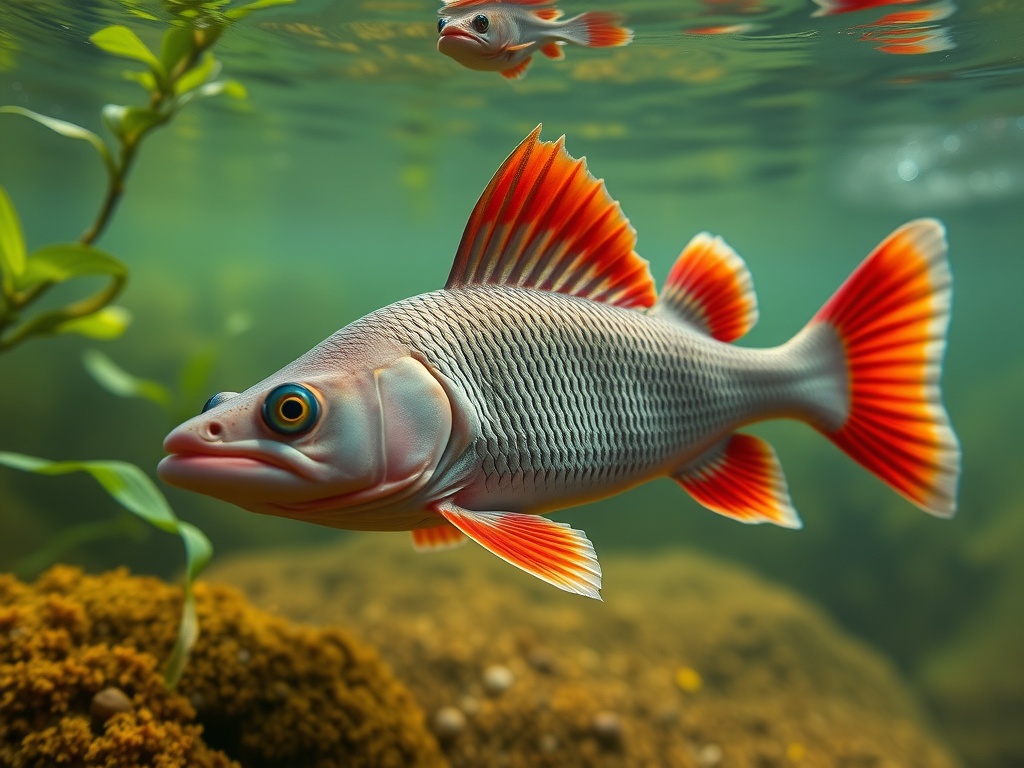
About the Redtail catfish
The Redtail catfish is a large freshwater fish native to the Amazon, Orinoco, and Essequibo river basins in South America. It is easily recognized by its striking reddish-orange tail and long whisker-like barbels. This catfish is a bottom-dweller, using its sensitive barbels to detect prey in murky waters. Renowned for its impressive size, the Redtail catfish is a popular but challenging species in the aquarium trade due to its rapid growth and predatory nature.
Fascinating facts
Giant Catfish
Redtail catfish can reach lengths of up to 1.8 meters (5.9 feet), making them one of the largest catfish species in South America.
River Dwellers
They inhabit deep, slow-moving parts of large rivers, often hiding among submerged roots and debris during the day.
Diverse Diet
Their diet consists of fish, crustaceans, and even fruits that fall into the water, showcasing opportunistic feeding habits.
Detailed description
The Redtail catfish (Phractocephalus hemioliopterus) is a robust, large-bodied freshwater fish, often reaching lengths of 1.3 meters (4.3 feet) and weights exceeding 50 kilograms (110 lbs) in the wild, though most individuals are somewhat smaller. Its most distinctive feature is the vivid reddish-orange coloration of its caudal fin, contrasting with a dark dorsum and pale ventral surface. The body is elongated and cylindrical, with a broad, flattened head and a wide mouth equipped with three pairs of prominent barbels—one maxillary and two mandibular—that serve as sensory organs for detecting prey in turbid waters. The skin is thick and scaleless, covered in a protective mucus layer. This species possesses a strong, bony skull and a well-developed lateral line system, enhancing its ability to sense vibrations and movement. Redtail catfish are primarily nocturnal, spending daylight hours resting in submerged structures or deep pools. They are solitary by nature, except during the breeding season, and are highly territorial, especially as adults. Their diet is diverse, consisting of fish, crustaceans, and occasionally fruits or seeds that fall into the water, reflecting their opportunistic feeding strategy. In their native range, they play a crucial ecological role as apex benthic predators, influencing the structure of aquatic communities.
Did you know?
Despite their popularity in home aquariums, Redtail catfish often outgrow most tanks, sometimes leading to their release into non-native waters where they can become invasive.
Research & sources
Wikipedia summary
The redtail catfish, is a large species of South American pimelodid (long-whiskered) catfish. It is known in Venezuelan Spanish as cajaro; in Guyana, it is known as a banana catfish, and in Brazil it is known as pirarara, a fusion of words from the indigenous Tupi language: pirá and arara. It is the only extant species of its genus, Phractocephalus.
Behaviour & social structure
Redtail catfish are predominantly nocturnal hunters, emerging from shelter at dusk to actively forage along riverbeds and flooded forests. They rely heavily on their sensitive barbels to detect chemical cues and movements of prey in low-visibility environments. Their feeding behavior is characterized by ambush predation, lying in wait or slowly stalking before rapidly engulfing prey with a powerful suction action. Juveniles may form loose aggregations for protection, but adults are solitary and establish defined territories, which they defend against conspecifics. During the day, they seek refuge under submerged logs, root tangles, or in deep river channels. While generally non-aggressive towards humans, they can display defensive behaviors if threatened. Seasonal flooding triggers increased activity and dispersal, as the fish exploit newly available habitats and food resources.
Reproduction & life cycle
Reproductive activity in Redtail catfish is closely linked to the annual flood pulse of the Amazon and Orinoco basins, typically occurring at the onset of the rainy season (November to March). Spawning is believed to take place in shallow, vegetated floodplain areas, where pairs engage in courtship behaviors involving tactile and chemical cues. Females are highly fecund, capable of producing tens of thousands of adhesive eggs per spawning event. After external fertilization, eggs are deposited on submerged vegetation or debris. There is no documented parental care; larvae are left to develop independently, relying on yolk reserves before transitioning to active feeding. Growth rates are rapid in the first year, which helps reduce predation risk. Sexual maturity is generally reached at 2–3 years of age, depending on environmental conditions.
Adaptations & survival
Redtail catfish exhibit several adaptations for survival in dynamic riverine environments. Their barbels are highly sensitive to touch and chemical stimuli, allowing them to locate prey in turbid or dark waters. The broad, muscular body and powerful tail provide strong swimming capabilities, enabling them to navigate strong currents and migrate during seasonal floods. Their ability to exploit a wide range of food sources, including carrion and terrestrial fruits, reflects dietary plasticity. The thick, mucus-covered skin offers protection against parasites and minor injuries. Physiologically, they can tolerate fluctuations in oxygen levels, a crucial adaptation for life in floodplain habitats where hypoxic conditions are common. Their large size and rapid juvenile growth serve as deterrents to most natural predators.
Cultural significance
The Redtail catfish holds significant cultural value in several South American countries. In Brazil, it is known as 'pirarara,' a name derived from the Tupi language, and features in indigenous folklore as a powerful river spirit. It is a prized catch among local and sport fishers for its size and strength. In some regions, its meat is consumed, though it is not a staple due to concerns about accumulation of toxins in large individuals. The species is also popular in the international aquarium trade, though its large adult size often leads to challenges in captivity and frequent releases into non-native waters. Symbolically, the Redtail catfish is associated with the vitality and abundance of the Amazonian waterways.
Recent research
Recent research on Phractocephalus hemioliopterus has focused on its ecological role as a top predator and its responses to environmental changes such as river damming and deforestation. Genetic studies have clarified its taxonomic position as the sole extant member of its genus and have explored population structure across its range. Studies on its feeding ecology have highlighted its importance in nutrient cycling, as it consumes both aquatic and terrestrial food sources. Ongoing research is investigating the impacts of invasive populations in Asia and the potential for disease transmission. Advances in telemetry and tagging are providing new insights into migration patterns and habitat use, informing conservation strategies.
Videos
Habitat
Large rivers, floodplains, and freshwater lakes in South America

Conservation
The Redtail catfish is currently classified as Least Concern on the IUCN Red List.
Threats & challenges
Currently assessed as Least Concern by the IUCN, Redtail catfish populations remain stable across much of their range. However, localized threats include overfishing for food and the aquarium trade, habitat degradation due to deforestation, dam construction, and water pollution. Invasive populations have been reported outside their native range, particularly in Southeast Asia, where released aquarium specimens threaten local ecosystems. Climate change poses a long-term risk by altering flood regimes and water quality. While not currently endangered, ongoing habitat modification and unsustainable harvest could impact future population trends, warranting continued monitoring.
Taxonomy
Scientific name
Phractocephalus hemioliopterus
- Kingdom
- Animalia
- Phylum
- Chordata
- Class
- Actinopterygii
- Order
- Siluriformes
- Family
- Pimelodidae
- Genus
- Phractocephalus
- Species
- hemioliopterus
Where to see a redtail catfish
3 zoos and aquariums in 2 countries are recorded as keeping this species.
 Blue Planet Aquarium🇬🇧 Ellesmere Port, United Kingdom
 National Zoological Park🇺🇸 Washington, United States
 Blank Park Zoo🇺🇸 United States
Community notes
Share your observations about the Redtail catfish.
No community notes yet. Be the first!
Discover more wildlife
More fascinating animals from the encyclopedia.