
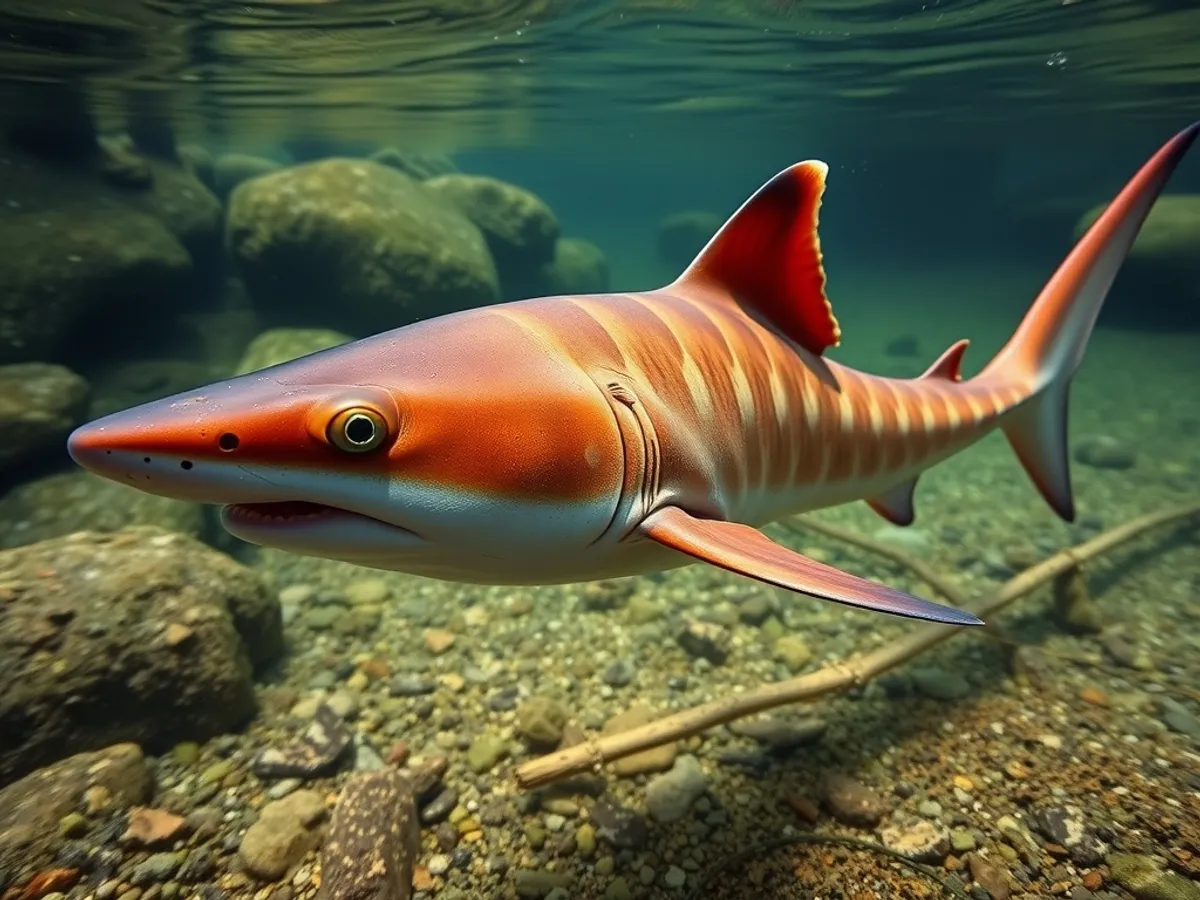
About the Redtail Shark
The Redtail Shark is a striking freshwater fish known for its sleek, jet-black body and vibrant, red tail fin. Despite its common name, it is not a true shark but rather a type of cyprinid, closely related to carp and minnows. Native to Thailand's river basins, this species is popular in the aquarium trade for its bold coloration and active behavior. In the wild, it is critically endangered due to habitat loss and overcollection, but it remains widely bred in captivity. Redtail Sharks are territorial and require ample space and hiding spots when kept in aquariums.
Fascinating facts
Not a True Shark
Despite their name, Redtail Sharks are not true sharks but belong to the cyprinid family, which includes carps and minnows.
Critically Endangered in the Wild
Wild Redtail Shark populations are listed as Critically Endangered due to habitat loss and overfishing in their native Thailand.
Color Signals Health
The intensity of the Redtail Shark's coloration indicates its health and stress levels, with brighter colors showing a healthy, stress-free fish.
Detailed description
The Redtail Shark (Epalzeorhynchos bicolor) is a medium-sized freshwater cyprinid, typically reaching 12–16 cm (4.7–6.3 in) in length. Its most distinctive features are a deep, velvety black body contrasted by a vivid, scarlet-red caudal fin, with the dorsal, pectoral, pelvic, and anal fins remaining black. The body is elongated and laterally compressed, with a slightly arched back and a pointed snout, giving it a streamlined, 'shark-like' appearance. The mouth is subterminal and equipped with two pairs of short barbels, aiding in substrate foraging. Eyes are relatively large, adapted for low-light riverine environments. Redtail Sharks are primarily benthic, spending much of their time near the substrate, where they actively patrol territories. They are known for their agility and rapid darting movements, which, along with their coloration, serve both as predator deterrence and intraspecific signaling. In the wild, they inhabit clear to turbid streams and rivers with moderate to fast flow, often sheltering among submerged roots, rocks, and dense vegetation. Their natural habitat experiences seasonal fluctuations in water level and chemistry, to which they are well adapted. Socially, they are solitary and highly territorial, especially as adults, displaying aggressive behaviors towards conspecifics and similar-shaped fish. Sexual dimorphism is subtle, with females generally having a fuller abdomen and slightly duller coloration when mature. Their lifespan in captivity can reach 5–8 years, though wild longevity is less well documented.
Did you know?
Wild populations of Redtail Sharks are almost extinct due to habitat destruction, but the species is common in aquariums thanks to captive breeding.
Research & sources
Wikipedia summary
The red-tailed black shark, also known as the redtail shark, red tailed shark, and redtail sharkminnow, is a species of tropical freshwater fish in the carp family, Cyprinidae. It is named after its shark-like appearance and movement, as well as its distinctive red tail. Despite its name, it is more closely related to carp. It is endemic to streams and rivers in Thailand and is currently critically endangered. However, it is common in aquaria, where it is prized for its deep black body, and vivid red orange tail. These are moderately sized tropical aquarium fish who are active benthic swimmers. They are omnivorous but are willing to scavenge if the opportunity arises. They are known for their activity as well as their temperament towards other fish. The red-tailed black sharks seen in the aquarium trade today are all captive bred.
Behaviour & social structure
Redtail Sharks are crepuscular, exhibiting peak activity during dawn and dusk. They are omnivorous foragers, feeding on a variety of algae, detritus, small crustaceans, insect larvae, and plant matter. In the wild, they graze along the substrate, using their barbels to detect edible items. In captivity, they readily accept commercial foods but benefit from a varied diet. Territoriality is a hallmark of their behavior; individuals establish and vigorously defend specific areas, often chasing away intruders with displays that include flaring fins and rapid charges. Aggression is most pronounced towards conspecifics and similar species, especially in confined spaces. They are generally solitary, but juveniles may tolerate each other until maturity. Daily routines include active patrolling, foraging, and periodic retreats to shelters. They are sensitive to environmental changes and may become reclusive or stressed if water quality deteriorates.
Reproduction & life cycle
Reproductive behavior in Epalzeorhynchos bicolor is poorly documented in the wild, as natural breeding has rarely been observed. In their native range, spawning is believed to coincide with the onset of the rainy season (May–October), when water levels rise and food becomes abundant. The species is an egg-scatterer, with females releasing adhesive eggs among dense vegetation or submerged roots. Males fertilize the eggs externally. There is no parental care; eggs and fry are left to develop independently. In captivity, successful breeding is extremely rare and typically requires hormonal induction, as natural courtship and spawning cues are difficult to replicate. Incubation lasts 24–48 hours at optimal temperatures (26–28°C), with fry becoming free-swimming within 3–4 days. Sexual maturity is reached at approximately 1–2 years of age.
Adaptations & survival
Redtail Sharks possess several adaptations for their riverine environment. Their streamlined, laterally compressed bodies and strong caudal fins enable swift swimming and maneuverability in fast-flowing waters. The subterminal mouth and sensitive barbels facilitate efficient foraging along the substrate, allowing them to exploit a variety of food resources. Their striking coloration may serve as a warning to potential competitors or as camouflage among dark substrates and red-leaved aquatic plants. Behavioral adaptations include pronounced territoriality, which reduces competition for resources. Physiologically, they tolerate a range of water conditions, including fluctuations in pH (6.5–7.5), temperature (22–28°C), and dissolved oxygen, reflecting the variable nature of their native habitats.
Cultural significance
The Redtail Shark holds no significant role in traditional Thai folklore or subsistence fisheries but has become iconic in the global aquarium trade since the mid-20th century. Its striking appearance and active behavior have made it a popular ornamental fish, symbolizing vigor and territoriality among aquarists. In some cultures, its 'shark-like' appearance is associated with strength or resilience, but these are modern interpretations. There are no known traditional medicinal or culinary uses.
Recent research
Recent research has focused on the species’ genetics, captive breeding, and conservation status. Genetic studies have clarified its phylogenetic placement within Cyprinidae, confirming its close relation to other Epalzeorhynchos species. Captive breeding protocols have been refined using hormonal induction, as natural spawning is rare in aquaria. Conservation research highlights the urgent need for habitat protection and potential reintroduction, but success is hampered by the lack of viable wild populations and suitable habitats. Ongoing studies are investigating the ecological requirements and stress physiology of captive populations to inform future conservation actions. Notably, the Redtail Shark serves as a model for understanding the impacts of habitat loss and the challenges of ex-situ conservation for riverine fishes.
Sources
Epalzeorhynchos bicolor (Redtail Shark): Taxonomy, Ecology, and Conservation
Vidthayanon, C. et al. (2011)
scientificIUCN Red List of Threatened Species: Epalzeorhynchos bicolor
International Union for Conservation of Nature (IUCN)
conservationVideos
Habitat
Freshwater rivers and streams

Conservation
The Redtail Shark is currently classified as Critically Endangered on the IUCN Red List.
Threats & challenges
The Redtail Shark is classified as Critically Endangered by the IUCN. Its wild populations have suffered catastrophic declines since the 1970s, primarily due to habitat destruction from dam construction, agricultural expansion, and urbanization in Thailand’s Chao Phraya and Mae Klong river basins. Overcollection for the aquarium trade historically contributed to declines, but all aquarium specimens are now captive-bred. Pollution, sedimentation, and altered hydrology further threaten remaining populations. Surveys indicate that the species may be extinct in the wild, with only sporadic, unconfirmed sightings in recent decades. Conservation challenges include the lack of protected habitats, limited knowledge of wild ecology and reproduction, and the absence of effective reintroduction programs. Population trends remain negative, with urgent need for habitat restoration and ex-situ conservation measures.
Taxonomy
Scientific name
Epalzeorhynchos bicolor
- Kingdom
- Animalia
- Phylum
- Chordata
- Class
- Actinopterygii
- Order
- Cypriniformes
- Family
- Cyprinidae
- Genus
- Epalzeorhynchos
- Species
- bicolor
Community notes
Share your observations about the Redtail Shark.
No community notes yet. Be the first!
Discover more wildlife
More fascinating animals from the encyclopedia.