
About the Ripsaw Catfish
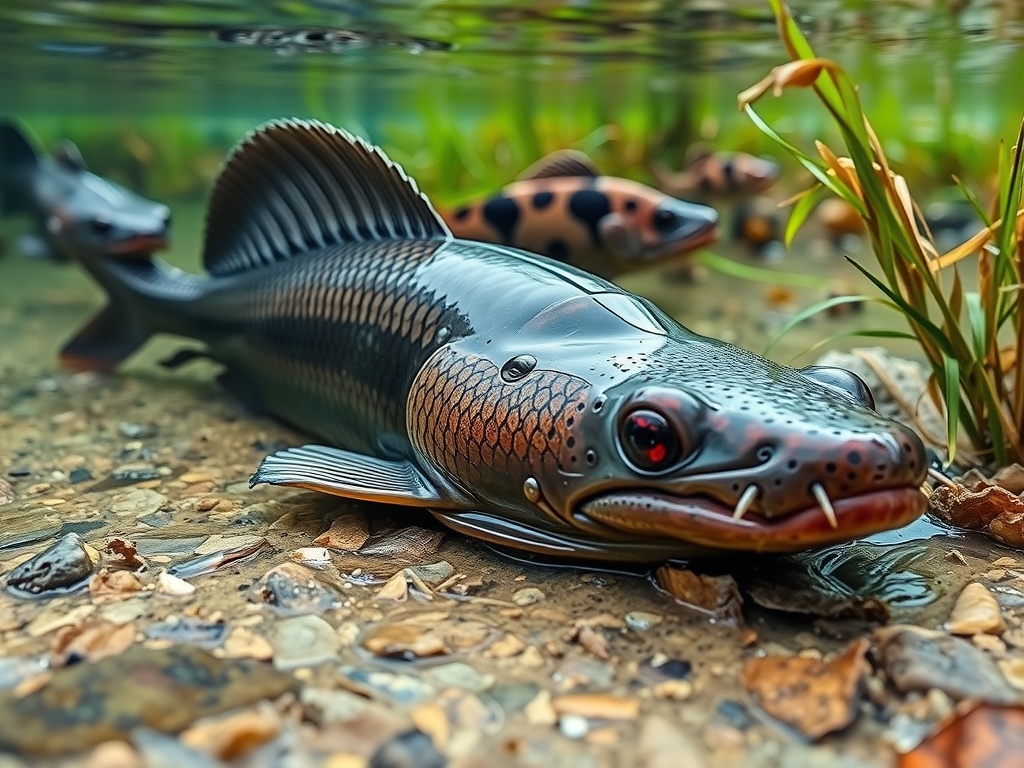
The Ripsaw Catfish is a large, armored freshwater fish native to South America, particularly the Amazon and Orinoco river basins. Recognized by the sharp, bony scutes lining its lateral sides—resembling a saw blade—it uses these for protection against predators. It is a benthic feeder, often foraging along riverbeds for plant matter and detritus. Despite its intimidating appearance and size, the Ripsaw Catfish is peaceful and plays a crucial role in its ecosystem by recycling organic material.
Fascinating facts
Armored Body
The Ripsaw Catfish is covered in rows of bony scutes, which provide protection from predators and give it a saw-like appearance.
Habitat Preference
It prefers slow-moving, turbid waters with muddy or sandy bottoms, where it can forage for food and avoid strong currents.
Sound Production
This catfish can create grunting noises by rubbing its pectoral fins, a form of communication or defense mechanism.
Detailed description
The Ripsaw Catfish (Oxydoras niger) is a robust, heavily armored freshwater fish that can reach lengths of up to 100 cm (39 inches) and weights exceeding 13 kg (29 lbs), making it one of the largest doradid catfish. Its most distinctive feature is the series of sharp, ossified lateral scutes (bony plates) along each side, which give the appearance of a saw blade and provide significant protection from predators. The body is elongated and laterally compressed, with a broad, flattened head and a ventrally positioned mouth adapted for bottom-feeding. The coloration is typically dark gray to black, often with a lighter underside, providing camouflage against the riverbed. The species possesses three pairs of barbels (whisker-like sensory organs) around the mouth, which are highly sensitive and aid in detecting food in murky waters. Oxydoras niger is primarily nocturnal, spending daylight hours resting in deeper channels and becoming active at night to forage. It is a slow-growing, long-lived species, with individuals in the wild estimated to live over 15 years. The Ripsaw Catfish is generally peaceful, often found in loose aggregations, and plays a key ecological role in detritus processing and nutrient cycling within its habitat.
Did you know?
The Ripsaw Catfish can produce audible grunting sounds underwater by grinding its pectoral fin bones against its shoulder girdle.
Research & sources
Behaviour & social structure
Oxydoras niger exhibits benthic (bottom-dwelling) behavior, spending most of its time foraging along muddy or sandy substrates. It uses its sensitive barbels to locate edible material, including detritus, plant matter, small invertebrates, and occasionally carrion. Feeding is primarily nocturnal, with individuals emerging from deeper waters at dusk to search for food in shallower floodplains or river margins. Socially, the Ripsaw Catfish is non-territorial and often forms loose groups, especially during the wet season when food is abundant. It is generally non-aggressive towards conspecifics and other species, relying on its armored scutes for defense rather than confrontation. During the dry season, it may migrate to deeper channels or congregate in remaining pools, displaying seasonal movement patterns linked to water levels.
Reproduction & life cycle
Reproductive behavior in Oxydoras niger is closely tied to the seasonal flooding cycles of the Amazon and Orinoco basins. Spawning typically occurs at the onset of the rainy season (November to March), when rising water levels provide access to floodplain habitats rich in food and shelter for developing young. The species is oviparous, with females releasing thousands of adhesive eggs among submerged vegetation or debris. Fertilization is external, and there is no evidence of parental care post-spawning; eggs and larvae are left to develop independently. Larval development is rapid, with juveniles seeking refuge in shallow, vegetated areas to avoid predation. Sexual maturity is reached at approximately 3-4 years of age, depending on environmental conditions.
Adaptations & survival
The Ripsaw Catfish possesses several adaptations for survival in dynamic riverine environments. Its bony scutes provide effective armor against predators such as large fish and caimans. The ventral mouth and elongated barbels are specialized for benthic foraging, allowing efficient detection and consumption of detritus and small organisms in turbid waters. The species is tolerant of low-oxygen conditions, utilizing a modified, highly vascularized gut for facultative air breathing during hypoxic events. Its dark coloration and nocturnal habits further reduce predation risk. Seasonal migrations enable the species to exploit changing habitats and food resources as water levels fluctuate.
Cultural significance
In local Amazonian and Orinoco cultures, the Ripsaw Catfish is occasionally consumed as food, though its tough armor and bony structure make it less desirable than other catfish species. Its striking appearance has made it popular in the international aquarium trade, particularly among enthusiasts of large, exotic fish. In some indigenous folklore, armored catfish are associated with river spirits or are believed to possess protective qualities due to their formidable defenses, though Oxydoras niger itself is not a major figure in regional mythology.
Recent research
Recent research on Oxydoras niger has focused on its ecological role in nutrient cycling and sediment bioturbation, with studies highlighting its importance in maintaining healthy floodplain ecosystems. Genetic studies have clarified its phylogenetic relationships within the Doradidae family, revealing significant genetic diversity across its range. Ongoing research is examining the impacts of habitat fragmentation and hydrological changes on its reproductive success and population connectivity. Additionally, there is growing interest in its physiological adaptations to hypoxia and the potential impacts of climate change on its distribution.
Videos
Habitat
Large slow-moving rivers and floodplains

Conservation
The Ripsaw Catfish is currently classified as Least Concern on the IUCN Red List.
Threats & challenges
Currently classified as Least Concern by the IUCN, Oxydoras niger faces localized threats from habitat degradation, overfishing (primarily for the ornamental fish trade and local consumption), and pollution from agricultural runoff and mining activities. Large-scale hydroelectric dam construction and river channelization in the Amazon and Orinoco basins pose significant long-term risks by altering natural flood regimes essential for reproduction. Despite these challenges, the species remains widespread and abundant in much of its range, though population trends should be monitored as human impacts intensify.
Taxonomy
Scientific name
Oxydoras niger
- Kingdom
- Animalia
- Phylum
- Chordata
- Class
- Actinopterygii
- Order
- Siluriformes
- Family
- Doradidae
- Genus
- Oxydoras
- Species
- niger
Where to see a ripsaw catfish
1 zoo and aquarium in 1 country are recorded as keeping this species.
Community notes
Share your observations about the Ripsaw Catfish.
No community notes yet. Be the first!
Discover more wildlife
More fascinating animals from the encyclopedia.