
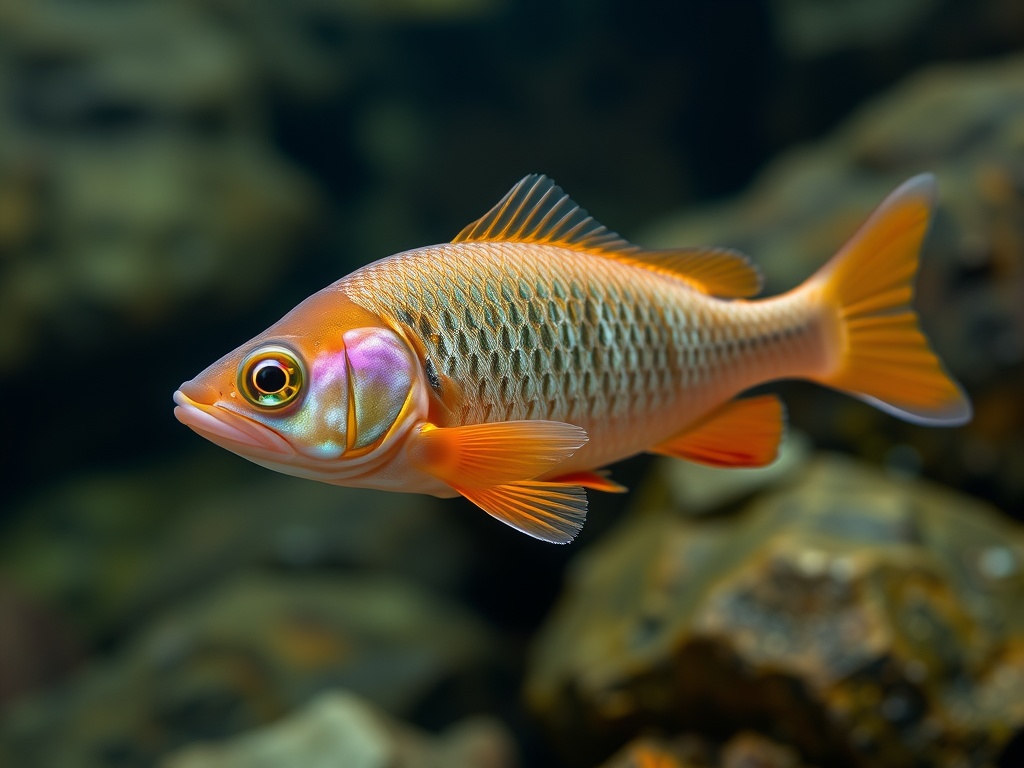
About the Rosy barb
The Rosy barb is a vibrant freshwater fish native to South Asia, particularly found in rivers and lakes of India, Bangladesh, and Nepal. It is well known for its striking pink to reddish coloration, with males becoming especially vivid during the breeding season. Rosy barbs are social, active swimmers that prefer to live in groups and are popular in the aquarium trade due to their hardy nature and adaptability. Their peaceful temperament and tolerance of a range of water conditions make them an excellent choice for beginner aquarists.
Fascinating facts
Colorful Breeders
Male Rosy barbs develop intense red and orange hues during the breeding season to attract mates.
Omnivorous Diet
Rosy barbs eat a varied diet in the wild, including insects, plant matter, algae, and small crustaceans.
Active Swimmers
These fish are highly active and thrive in aquariums with plenty of swimming space and moderate water flow.
Detailed description
The rosy barb (Pethia conchonius) is a robust, deep-bodied cyprinid fish, typically reaching 6–8 cm in standard length in the wild, though aquarium specimens may grow up to 10 cm. Its body is laterally compressed, with a slightly arched back and a forked caudal fin. The species is renowned for its vibrant coloration: males display a metallic pink to deep red hue, especially pronounced during the breeding season, while females are generally paler with a yellowish-silver sheen. Both sexes possess a distinctive black spot near the base of the caudal peduncle and faint, sometimes indistinct, vertical bars along the flanks. The dorsal fin is short and rounded, and all fins may take on a reddish tint. Rosy barbs are highly social, forming loose shoals in their natural habitats, which are typically slow-moving rivers, streams, and lakes with abundant aquatic vegetation. They are diurnal, actively foraging during daylight hours. Their omnivorous diet includes algae, detritus, small invertebrates, and plant matter. Rosy barbs are hardy and adaptable, tolerating a wide range of water temperatures (18–26°C) and pH (6.0–8.0), which contributes to their success both in the wild and in captivity. Their streamlined body and strong swimming ability allow them to thrive in both still and gently flowing waters.
Did you know?
During breeding, male Rosy barbs turn a deep red to impress females and establish dominance.
Research & sources
Wikipedia summary
The rosy barb is a subtropical freshwater cyprinid fish found in southern Asia from Afghanistan to Bangladesh.
Behaviour & social structure
Rosy barbs are active, shoaling fish that exhibit pronounced social behaviors. In the wild, they form groups of 5–20 individuals, which provides protection from predators and enhances foraging efficiency. Within the group, a loose hierarchy may develop, with dominant males displaying brighter colors and more assertive behaviors, especially during the breeding season. Feeding is opportunistic; they graze on algae and plant material, and will also hunt for small crustaceans, insect larvae, and zooplankton. In aquaria, they are known to be peaceful but may nip the fins of slower or long-finned tankmates if kept in insufficient numbers. Their daily routine involves active swimming and foraging during daylight, with periods of rest near the substrate or among vegetation at night. Courtship displays are elaborate, with males chasing and circling females, often in the presence of other group members.
Reproduction & life cycle
Rosy barbs are oviparous, engaging in group spawning during the onset of the rainy season in the wild, which typically corresponds to increased water levels and temperature. In captivity, breeding can be induced by simulating these conditions. Males intensify in color and perform courtship displays, chasing and nudging females. Spawning occurs among dense aquatic plants, where females scatter up to 200–300 adhesive eggs per session. There is no parental care; adults may consume eggs if not separated. Incubation lasts 24–36 hours at optimal temperatures (24–26°C), after which larvae hatch and become free-swimming within 3–5 days. Sexual maturity is reached at 6–8 months under favorable conditions.
Adaptations & survival
Rosy barbs possess several adaptations for survival in variable freshwater environments. Their laterally compressed body and strong fins enable agile swimming in both still and gently flowing waters. The species’ omnivorous dentition allows efficient processing of both plant and animal matter, supporting dietary flexibility. Their shoaling behavior reduces individual predation risk and increases foraging success. The bright breeding coloration of males serves as a sexual signal, while the more subdued coloration of females and juveniles provides camouflage. Their tolerance of a wide range of water parameters is an evolutionary advantage, allowing them to colonize diverse habitats and persist in disturbed or altered environments.
Cultural significance
The rosy barb holds considerable value in the ornamental fish trade, being one of the earliest cyprinids introduced to aquariums in Europe and North America in the late 19th century. Its hardiness and attractive coloration have made it a staple in community tanks worldwide. In parts of South Asia, the species is occasionally used in traditional medicine and is sometimes featured in local folklore as a symbol of vitality and beauty. However, it does not have major religious or mythological significance compared to some other regional fish species.
Recent research
Recent genetic studies have clarified the taxonomic placement of the rosy barb within the genus Pethia, distinguishing it from closely related species previously grouped under Puntius. Ongoing research focuses on its adaptability to urban and altered habitats, reproductive biology, and the ecological impact of introduced populations. Studies on its role as a bioindicator for water quality are also emerging, given its tolerance to a range of environmental conditions. Additionally, selective breeding in the aquarium trade has produced several color morphs, prompting investigations into the genetic basis of pigmentation and sexual dimorphism.
Videos
Habitat
Freshwater rivers, streams, and lakes

Conservation
The Rosy barb is currently classified as Least Concern on the IUCN Red List.
Threats & challenges
Currently classified as Least Concern by the IUCN, the rosy barb faces few major threats in its native range. However, localized challenges include habitat degradation from pollution, agricultural runoff, and water extraction. In some areas, over-collection for the aquarium trade has been noted, but this is not considered a significant threat due to the species’ high reproductive rate and widespread distribution. Introduced populations outside their native range, such as in Singapore and parts of the United States, may pose ecological risks by competing with native species. Climate change and ongoing habitat modification remain potential long-term challenges.
Taxonomy
Scientific name
Pethia conchonius
- Kingdom
- Animalia
- Phylum
- Chordata
- Class
- Actinopterygii
- Order
- Cypriniformes
- Family
- Cyprinidae
- Genus
- Pethia
- Species
- conchonius
Community notes
Share your observations about the Rosy barb.
No community notes yet. Be the first!
Discover more wildlife
More fascinating animals from the encyclopedia.