
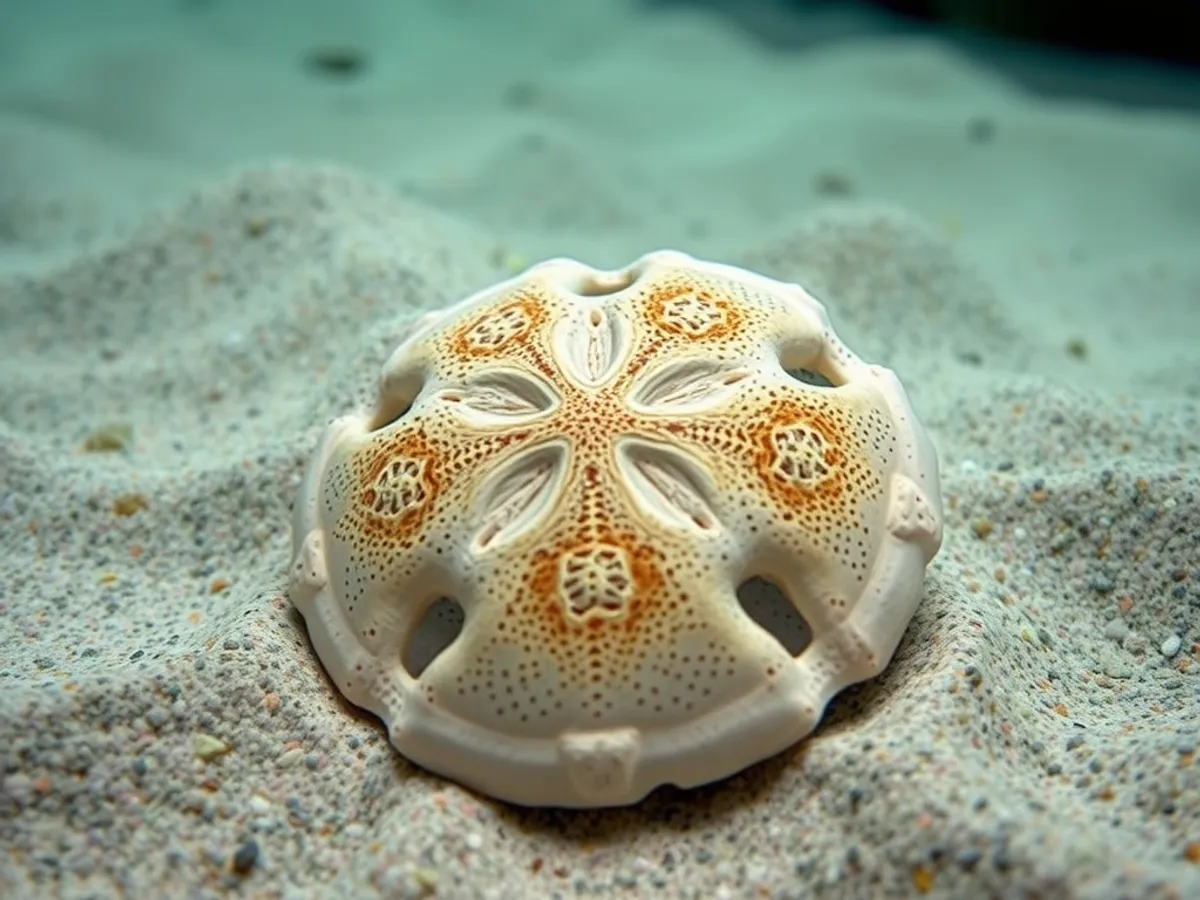
About the Sand Dollar
The sand dollar is a flattened, burrowing sea urchin found along sandy ocean floors, most commonly in shallow coastal waters. Its rigid, disc-shaped skeleton is covered with tiny spines that help it move and burrow beneath the sand. Sand dollars are well-known for the star-shaped pattern on their upper surface, which is actually a petal-like arrangement of pores used for respiration. They feed primarily on microscopic algae and organic particles filtered from the sand. These unique invertebrates play an important role in marine ecosystems by helping to recycle nutrients.
Fascinating facts
Burrowing Masters
Sand dollars use their tiny spines and cilia to burrow just below the sand's surface, protecting themselves from predators and strong currents.
Star Pattern
The distinctive star design on their upper surface is actually a grouping of petal-like pores used for gas exchange.
Echinoderm Relatives
Sand dollars are echinoderms, making them close relatives of sea urchins, sea cucumbers, and starfish.
Detailed description
Sand dollars, such as Dendraster excentricus, are distinctive echinoderms characterized by their flattened, discoidal bodies, typically measuring 7–10 cm in diameter, though some species can reach up to 15 cm. The rigid exoskeleton, or test, is composed of interlocking calcium carbonate plates, forming a petal-like pattern of pores (petaloids) on the dorsal surface, which facilitate gas exchange via tube feet. The body is covered with thousands of minute, velvety spines and cilia, which aid in locomotion, burrowing, and the transport of food particles to the mouth, located centrally on the ventral side. Sand dollars possess a specialized feeding structure called Aristotle’s lantern, adapted for scraping and ingesting detritus, microalgae, and diatoms from sand grains. They are typically found in dense aggregations in sandy or muddy substrates of intertidal to subtidal zones, from the low tide mark to depths of 90 meters. Their coloration ranges from grayish to purplish-brown in life, fading to white after death as the spines and soft tissues are lost. Sand dollars exhibit bilateral symmetry superimposed on their pentaradial echinoderm plan, an adaptation for their burrowing lifestyle. They play a crucial ecological role in sediment turnover and nutrient cycling. Their lifespan can reach up to 10 years in the wild, with growth rates influenced by food availability and environmental conditions.
Did you know?
A living sand dollar appears dark and fuzzy due to its tiny, moving spines, but it's only after death that its skeleton turns white and smooth.
Research & sources
Wikipedia summary
Sand dollars are species of flat, burrowing sea urchins belonging to the order Clypeasteroida. Some species within the order, not quite as flat, are known as sea biscuits. Sand dollars can also be called "sand cakes" or "cake urchins".
Behaviour & social structure
Sand dollars are primarily sedentary but exhibit limited movement by coordinated action of their spines and cilia, allowing them to burrow just beneath the sand surface for protection from predators and environmental stressors. They are suspension and deposit feeders, orienting themselves at a slight angle to the current to maximize the capture of organic particles and plankton. Juveniles often ingest heavier sand grains to increase their weight and prevent displacement by waves. Sand dollars can form dense beds, sometimes exceeding hundreds of individuals per square meter, which may facilitate reproductive success and reduce predation risk. They are most active during periods of strong water movement, such as tidal changes, and may adjust their position to optimize feeding. Social interactions are limited, but aggregation may provide hydrodynamic advantages and increased fertilization efficiency during spawning events.
Reproduction & life cycle
Dendraster excentricus reproduces via broadcast spawning, typically during late spring and summer when water temperatures rise. Males and females release sperm and eggs simultaneously into the water column, where external fertilization occurs. Spawning is often synchronized within populations, possibly triggered by environmental cues such as temperature, photoperiod, and lunar cycles. The resulting planktonic larvae, called echinopluteus, undergo several weeks of development, feeding on phytoplankton before settling to the substrate and metamorphosing into juvenile sand dollars. There is no parental care; survival rates are low due to predation and environmental hazards. Sexual maturity is generally reached at 2–3 years of age, depending on food availability and local conditions.
Adaptations & survival
Sand dollars exhibit several specialized adaptations for life in dynamic sandy environments. Their flattened, low-profile body reduces drag and helps prevent dislodgement by waves and currents. The dense covering of spines and cilia not only facilitates movement and feeding but also assists in rapid burrowing to escape predators such as fish, sea stars, and crabs. The petaloid pores enhance gas exchange in low-oxygen sediments. Juvenile sand dollars ingest sand grains to increase their mass, stabilizing their position in turbulent waters. Their ability to aggregate in large numbers may improve reproductive success and provide collective defense against predators. The bilateral symmetry and anterior-posterior axis are evolutionary modifications for directional movement and efficient burrowing.
Cultural significance
Sand dollars hold symbolic value in various cultures, often associated with peace, transformation, and spiritual themes. Their distinctive skeletons, with a central star pattern, are commonly collected as souvenirs and used in jewelry and decorative arts. In folklore, sand dollars are sometimes linked to Christian symbolism, representing the story of Christ or the Star of Bethlehem. They have been used in educational settings to illustrate echinoderm anatomy and marine ecology. However, there is no significant history of traditional medicinal or dietary use.
Recent research
Recent research has focused on the effects of ocean acidification on sand dollar calcification and larval development, revealing increased vulnerability in lower pH conditions. Studies on population genetics have shown significant gene flow among populations along the Pacific coast, suggesting high dispersal potential of larvae. Investigations into their sediment bioturbation role highlight their importance in nutrient cycling and benthic community structure. Ongoing research is examining the impact of microplastics and pollutants on sand dollar health and reproductive success. Advances in imaging and molecular techniques are providing new insights into their developmental biology and evolutionary relationships within Echinodermata.
Videos
Habitat
Sandy ocean floors, shallow coastal waters

Conservation
The Sand Dollar is currently classified as Least Concern on the IUCN Red List.
Threats & challenges
While sand dollars are currently listed as Least Concern, they face several localized threats. Coastal development, pollution, sedimentation, and habitat disturbance from dredging and trawling can degrade their sandy habitats. Ocean acidification poses a long-term risk by weakening their calcium carbonate tests, making them more vulnerable to predation and environmental stress. Overcollection for the curio trade and educational purposes can impact local populations. Climate change may alter reproductive timing and larval dispersal patterns. Despite these challenges, sand dollar populations remain stable in most regions, but ongoing monitoring is recommended to detect emerging threats.
Taxonomy
Scientific name
Dendraster excentricus
- Kingdom
- Animalia
- Phylum
- Echinodermata
- Class
- Echinoidea
- Order
- Clypeasteroida
- Family
- Dendrasteridae
- Genus
- Dendraster
- Species
- excentricus
Community notes
Share your observations about the Sand Dollar.
No community notes yet. Be the first!
Discover more wildlife
More fascinating animals from the encyclopedia.