
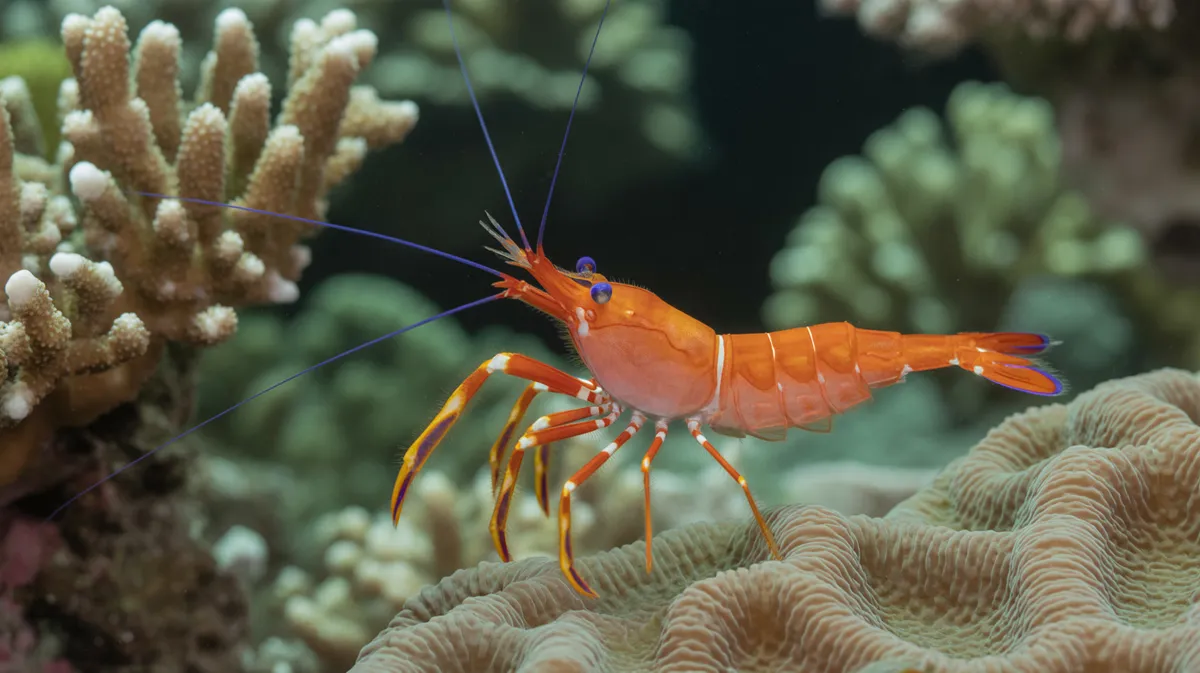
About the Scarlet cleaner shrimp
The scarlet cleaner shrimp, also known as the Pacific cleaner shrimp or skunk cleaner shrimp, is a vibrantly colored marine invertebrate recognized by its bright red and white striped body and long white antennae. This shrimp is famous for its symbiotic behavior, setting up 'cleaning stations' on coral reefs where it removes parasites and dead tissue from fish clients. It is widely admired in the aquarium trade for both its striking appearance and its helpful cleaning habits. Found in tropical Indo-Pacific waters, the scarlet cleaner shrimp plays a vital role in maintaining the health of reef fish populations.
Fascinating facts
Expert Cleaners
Scarlet cleaner shrimp operate cleaning stations, where fish line up to have parasites and dead skin removed from their bodies.
Brightly Colored
The shrimp's vibrant red and white stripes serve as a visual signal to attract fish seeking cleaning services.
Hermaphroditic Nature
Each individual is a simultaneous hermaphrodite, possessing both male and female reproductive organs, allowing for flexible breeding.
Detailed description
Lysmata amboinensis, commonly called the scarlet cleaner shrimp or skunk cleaner shrimp, is a small, decapod crustacean reaching up to 6 cm in length. Its body is semi-translucent white with vivid longitudinal red stripes running from the rostrum to the tail, and a prominent white dorsal stripe. The long, white antennae are highly conspicuous and serve both sensory and communicative functions. The species possesses a laterally compressed body, with chelae (claws) on the first two pairs of walking legs, used for grooming and feeding. The exoskeleton is periodically shed through molting, a process essential for growth. Lysmata amboinensis is renowned for its cleaning symbiosis with reef fishes, establishing cleaning stations where it removes ectoparasites, dead tissue, and mucus from client fish. It is typically found in pairs or small groups, often sheltering in crevices or under ledges during the day. The shrimp is protandric hermaphroditic, meaning individuals first mature as males and later develop female reproductive capability, allowing for flexible breeding pairs. Its striking coloration and behavior make it a popular species in marine aquaria, but it plays a crucial ecological role in maintaining reef fish health in the wild.
Did you know?
Despite their tiny size, scarlet cleaner shrimp are essential to reef ecosystems because their cleaning services significantly reduce fish parasites and stress.
Research & sources
Wikipedia summary
Scarlet cleaner shrimp may refer to:Lysmata amboinensis, also known as the skunk cleaner shrimp Lysmata debelius, also known as the blood shrimp
Behaviour & social structure
Scarlet cleaner shrimp are diurnal and exhibit complex social and cleaning behaviors. They establish cleaning stations in prominent reef locations, where they use their long antennae to signal availability to passing fish. Upon approach, the shrimp performs a characteristic rocking or swaying dance to attract clients. Cleaning involves meticulously picking parasites, necrotic tissue, and debris from the skin, gills, and even the mouths of fish, including predatory species. Aggression is minimal, though mild territorial disputes may occur between individuals over cleaning stations. Feeding is omnivorous: in addition to cleaning, they scavenge detritus, algae, and small invertebrates. They are highly responsive to chemical and tactile cues from fish, and their cleaning services can reduce parasite loads and stress in client species. Socially, they may form monogamous pairs or small cooperative groups, especially in areas with abundant fish traffic.
Reproduction & life cycle
Lysmata amboinensis displays protandric simultaneous hermaphroditism: individuals first mature as functional males and later develop female reproductive organs, allowing them to function as both sexes simultaneously. Mating typically occurs at night, shortly after the female molts and her exoskeleton is still soft. The shrimp engage in courtship behaviors, and fertilization is external. Females carry fertilized eggs (up to several hundred) attached to their pleopods (swimming legs) beneath the abdomen for about 10–14 days. After hatching, larvae are planktonic and undergo several zoeal stages over 4–6 weeks before settling to the benthos and metamorphosing into juveniles. There is no parental care beyond egg brooding. Breeding occurs year-round in tropical environments, with increased frequency in stable, warm conditions.
Adaptations & survival
Key adaptations include the development of long, sensitive antennae for detecting chemical and tactile cues from fish, and bright coloration that advertises their cleaning services while reducing predation risk through mutualistic relationships. Their chelae are adapted for precise manipulation and removal of small parasites. The ability to molt frequently allows for rapid tissue repair and growth. Protandric hermaphroditism maximizes reproductive opportunities in low-density populations. Their behavioral repertoire—such as the cleaning dance—facilitates communication with diverse fish species. Additionally, their semi-translucent body aids in camouflage when not actively cleaning.
Cultural significance
The scarlet cleaner shrimp holds considerable value in the marine aquarium trade due to its striking appearance and beneficial cleaning behavior. In popular culture, it is often featured in documentaries and educational materials highlighting symbiotic relationships on coral reefs. While there are no significant traditional uses or mythological associations documented, its role as a model organism in studies of symbiosis, communication, and hermaphroditism has made it important in scientific and educational contexts.
Recent research
Recent research has focused on the molecular basis of cleaning behavior, the ecological impact of cleaner shrimp on reef fish health, and the evolution of hermaphroditism in Lysmata species. Studies have shown that cleaner shrimp can reduce parasite loads and stress in client fish, contributing to overall reef resilience. Genetic analyses have clarified species boundaries within the Lysmata genus, and advances in captive breeding have improved aquaculture techniques. Ongoing research investigates the chemical cues involved in shrimp-fish communication and the effects of environmental stressors on cleaning symbioses.
Videos
Habitat
Coral reefs

Conservation
The Scarlet cleaner shrimp is currently classified as Least Concern on the IUCN Red List.
Threats & challenges
Currently classified as Least Concern by the IUCN, Lysmata amboinensis faces localized threats from over-collection for the aquarium trade, habitat degradation, and coral reef decline due to climate change, pollution, and ocean acidification. Unsustainable harvesting can deplete wild populations, especially in areas with high demand. Habitat loss from coral bleaching and destructive fishing practices also poses risks. However, the species' wide distribution and adaptability provide some resilience. Captive breeding programs have been developed to reduce pressure on wild stocks.
Taxonomy
Scientific name
Lysmata amboinensis
- Kingdom
- Animalia
- Phylum
- Arthropoda
- Class
- Malacostraca
- Order
- Decapoda
- Family
- Hippolytidae
- Genus
- Lysmata
- Species
- amboinensis
Community notes
Share your observations about the Scarlet cleaner shrimp.
No community notes yet. Be the first!
Discover more wildlife
More fascinating animals from the encyclopedia.