
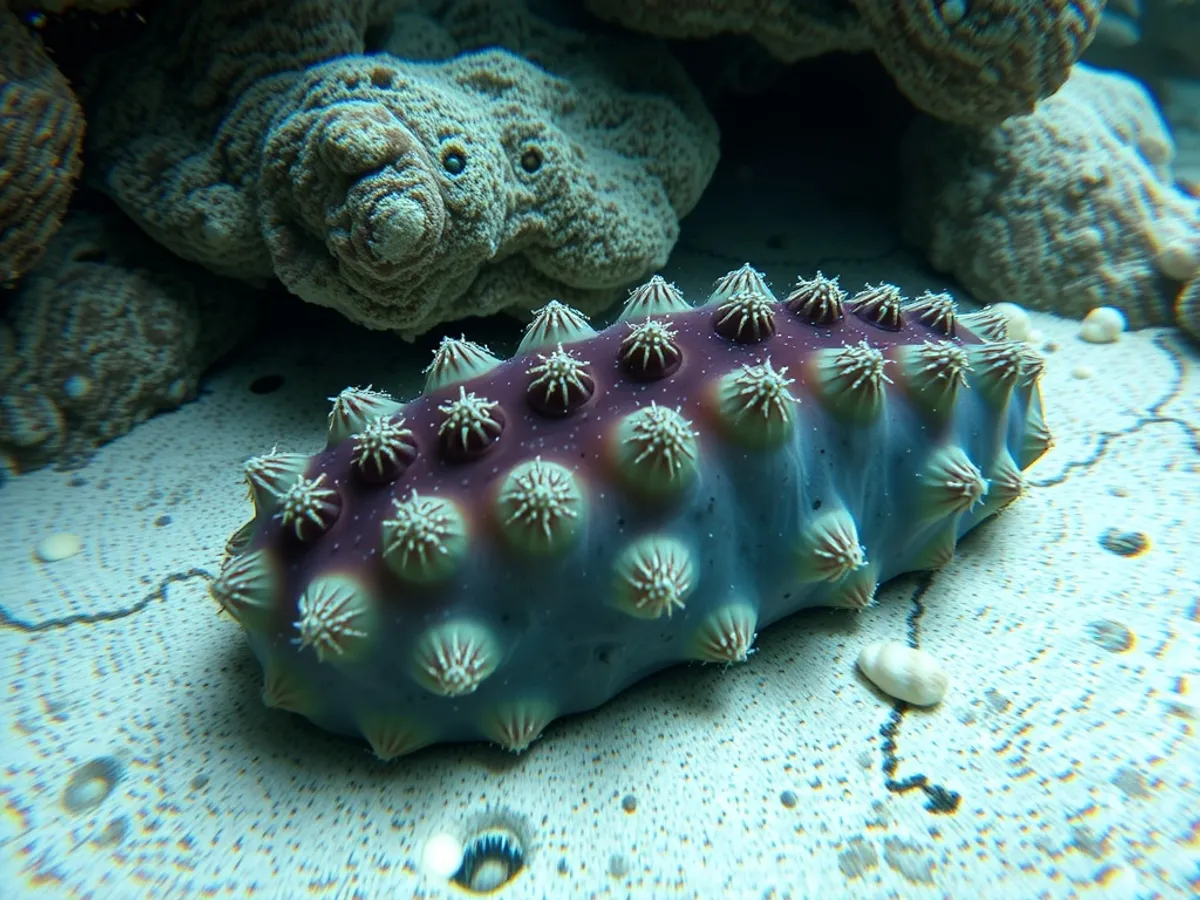
About the Sea Cucumber
Sea cucumbers (class Holothuroidea) are echinoderms, related to sea stars and urchins, and they run on hydraulics rather than muscle in the way vertebrates do. Their body wall is made of mutable collagenous tissue, a material they can chemically stiffen or liquefy on command, letting a rigid animal pour itself through a crack in a reef and then set solid again on the far side. Most species breathe through a pair of branched respiratory trees inside the body cavity, ventilated by pumping seawater in and out through the anus, and this hospitable interior is exploited by pearlfish, which live inside the cucumber and slip in tail-first. When attacked, some tropical Holothuria eject sticky white Cuvierian tubules from the anus, which swell in seawater and entangle a crab or fish; other species eviscerate outright, expelling gut and respiratory trees and regenerating a full set of organs over the following weeks. Deposit feeders sweep sediment into the mouth with a ring of tentacles, digest the organic film, and pass clean sand out, and on some reefs they turn over hundreds of kilograms of sediment per hectare per year while raising the pH of the water they excrete, which may help corals calcify. Demand for dried beche-de-mer has stripped high-value species from reef after reef across the Indo-Pacific.
Fascinating facts
Nature’s Vacuum Cleaner
Sea cucumbers help maintain healthy ocean floors by consuming decaying organic matter and recycling nutrients back into the ecosystem.
Unusual Defense
When threatened, sea cucumbers can expel internal organs or sticky threads to confuse or trap predators, later regenerating the lost parts.
Underwater Roommates
Some small fish and shrimp species live inside sea cucumbers, entering through the anus for shelter and protection.
Detailed description
Holothuria edulis, commonly known as the edible sea cucumber or pink sea cucumber, is a medium-sized echinoderm typically reaching lengths of 20–30 cm, though some individuals may grow up to 40 cm. Its body is elongated and cylindrical, with a leathery, flexible skin that ranges in coloration from dark brown to purplish-black dorsally and a contrasting pink or reddish ventral surface. The body wall contains microscopic calcareous ossicles, providing both structure and some protection. Around the mouth, located at one end of the body, are 20 branched, retractile tentacles used for feeding. Holothuria edulis is a slow-moving, benthic detritivore, spending most of its life on sandy or muddy substrates in shallow tropical and subtropical Indo-Pacific waters, typically at depths of 0–20 meters. It plays a crucial ecological role by ingesting sediment and organic debris, digesting the organic matter, and excreting cleaner, oxygenated sand, thus contributing to nutrient cycling and sediment health. This species is primarily nocturnal, often hiding under rocks or within seagrass beds during the day and emerging at night to feed. Its unique defense mechanisms include the ability to expel sticky Cuvierian tubules or even parts of its internal organs to deter predators, which it can later regenerate. The respiratory system consists of a pair of 'respiratory trees' connected to the cloaca, allowing gas exchange via water pumped through the anus. Holothuria edulis is solitary but may aggregate in areas of high food availability, and it exhibits remarkable regenerative abilities, not only of lost organs but also of damaged body wall tissue.
Did you know?
Sea cucumbers have a unique symbiotic relationship with certain fish and shrimp that live inside their cloaca for protection.
Research & sources
Wikipedia summary
Sea cucumbers are echinoderms from the class Holothuroidea. They are benthic marine animals found on the sea floor worldwide, and the number of known holothuroid species worldwide is about 1,786, with the greatest number being in the Asia–Pacific region. Sea cucumbers serve a useful role in the marine ecosystem as detritivores who help recycle nutrients, breaking down detritus and other organic matter, after which microbes can continue the decomposition process.
Behaviour & social structure
Holothuria edulis exhibits primarily solitary behavior, although loose aggregations can occur where food is abundant. It is a detritivore, feeding by extending its branched oral tentacles to collect organic-rich sediments and detritus from the substrate, which are then brought to the mouth for ingestion. Feeding typically occurs at night, reducing predation risk and competition. During the day, individuals often remain partially buried or concealed under rocks and seagrass. Locomotion is achieved through coordinated movement of tube feet located on the ventral surface, aided by subtle muscular contractions of the body wall. When threatened, H. edulis may expel Cuvierian tubules—sticky, toxic threads that entangle and deter predators such as fish and crustaceans. Social interactions are minimal outside of spawning events, and there is no evidence of territoriality or complex social structure.
Reproduction & life cycle
Holothuria edulis reproduces primarily through external sexual reproduction, with separate male and female individuals releasing gametes into the water column during synchronized spawning events, often triggered by environmental cues such as temperature, lunar cycles, or phytoplankton blooms. Spawning typically occurs during the warmer months, with peak activity varying by region. Fertilization is external, and the resulting planktonic larvae (auricularia stage) undergo several developmental stages before settling to the substrate and metamorphosing into juvenile sea cucumbers. Some populations have been observed to reproduce asexually by transverse fission, where the animal splits and regenerates missing parts, although this is less common. There is no parental care, as eggs and larvae are left to develop independently in the plankton.
Adaptations & survival
Holothuria edulis possesses several key adaptations for benthic life. Its tough, flexible skin and embedded ossicles provide protection and support. The branched oral tentacles are highly sensitive and efficient at collecting fine organic particles from sediments. The ability to expel Cuvierian tubules or eviscerate internal organs serves as a potent defense against predation, with rapid regeneration minimizing long-term harm. Its respiratory trees, unique among echinoderms, allow efficient gas exchange in low-oxygen environments. The animal's capacity for both sexual and occasional asexual reproduction enhances population resilience. Biochemical adaptations include the production of saponins (holothurins), which are toxic compounds that deter many potential predators.
Cultural significance
Holothuria edulis has significant economic and cultural value in many Indo-Pacific countries, where it is harvested for food and traditional medicine. Processed sea cucumbers, known as bêche-de-mer or trepang, are considered a delicacy and are believed to have medicinal properties in traditional Chinese medicine, including benefits for joint health and immune function. The species also features in local folklore and is sometimes used in rituals or as a symbol of marine abundance. Sustainable management practices are increasingly being promoted to balance cultural and economic uses with conservation.
Recent research
Recent research on Holothuria edulis has focused on its ecological role in sediment bioturbation and nutrient cycling, with studies demonstrating its importance in maintaining healthy benthic ecosystems. Molecular studies have explored population genetics and connectivity across its range, informing management and conservation strategies. Advances in aquaculture techniques are enabling more sustainable production for the seafood market, reducing pressure on wild populations. Biomedical research has investigated the bioactive compounds (e.g., saponins) produced by H. edulis for potential pharmaceutical applications, including anti-inflammatory and anticancer properties. Ongoing studies are examining the species' responses to environmental stressors such as ocean acidification and warming, with implications for future resilience.
Videos
Habitat
Ocean

Conservation
The Sea Cucumber is currently classified as Least Concern on the IUCN Red List.
Threats & challenges
While Holothuria edulis is currently listed as Least Concern by the IUCN, it faces localized threats from overharvesting for the bêche-de-mer trade, habitat degradation (especially of seagrass beds and coral reefs), and pollution. Unsustainable fishing practices and illegal collection can lead to population declines, particularly in areas where the species is heavily exploited. Climate change poses additional risks through ocean warming, acidification, and increased frequency of extreme weather events, which can impact reproductive cycles and larval survival. Habitat loss due to coastal development and destructive fishing methods (e.g., trawling) further threaten populations. Despite these challenges, the species' wide distribution and high reproductive potential have so far prevented global declines.
Taxonomy
Scientific name
Holothuria edulis
- Kingdom
- Animalia
- Phylum
- Echinodermata
- Class
- Holothuroidea
- Order
- Holothuriida
- Family
- Holothuriidae
- Genus
- Holothuria
- Species
- edulis
Community notes
Share your observations about the Sea Cucumber.
No community notes yet. Be the first!
Discover more wildlife
More fascinating animals from the encyclopedia.