
About the Southern Right Whale
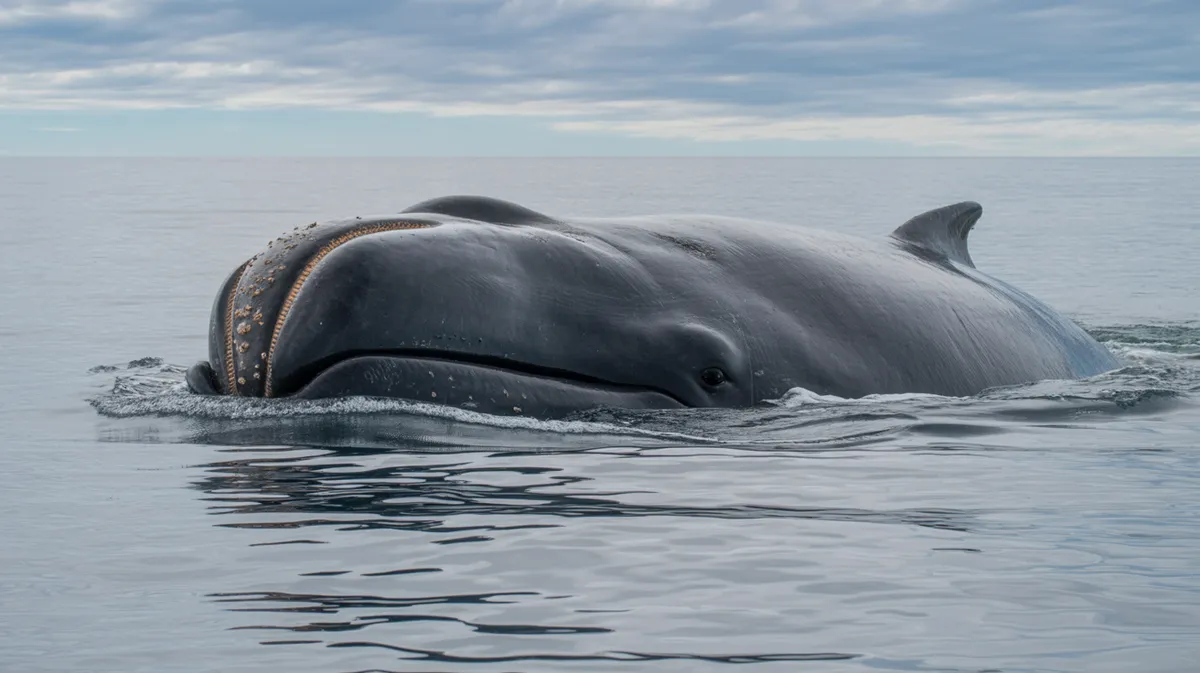
The southern right whale (Eubalaena australis) is named for the whaling judgement that it was the "right" whale to kill: it is slow, coastal, floats when dead because of its thick blubber, and yields enormous quantities of oil and baleen. It has no dorsal fin, a broad V-shaped blow, and a head covered with callosities, roughened patches of thickened skin that appear white because they are colonised by pale whale lice, cyamid crustaceans. The pattern of callosities is unique to each animal and stable for life, so it functions as a fingerprint, and the long-term Peninsula Valdes and South African catalogues rest on it. Right whales are skim feeders, cruising slowly with the mouth open and straining copepods and krill continuously through baleen plates up to 2.5 metres long, rather than lunging like rorquals. They are playful sailors, holding their broad flukes up out of the water for long periods to catch the wind and be pushed along. Unlike the North Atlantic right whale, which is down to a few hundred animals and sliding toward extinction, the southern species has rebuilt to well over 10,000, though not evenly. At Peninsula Valdes in Argentina, kelp gulls have learned to peck flesh and blubber from the backs of surfacing mothers and calves, causing lesions and calf deaths on a scale that has become a genuine conservation problem.
Fascinating facts
Lack of Dorsal Fin
Southern Right Whales are unique among large whales because they lack a dorsal fin, giving their backs a smooth, broad appearance when surfacing.
Callosity Patterns
The rough, white patches on their heads, called callosities, are as unique as fingerprints and help researchers identify individual whales.
High Breaching Behavior
These whales are famous for their spectacular breaching, often leaping out of the water and creating enormous splashes.
Detailed description
The Southern Right Whale (Eubalaena australis) is a robust baleen whale, typically measuring 13–18 meters in length and weighing up to 80,000 kilograms, with females generally larger than males. Its body is stocky and mostly black, occasionally with white patches on the belly or chin. The head is massive, comprising up to one-third of the body length, and is characterized by rough, white callosities—unique to each individual—used for identification. Unlike many other whales, it lacks a dorsal fin and has broad, paddle-shaped pectoral flippers. The mouth is strongly arched, housing up to 270 pairs of long, fine baleen plates (up to 2.8 meters) used for filter feeding. Southern Right Whales are slow, graceful swimmers, often seen breaching, lobtailing, and engaging in social behaviors near the surface. They are known for their acrobatic displays, including tail slapping and spyhopping. These whales are migratory, spending summers in high-latitude feeding grounds and winters in coastal, warmer waters for breeding and calving. Their thick blubber layer provides insulation in cold waters and serves as an energy reserve. The species is highly vocal, producing a variety of low-frequency sounds for communication and navigation. Their lifespan is estimated at 70–100 years, with some individuals possibly exceeding a century.
Did you know?
Southern Right Whales have one of the largest testes of any animal on Earth, weighing up to 500 kg each!
Research & sources
Wikipedia summary
The southern right whale is a baleen whale, one of three species classified as right whales belonging to the genus Eubalaena. Southern right whales inhabit oceans south of the Equator, between the latitudes of 20° and 60° south. In 2009 the global population was estimated to be approximately 13,600.
Behaviour & social structure
Southern Right Whales are generally social, often observed in small groups of two to three individuals, though larger aggregations can form in breeding areas. They exhibit a range of surface behaviors, such as breaching (leaping from the water), flipper and tail slapping, and rolling, which are believed to play roles in communication, play, and parasite removal. Feeding primarily occurs in high-latitude regions, where they employ skim feeding: swimming slowly with their mouths open near the surface to filter copepods, krill, and other zooplankton through their baleen plates. Unlike rorquals, they do not lunge feed. Social interactions are especially prominent during the breeding season, with males competing for access to females through non-aggressive displays. Calves are often seen swimming close to their mothers, riding in the slipstream (echelon position) for protection and energy conservation. Daily routines involve alternating periods of feeding, resting, and socializing, with extended surface intervals during calving and nursing.
Reproduction & life cycle
Southern Right Whales have a biennial or triennial reproductive cycle. Mating occurs primarily in winter and early spring (June–October) in sheltered coastal waters. Courtship involves multiple males surrounding a single female, engaging in competitive but non-violent displays. Females give birth to a single calf after a gestation period of approximately 12–13 months. Calves are born at around 4.5–6 meters in length and weigh up to 1,500 kilograms. Mothers are highly attentive, nursing their young for 6–12 months, with calves gaining up to 90 kilograms per day from the rich milk. Calving intervals are typically 3 years, as females require time to replenish energy reserves. Sexual maturity is reached at 7–10 years. There is no evidence of long-term pair bonds; mating is promiscuous, and males have evolved large testes (up to 1,000 kg) to maximize sperm competition.
Adaptations & survival
Southern Right Whales possess several adaptations for survival in cold, open ocean environments. Their thick blubber layer, up to 40 cm, provides insulation and energy storage. The arched mouth and long baleen plates are specialized for efficient skim feeding on small zooplankton. The lack of a dorsal fin reduces drag and allows maneuverability in shallow coastal waters. Callosities on the head, colonized by cyamids (whale lice), may offer protection against predators and serve as a unique identification feature. Their large, flexible flippers aid in slow, controlled swimming and turning. Behavioral adaptations include seasonal migration between feeding and breeding grounds, and the use of low-frequency vocalizations that travel long distances underwater for communication and navigation. Calves ride in the mother's slipstream to conserve energy and avoid predators.
Cultural significance
Southern Right Whales have played a prominent role in the maritime history and culture of southern hemisphere nations. Historically, they were targeted by shore-based whalers for their oil and baleen, leading to dramatic population declines. Today, they are celebrated as icons of marine conservation and ecotourism, especially in South Africa, Argentina, Australia, and New Zealand, where whale-watching contributes significantly to local economies. In indigenous cultures, whales often symbolize abundance, strength, and spiritual connection to the sea. The distinctive callosities and surface behaviors of Southern Right Whales have inspired local folklore and art. Their recovery is seen as a symbol of successful international conservation efforts.
Recent research
Recent research has focused on population genetics, revealing strong site fidelity and limited gene flow between regional populations, which has implications for management. Long-term photo-identification studies using callosity patterns have provided valuable data on individual lifespans, calving intervals, and migration routes. Satellite tagging and acoustic monitoring have improved understanding of migration, habitat use, and the impact of noise pollution. Studies on health have documented the effects of entanglement, ship strikes, and skin lesions linked to environmental stressors. Ongoing research is investigating the impacts of climate change on prey availability and reproductive success. The Southern Right Whale is also a model species for studying baleen whale communication and social structure.
Videos
Habitat
Temperate and sub-Antarctic ocean waters
Conservation
The Southern Right Whale is currently classified as Least Concern on the IUCN Red List.
Threats & challenges
Although the Southern Right Whale population is recovering from the brink of extinction due to 19th and early 20th-century whaling, several threats persist. Entanglement in fishing gear, particularly in gillnets and lobster pot lines, remains a significant cause of injury and mortality. Ship strikes are an increasing concern, especially in busy coastal regions. Climate change poses long-term risks by altering prey availability and distribution, potentially impacting reproductive success. Noise pollution from shipping and industrial activities may interfere with communication and navigation. Habitat degradation and pollution, including oil spills and plastic debris, also threaten their health. While the global population is estimated at over 13,600 and increasing at 7% per year in some regions, certain subpopulations (e.g., off Chile-Peru) remain critically endangered.
Taxonomy
Scientific name
Eubalaena australis
- Kingdom
- Animalia
- Phylum
- Chordata
- Class
- Mammalia
- Order
- Cetacea
- Family
- Balaenidae
- Genus
- Eubalaena
- Species
- australis
Community notes
Share your observations about the Southern Right Whale.
No community notes yet. Be the first!
Discover more wildlife
More fascinating animals from the encyclopedia.