
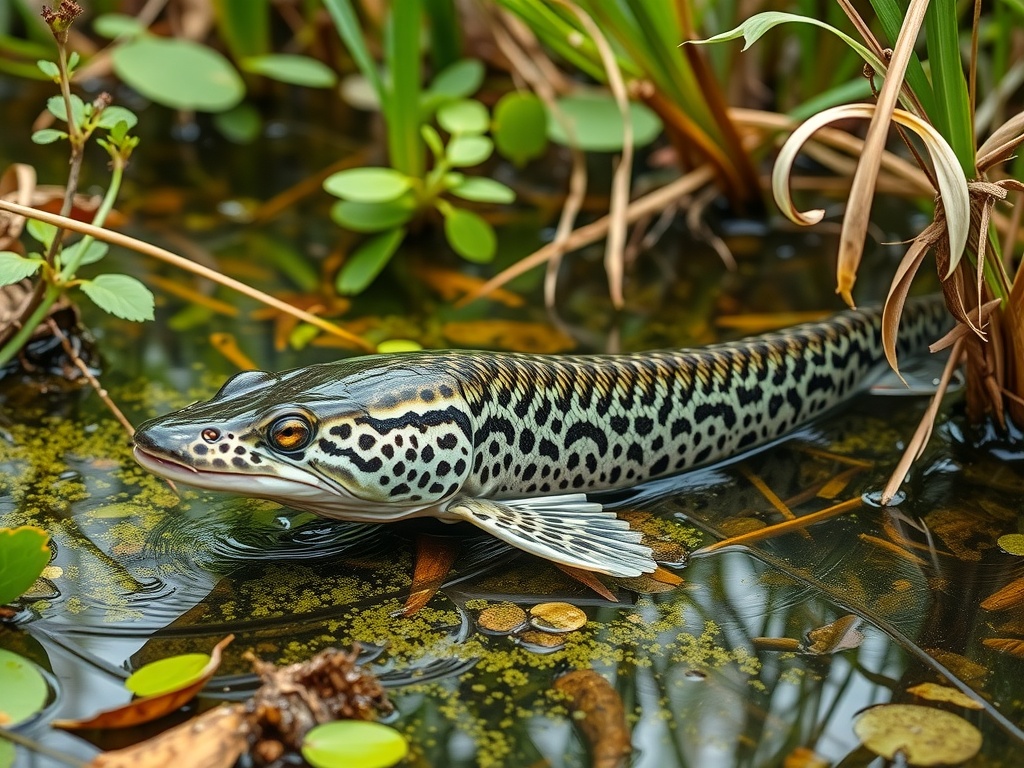
About the Spotted gar
The spotted gar is a long, slender freshwater fish recognized by its olive-green to brown coloration and distinctive dark spots covering its body, head, and fins. This ancient fish is characterized by a broad snout and sharp, needle-like teeth, which it uses to capture prey. Spotted gars are well-adapted to slow-moving, vegetated waters in the central and southeastern United States. Their tough, ganoid scales provide protection, and they are capable of gulping air, allowing them to survive in low-oxygen environments.
Fascinating facts
Ancient lineage
Spotted gars belong to one of the oldest groups of ray-finned fish, with relatives dating back to the Mesozoic Era.
Habitat specialist
They thrive in slow, weedy waters where they can ambush prey and avoid predators.
Hard scales
Their tough, diamond-shaped ganoid scales offer excellent protection and were historically used as tools by indigenous peoples.
Detailed description
The spotted gar (Lepisosteus oculatus) is a medium-sized, primitive ray-finned fish distinguished by its elongated, torpedo-shaped body and a broad, short snout. Adults typically measure 60–90 cm (24–35 in) in length, with some individuals reaching up to 112 cm (44 in), and weigh between 1.8–2.7 kg (4–6 lbs), though larger specimens have been recorded. Its olive-green to brown dorsal coloration transitions to a lighter, yellowish ventral side, and the entire body, head, and fins are marked with distinctive round black spots. The body is armored with thick, diamond-shaped ganoid scales composed of ganoine, an enamel-like substance, providing exceptional protection against predators and environmental hazards. The jaws are lined with sharp, conical teeth adapted for grasping slippery prey. Spotted gars possess a vascularized swim bladder, functioning as a primitive lung, allowing them to gulp atmospheric air and survive in hypoxic (low-oxygen) waters. Their lateral line system is well-developed, aiding in the detection of vibrations and movement in murky or vegetated environments. The species is generally solitary but may aggregate in favorable habitats. Spotted gars are considered living fossils, exhibiting many ancestral features retained from early actinopterygian fishes.
Did you know?
The spotted gar's eggs are highly toxic to humans and many other animals if ingested.
Research & sources
Wikipedia summary
The spotted gar is a freshwater fish native to North America that has an abundance of dark spots on its head, fins, and dart-like body. Spotted gar have an elongated mouth with many needle-like teeth to catch other fish and crustaceans. It is one of the smallest of the seven species of gar found in North America, growing 2–3 ft in length and weighing 4–6 lb (1.8–2.7 kg) typically. Gars have diamond-shaped, thick, enamel (ganoid) scales. The name Lepisosteus is Greek for "bony scale".
Behaviour & social structure
Spotted gars are primarily crepuscular and nocturnal predators, becoming most active during dusk and nighttime hours. They are ambush hunters, relying on their cryptic coloration and stillness to blend into submerged vegetation or debris, waiting motionless for unsuspecting prey to approach. When prey such as small fish, crustaceans, or aquatic insects come within striking distance, the gar lunges with a rapid sideways sweep of its head, capturing prey with its tooth-lined jaws. Feeding is opportunistic, and diet composition can vary seasonally and with habitat. Social interactions are minimal outside of the breeding season, as individuals are generally solitary and territorial. During the day, they often rest near the water surface or among dense aquatic plants. Spotted gars are capable of air-breathing, surfacing periodically to gulp air, especially in warm, stagnant waters where dissolved oxygen is low.
Reproduction & life cycle
Spotted gars exhibit seasonal spawning, typically breeding from late spring to early summer (April to June), when water temperatures reach 18–23°C (64–73°F). Males and females migrate to shallow, vegetated floodplains, backwaters, or marshes for spawning. Females are often accompanied by multiple males, and spawning involves vigorous thrashing as eggs and sperm are released simultaneously. Females can lay between 3,000 and 20,000 adhesive, toxic eggs, which attach to submerged vegetation or debris. There is no parental care; adults leave the spawning grounds after egg deposition. The eggs hatch after 7–9 days, depending on temperature. Larvae possess an adhesive organ on their snout, allowing them to attach to vegetation until yolk absorption is complete. Juveniles begin feeding on zooplankton and small invertebrates before transitioning to piscivory as they grow.
Adaptations & survival
The spotted gar exhibits several key adaptations for survival in variable freshwater environments. Its ganoid scales provide a nearly impenetrable armor against predators and parasites. The vascularized swim bladder enables facultative air-breathing, allowing the species to inhabit waters with low dissolved oxygen, such as swamps and stagnant backwaters. The elongated, streamlined body and reduced swim bladder buoyancy facilitate stealthy movement and sudden bursts of speed during ambush predation. The lateral line system enhances prey detection in turbid waters. Additionally, the toxicity of gar eggs deters most potential egg predators. Their ability to exploit a wide range of prey and tolerate fluctuating environmental conditions contributes to their ecological success.
Cultural significance
While not a major game fish, the spotted gar has been caught by anglers for sport and is sometimes kept in public aquaria due to its unique appearance. Historically, indigenous peoples and early settlers utilized gar scales and bones for tools, arrowheads, and jewelry, and gar flesh was occasionally consumed despite the toxicity of the eggs. In some regions, gars have been viewed with superstition or as nuisances, but they play an important ecological role as mid-level predators. The species is also of interest to evolutionary biologists as a 'living fossil,' providing insight into the early evolution of ray-finned fishes.
Recent research
Recent research on the spotted gar has focused on its genome, which was sequenced in 2016. The gar genome provides a critical evolutionary link between teleost fishes and tetrapods, aiding in the study of vertebrate genome evolution and the origins of key vertebrate features. Studies have also examined the species' physiological adaptations to hypoxia, reproductive ecology, and responses to environmental contaminants. Ongoing research includes the impacts of habitat modification and climate change on population dynamics, as well as the role of gars in aquatic food webs. Conservation genetics is being used to assess population structure and connectivity across fragmented habitats.
Videos
Habitat
Freshwater rivers, lakes, swamps, and bayous with abundant vegetation

Conservation
The Spotted gar is currently classified as Least Concern on the IUCN Red List.
Threats & challenges
Currently, the spotted gar is classified as Least Concern by the IUCN, with stable populations across much of its range. However, localized threats include habitat loss due to wetland drainage, river channelization, and dam construction, which reduce access to spawning and nursery habitats. Water pollution, particularly from agricultural runoff and industrial waste, can degrade habitat quality and affect reproductive success. Overfishing and bycatch in commercial fisheries are minor threats in some areas. Invasive species, such as common carp, may compete for resources or alter aquatic vegetation structure. Despite these challenges, the species' broad ecological tolerance and adaptability have allowed it to persist in many altered environments.
Taxonomy
Scientific name
Lepisosteus oculatus
- Kingdom
- Animalia
- Phylum
- Chordata
- Class
- Actinopterygii
- Order
- Lepisosteiformes
- Family
- Lepisosteidae
- Genus
- Lepisosteus
- Species
- oculatus
Where to see a spotted gar
1 zoo and aquarium in 1 country are recorded as keeping this species.

Community notes
Share your observations about the Spotted gar.
No community notes yet. Be the first!
Discover more wildlife
More fascinating animals from the encyclopedia.