
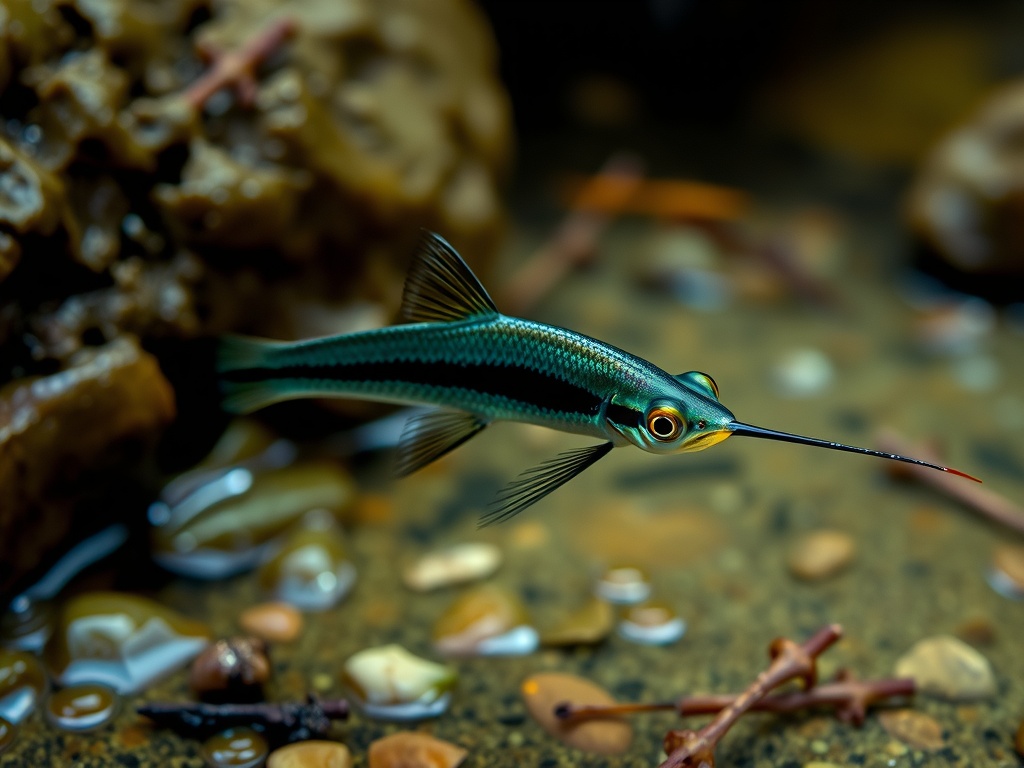
About the Swordtail
The Swordtail is a small, vibrant freshwater fish native to Central America. It is named for the distinct sword-like extension of the lower part of the male’s tail fin, which is used in courtship displays. Swordtails are popular in the aquarium trade due to their hardy nature, variety of color morphs, and peaceful temperament. In the wild, they inhabit fast-flowing streams and rivers with dense vegetation, where they feed on a mix of plant material and small invertebrates. Their adaptability and prolific breeding make them a common sight in both natural habitats and home aquariums.
Fascinating facts
Livebearers
Swordtails are livebearers, meaning they give birth to free-swimming young instead of laying eggs.
Omnivorous Diet
Swordtails consume both plant matter and small invertebrates, making them omnivores in their natural environment.
Sword-like Tail
Only male Swordtails possess the iconic elongated lower tail fin, which resembles a sword and is used for display during courtship.
Detailed description
The Swordtail (Xiphophorus hellerii) is a slender-bodied freshwater fish, typically reaching 8–12 cm in length, with males distinguished by an elongated, sword-like extension of the lower caudal fin rays, which can add up to 5 cm to their total length. Females are generally larger and more robust, lacking the sword extension. The species displays sexual dimorphism not only in fin morphology but also in coloration, with wild forms exhibiting olive green bodies accented by a red or orange lateral stripe, though selective breeding has produced a wide array of color morphs in captivity. Swordtails possess a terminal mouth suited for omnivorous feeding, and their scales are cycloid, providing flexibility and protection. Their lateral line system is well-developed, aiding in navigation and prey detection in turbid waters. Socially, swordtails are gregarious and form loose shoals, with males often engaging in elaborate courtship displays that involve fin flaring and chasing. In the wild, they inhabit clear to moderately turbid streams and rivers with dense aquatic vegetation, which provides both cover from predators and breeding sites. Their adaptability to varying water conditions, including slight salinity, has contributed to their success both in the wild and as an invasive species in some introduced regions. Swordtails are livebearers, giving birth to fully formed, free-swimming young, and are known for their high reproductive rate and rapid population growth under favorable conditions.
Did you know?
Swordtail females can store sperm from a single mating and use it to fertilize multiple broods over several months.
Research & sources
Wikipedia summary
Xiphophorus is a genus of euryhaline and freshwater fishes in the family Poeciliidae of order Cyprinodontiformes, native to Mexico and northern Central America. Xiphophorus species can be divided into three groups based on their evolutionary relationships: platyfish, northern swordtails, and southern swordtails. Platyfish formerly were classified in another genus, Platypoecilus, which is now obsolete. The type species is X. hellerii, the green swordtail. Like most other new world Poeciliids, platies and swordtails are live-bearers that use internal fertilization and give birth to live young instead of laying eggs like the bulk of the world's fishes. The name Xiphophorus derives from the Greek words ξίφος (dagger) and φόρος (bearer), referring to the gonopodium on the males. All are relatively small fishes, which reach a maximum length of 3.5–16 cm (1.4–6.3 in) depending on the exact species involved.
Behaviour & social structure
Swordtails are diurnal, exhibiting peak activity during daylight hours. They are opportunistic omnivores, feeding on algae, detritus, small crustaceans, insect larvae, and other invertebrates. Foraging occurs both at the substrate and mid-water levels, with individuals often grazing on biofilm and plant surfaces. Social hierarchies are established among males, with dominant individuals displaying more vivid coloration and longer swords, which are used in both courtship and competitive interactions. Aggression is generally low, but increased male density can lead to heightened competition and chasing. Swordtails exhibit schooling tendencies, particularly when threatened, as a means of predator avoidance. In aquaria, they are known for their peaceful disposition, though males may harass females if outnumbered. Rest periods are observed at night, with fish seeking shelter among vegetation or substrate.
Reproduction & life cycle
Swordtails are viviparous, utilizing internal fertilization via a modified anal fin in males called the gonopodium. Courtship involves males displaying their sword and performing lateral movements to attract females. Females can store sperm for several months, enabling multiple broods from a single mating event. Gestation lasts approximately 28–40 days, depending on temperature and environmental conditions. Brood sizes range from 20 to over 100 fry, with larger females producing more offspring. There is no parental care post-birth; fry are independent and must seek shelter immediately to avoid predation, including from adult conspecifics. Breeding occurs year-round in stable environments but may be seasonal in the wild, coinciding with periods of increased food availability.
Adaptations & survival
Swordtails possess several adaptations that enhance survival and reproductive success. The male's sword extension, while energetically costly and increasing predation risk, is a sexually selected trait favored by female choice. Their euryhaline physiology allows them to tolerate a range of salinities, facilitating colonization of diverse habitats. The ability to store sperm enables females to reproduce even in the absence of males for extended periods. Their cryptic coloration and rapid darting movements provide effective predator evasion. Additionally, their omnivorous diet and tolerance for variable water quality contribute to their ecological versatility.
Cultural significance
Swordtails have been popular in the aquarium trade since the early 20th century, valued for their hardiness, vivid coloration, and ease of breeding. They have contributed significantly to genetic and evolutionary research, particularly in studies of sexual selection, hybridization, and melanoma development. In some Central American cultures, native fish including swordtails are occasionally featured in folklore or as symbols of fertility due to their prolific breeding, though there is limited direct cultural mythology associated with the species.
Recent research
Swordtails are a model organism in evolutionary biology and genetics. Notably, hybridization between Xiphophorus species has been used to study the genetic basis of melanoma, with certain hybrids spontaneously developing tumors, providing insights into cancer genetics. Recent genomic studies have explored the mechanisms of sexual selection, particularly the evolution and maintenance of the sword trait. Ongoing research investigates the ecological impacts of swordtail introductions in non-native habitats and their role in local biodiversity shifts. Studies have also examined the effects of endocrine-disrupting chemicals on swordtail reproductive physiology, highlighting their utility as bioindicators of aquatic pollution.
Videos
Habitat
Freshwater streams and rivers

Conservation
The Swordtail is currently classified as Least Concern on the IUCN Red List.
Threats & challenges
In their native range, Swordtails face threats from habitat degradation, pollution, and competition with invasive species. However, their adaptability and prolific breeding have allowed populations to remain stable, and the species is currently listed as Least Concern by the IUCN. In regions where they have been introduced, Swordtails can become invasive, outcompeting native fish and altering local ecosystems. Over-collection for the aquarium trade is not considered a significant threat due to widespread captive breeding. Climate change and waterway modification may pose future risks by altering habitat availability and water quality.
Taxonomy
Scientific name
Xiphophorus hellerii
- Kingdom
- Animalia
- Phylum
- Chordata
- Class
- Actinopterygii
- Order
- Cyprinodontiformes
- Family
- Poeciliidae
- Genus
- Xiphophorus
- Species
- hellerii
Community notes
Share your observations about the Swordtail.
No community notes yet. Be the first!
Discover more wildlife
More fascinating animals from the encyclopedia.