
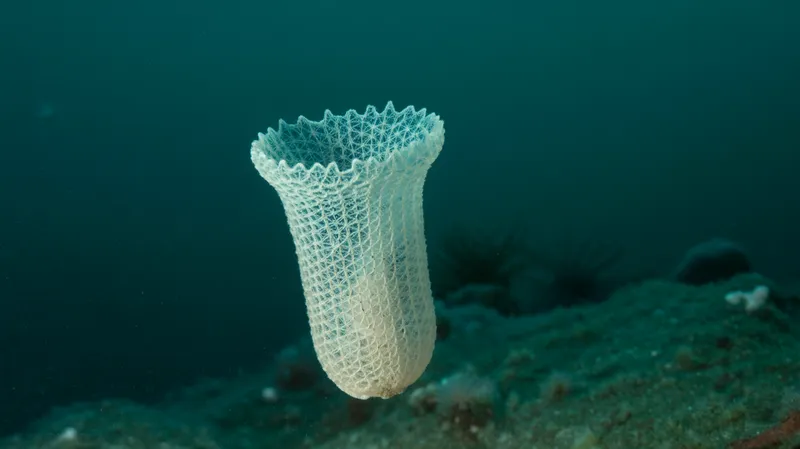
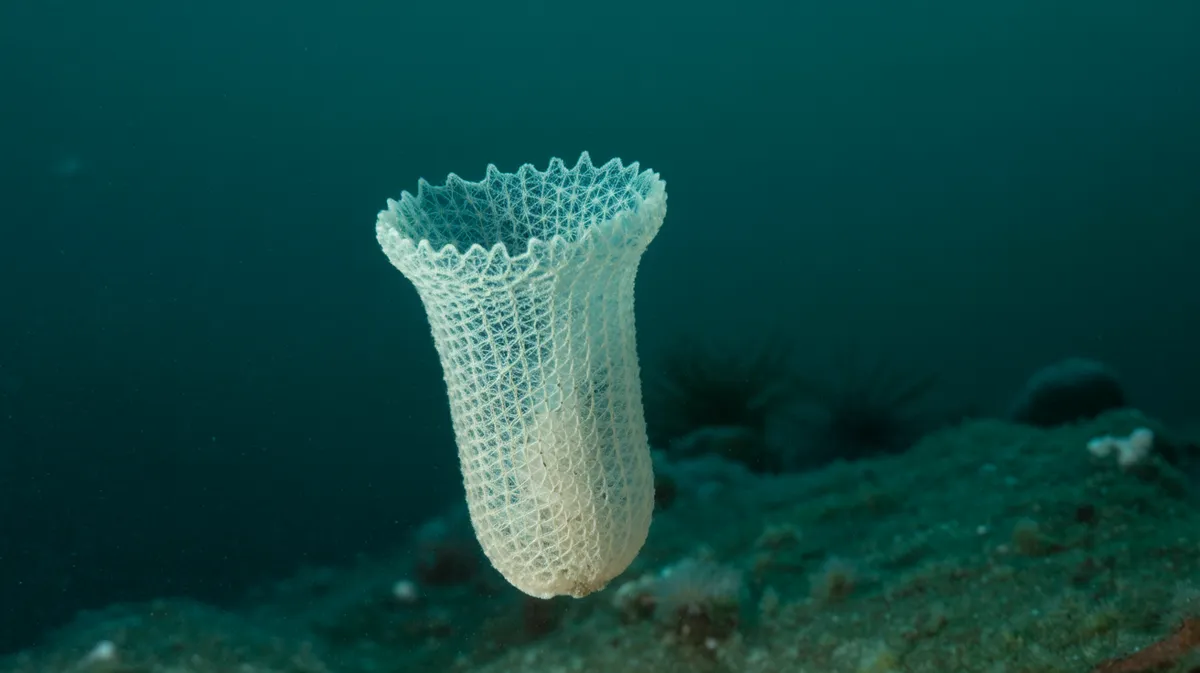
About the Venus Flower Basket
The Venus flower basket (Euplectella aspergillum) is a deep-sea glass sponge that builds itself a hollow, cylindrical lattice out of silica, and that lattice has become a case study in structural engineering. The skeleton is organised over at least seven hierarchical levels, from nanoscale layers within a single spicule up to the diagonal reinforcing bands wrapping the whole tube, and the square grid with double diagonals turns out to be a highly efficient way to resist buckling; a 2021 analysis found the sponge's arrangement outperforms standard lattice designs used in bridges and towers by a substantial margin. The individual spicules are also optical fibres: they carry light along their length with a layered refractive-index structure similar to commercial fibre, but they are made at seawater temperature rather than in a furnace and are far more flexible and less brittle. Inside almost every mature flower basket lives a pair of shrimp of the genus Spongicola. They enter as tiny larvae, feed on particles drawn through the sponge, grow too large to get back out through the lattice, and spend the rest of their lives together, breeding inside their glass prison; their offspring escape as larvae. In Japan, a dried flower basket containing its imprisoned shrimp pair is a traditional wedding gift, a symbol of a bond that ends only in death.
Fascinating facts
Shrimp Roommates
A pair of small shrimp often live inside a Venus Flower Basket, symbolizing eternal love and partnership in Japanese culture.
Glass Skeleton
The sponge's skeleton is made of silica, forming a complex lattice that is both lightweight and incredibly strong.
Deep Sea Dweller
Venus Flower Baskets are found at depths of 100 to 1,000 meters, thriving on the dark ocean floor far from sunlight.
Detailed description
The Venus Flower Basket (Euplectella aspergillum) is a deep-sea hexactinellid sponge renowned for its intricate, glass-like skeleton composed of silica spicules arranged in a highly regular, lattice-like cylindrical structure. Typically measuring between 10 and 30 centimeters in height and up to 6 centimeters in diameter, the sponge’s skeleton is both lightweight and remarkably strong, with a geometry that has inspired biomimetic engineering. The body wall is thin and perforated by numerous pores (ostia), through which water is drawn into a central cavity (spongocoel) and expelled through a large terminal opening (osculum). The tissue of E. aspergillum is syncytial, meaning it consists of a multinucleated cytoplasmic mass rather than discrete cells, a unique adaptation among sponges. This species is sessile, anchoring itself to soft sediments on the abyssal plains of the western Pacific Ocean, often at depths ranging from 100 to over 1,000 meters. The Venus Flower Basket is famous for its symbiotic relationship with certain species of commensal shrimp (notably Spongicola venusta), which enter the sponge as juveniles and become trapped as they grow, living out their lives within the protective lattice. The sponge’s feeding strategy is passive filtration, relying on ambient water currents to deliver plankton and organic detritus. Its slow growth and long lifespan—potentially several decades—reflect the stable but nutrient-poor conditions of the deep sea. The sponge’s skeleton also possesses remarkable optical properties, efficiently transmitting light along its length, a feature of interest in materials science. E. aspergillum is an important component of deep-sea benthic ecosystems, providing microhabitats for a range of small invertebrates.
Did you know?
The sponge's silica fibers are so well-constructed that they can transmit light like natural fiber-optic cables.
Research & sources
Wikipedia summary
The Venus' flower basket is a species of glass sponge found in the deep waters of the Pacific Ocean, usually at depths below 500 m (1,600 ft). Like other glass sponges, they build their skeletons out of silica, which forms a unique lattice structure consisting of spicules. This body structure is of great interest in materials science as the optical and mechanical properties are in some ways superior to man-made materials. Like other sponges, they feed by filtering sea water to capture plankton and marine snow. Little is known regarding their reproductive habits, though the fluid dynamics of their body structure likely influence reproduction and it is hypothesized that they may be hermaphroditic.
Behaviour & social structure
Euplectella aspergillum is a sessile organism, remaining anchored to the substrate throughout its life. It exhibits no locomotion or active hunting behavior; instead, it relies on the continuous flow of water through its porous body to obtain food and oxygen. The sponge’s filtration system is highly efficient, capable of processing hundreds of milliliters of seawater per hour. Water enters through small pores, passes through a network of canals lined with choanocyte chambers (flagellated cells), and exits via the osculum. This flow not only facilitates feeding but also aids in waste removal and gas exchange. The sponge’s social interactions are limited, but its symbiotic relationship with shrimp is notable: pairs of shrimp (male and female) live within the central cavity, feeding on detritus and plankton filtered by the sponge. The shrimp benefit from protection against predators, while the sponge is largely unaffected (commensalism). Daily routines are governed by the slow, continuous process of filtration and the maintenance of internal water flow, with little variation due to the stable conditions of the deep-sea environment.
Reproduction & life cycle
Reproductive biology in E. aspergillum is not fully understood, but like other hexactinellid sponges, it is believed to be hermaphroditic, producing both eggs and sperm. Gametes are released into the water column, where external fertilization occurs. The resulting larvae are free-swimming and planktonic, allowing for dispersal before settling onto the seafloor and metamorphosing into the adult form. There is no evidence of parental care; once larvae are released, they are independent. Asexual reproduction via budding has also been observed, with small clonal buds forming on the main body and eventually detaching. Breeding seasons are not well defined, likely due to the relatively constant environmental conditions at depth, but reproductive events may be triggered by subtle changes in nutrient availability or water temperature. The presence of symbiotic shrimp pairs inside the sponge is not a result of reproductive behavior by the sponge, but rather a unique ecological association.
Adaptations & survival
Euplectella aspergillum exhibits several remarkable adaptations for survival in the deep sea. Its silica-based skeleton is both flexible and resilient, able to withstand the high pressures and low temperatures of the abyssal environment. The lattice structure maximizes strength while minimizing material use, and the spicules are fused in a way that dissipates mechanical stress. The syncytial tissue organization allows for rapid transmission of electrical signals, enabling the sponge to respond to environmental stimuli such as changes in water flow or sedimentation. The efficient filtration system is adapted to capture minute particles from nutrient-poor waters. The symbiotic relationship with shrimp provides a microhabitat for the crustaceans, while the sponge benefits from the cleaning of its internal cavity by the shrimp. The optical properties of the spicules, which can transmit light with minimal loss, may play a role in attracting symbionts or deterring predators, though this remains speculative.
Cultural significance
The Venus Flower Basket holds significant cultural value, especially in Japan and other parts of East Asia, where it is considered a symbol of eternal love and marital fidelity. This symbolism arises from the observation that a pair of shrimp often becomes trapped within the sponge’s lattice, living together for life—an allegory for lifelong partnership. Dried specimens of the sponge are sometimes given as wedding gifts or displayed as ornaments. The sponge’s elegant structure has also inspired art, architecture, and biomimetic engineering, particularly in the design of lightweight, strong materials and optical fibers.
Recent research
Recent scientific research on Euplectella aspergillum has focused on the unique properties of its silica skeleton. Studies have revealed that the hierarchical organization of spicules imparts exceptional mechanical strength and flexibility, outperforming many synthetic materials. The optical properties of the spicules, which guide light with high efficiency, have inspired advances in fiber optic technology. Genomic and transcriptomic analyses are beginning to uncover the molecular mechanisms underlying silica biomineralization and tissue organization. Ongoing ecological studies are investigating the role of E. aspergillum in deep-sea biodiversity, particularly as a habitat for symbiotic and commensal organisms. There is also growing interest in the potential impacts of deep-sea mining and climate change on glass sponge populations.
Videos
Habitat
Deep ocean floor

Conservation
The Venus Flower Basket is currently classified as Least Concern on the IUCN Red List.
Threats & challenges
Currently, Euplectella aspergillum faces relatively few direct threats due to its deep-sea habitat, which is largely inaccessible to most human activities. However, potential threats include deep-sea trawling, which can damage benthic habitats, and the emerging interest in deep-sea mining for minerals, which could disrupt sponge populations and associated fauna. Climate change poses a long-term threat through ocean acidification, which may affect the availability of silica and the stability of sponge skeletons. Pollution, particularly microplastics and chemical contaminants, could also impact deep-sea ecosystems. Despite these concerns, the species is currently listed as Least Concern, but ongoing monitoring is recommended as human activities in the deep ocean increase.
Taxonomy
Scientific name
Euplectella aspergillum
- Kingdom
- Animalia
- Phylum
- Porifera
- Class
- Hexactinellida
- Order
- Lyssacinosa
- Family
- Euplectellidae
- Genus
- Euplectella
- Species
- aspergillum
Community notes
Share your observations about the Venus Flower Basket.
No community notes yet. Be the first!
Discover more wildlife
More fascinating animals from the encyclopedia.