
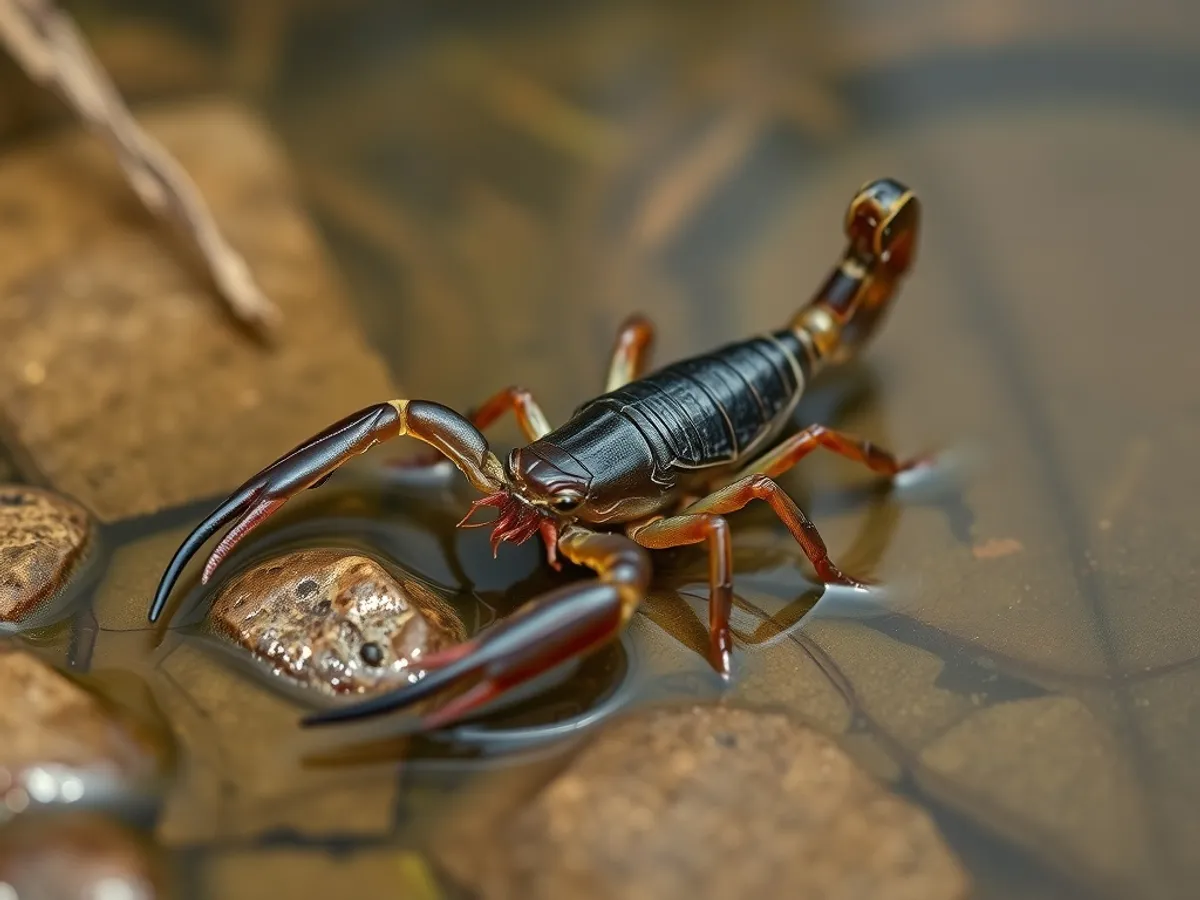
About the Water Scorpion
The Water Scorpion is an aquatic insect that closely resembles a terrestrial scorpion due to its raptorial front legs and elongated body, though it is unrelated. Found in still or slow-moving freshwater habitats, it is a skilled ambush predator, lying in wait for unsuspecting prey. Its long, slender tail is actually a breathing tube, allowing it to remain submerged while accessing air from the surface. Water Scorpions are part of the true bugs (order Hemiptera) and are notable for their slow movement and excellent camouflage among aquatic vegetation.
Fascinating facts
Ambush Predator
Water Scorpions use their forelegs to snatch prey, waiting motionless for long periods until an insect or tadpole comes close.
Breathing Tube
Their long tail-like structure is a siphon that they extend to the surface to breathe air while remaining hidden underwater.
Can Fly
Although mainly aquatic, Water Scorpions are capable fliers and may take to the air at night or if their habitat dries up.
Detailed description
Nepa cinerea, commonly known as the water scorpion, is a medium-sized aquatic insect typically measuring 22–35 mm in length, with a robust, flattened, and brownish body that provides excellent camouflage among submerged vegetation and detritus. Its most distinctive feature is the long, slender respiratory siphon at the posterior end, which can reach up to 15 mm and functions as a snorkel, allowing the insect to breathe atmospheric oxygen while remaining submerged. The raptorial forelegs are highly specialized for grasping and immobilizing prey, resembling those of a praying mantis, and are held folded in a characteristic position when at rest. The head is small with prominent compound eyes and piercing-sucking mouthparts (rostrum) adapted for injecting digestive enzymes and consuming liquefied tissues of prey. Water scorpions are generally solitary and sedentary, relying on their cryptic appearance and slow, deliberate movements to avoid detection by both predators and prey. They are ambush predators, lying motionless for extended periods until small aquatic invertebrates, tadpoles, or even small fish come within striking range. Respiration is facilitated by the siphon, which is extended to the water surface, while the rest of the body remains hidden. Adults are capable of flight but rarely leave the water except during dispersal or when colonizing new habitats. The life cycle includes incomplete metamorphosis, with aquatic nymphs resembling miniature adults. Nepa cinerea is an important component of freshwater ecosystems, acting as both predator and prey, and is sensitive to water quality and habitat disturbance.
Did you know?
Water Scorpions can survive out of water for short periods and sometimes fly to new locations in search of better habitats.
Research & sources
Wikipedia summary
Nepidae is a family of exclusively aquatic Heteropteran insects in the order Hemiptera. They are commonly called water scorpions for their superficial resemblance to scorpions, due to their raptorial forelegs and the presence of a long slender process at the posterior end of the abdomen, resembling a tail. There are 14 genera in the family, in two subfamilies, Nepinae and Ranatrinae. Members of the genus Ranatra, the most widespread and species-rich genus, are sometimes called needle bugs or water stick insects as they are slenderer than Nepa.
Behaviour & social structure
Water scorpions are primarily ambush predators, remaining motionless and partially buried in mud or concealed among aquatic plants. They use their raptorial forelegs to swiftly seize passing prey, which is then immobilized and consumed using their piercing mouthparts. Feeding occurs mostly during daylight hours, but they may also hunt at night in warmer conditions. Nepa cinerea is solitary, with individuals maintaining territories and showing little tolerance for conspecifics outside of the breeding season. They are generally slow-moving, relying on stealth rather than speed, and rarely swim actively, instead walking along the substrate or climbing vegetation. When threatened, they may feign death or use their siphon to rapidly escape to the surface. Adults are capable of short flights, especially during periods of drought or habitat desiccation, allowing them to colonize new water bodies.
Reproduction & life cycle
Breeding occurs in spring and early summer, triggered by rising water temperatures. Males locate females using chemical cues and engage in brief courtship behaviors, which may include tactile stimulation with the forelegs. Copulation is typically short, after which females lay eggs singly or in small clusters, inserting them into the stems of aquatic plants or soft submerged wood using a specialized ovipositor. Each female can lay up to 100 eggs over several weeks. The eggs are elongated and equipped with filamentous respiratory appendages that protrude from the substrate, facilitating gas exchange. Incubation lasts 2–4 weeks, depending on temperature, after which nymphs emerge and undergo 5–6 molts before reaching adulthood in 2–3 months. There is generally one generation per year in temperate regions. Parental care is absent; eggs and nymphs are independent from the moment of laying and hatching.
Adaptations & survival
Nepa cinerea exhibits several key adaptations for aquatic predation and survival. The elongated siphon is a unique respiratory adaptation, functioning as a snorkel to access atmospheric oxygen while the insect remains submerged and concealed. The raptorial forelegs are highly specialized for capturing and holding slippery prey. The flattened, cryptic body coloration provides camouflage against mud and decaying vegetation, reducing predation risk. The cuticle is water-repellent, minimizing waterlogging and facilitating buoyancy control. Behavioral adaptations include slow, deliberate movements and the ability to remain motionless for long periods, enhancing ambush efficiency. The eggs' respiratory filaments allow development in low-oxygen environments. Adults possess functional wings and can disperse by flight when necessary, increasing resilience to habitat changes.
Cultural significance
Water scorpions have limited direct cultural significance but are sometimes featured in educational materials and natural history displays due to their distinctive appearance and interesting adaptations. Their resemblance to true scorpions has led to occasional mentions in folklore and local names, but they are not generally associated with mythology or traditional uses. In some regions, they are used as bioindicators for freshwater ecosystem health due to their sensitivity to pollution.
Recent research
Recent research has focused on the biomechanics of the water scorpion's raptorial strike, revealing rapid acceleration and precise targeting of prey. Studies have also examined the respiratory efficiency of the siphon system and its role in survival under hypoxic conditions. Nepa cinerea is used in ecological studies as a model for predator-prey interactions in freshwater habitats. Molecular phylogenetic analyses have clarified relationships within Nepidae and their evolutionary history, indicating an ancient lineage dating back to the Early Cretaceous. Ongoing research is investigating the impact of environmental contaminants on development and reproductive success.
Videos
Habitat
Freshwater ponds, lakes, and slow-moving streams

Conservation
The Water Scorpion is currently classified as Least Concern on the IUCN Red List.
Threats & challenges
While Nepa cinerea is currently listed as Least Concern, it faces localized threats from habitat loss, water pollution (especially from agricultural runoff and pesticides), and the drainage or modification of wetlands and slow-moving water bodies. The species is sensitive to reductions in water quality and the removal of aquatic vegetation, which provides essential cover and breeding sites. Climate change and increasing frequency of droughts may also impact populations by reducing suitable aquatic habitats. However, the species' ability to disperse by flight offers some resilience to habitat fragmentation. There are no significant direct threats from human exploitation.
Taxonomy
Scientific name
Nepa cinerea
- Kingdom
- Animalia
- Phylum
- Arthropoda
- Class
- Insecta
- Order
- Hemiptera
- Family
- Nepidae
- Genus
- Nepa
- Species
- cinerea
Community notes
Share your observations about the Water Scorpion.
No community notes yet. Be the first!
Discover more wildlife
More fascinating animals from the encyclopedia.