Insects
Invertebrates with three-part bodies, three pairs of legs, and typically wings.
130 species
American cockroach
Periplaneta americana
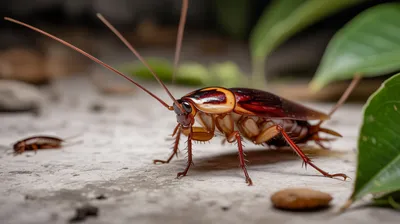
The American cockroach is one of the largest and most common cockroach species found worldwide, particularly in warm and humid environments. Recognizable by its reddish-brown color and yellowish figure-eight pattern on the back of its head, this insect is highly adaptable and thrives in both natural and human-inhabited environments. Despite its name, the American cockroach is believed to have originated in Africa and was introduced to the Americas in the 17th century. It is an omnivorous scavenger, feeding on a wide variety of decaying organic matter, and is known for its rapid movements and impressive resilience.
Antlion
Myrmeleon formicarius
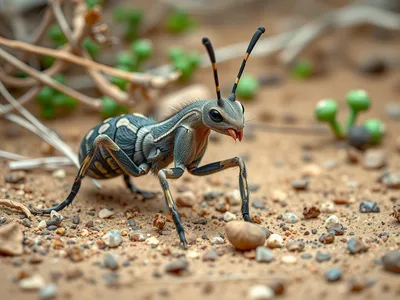
The famous conical sand pit is only half the story: most antlion species never build one at all, and simply lurk in litter or sand as ambushers. In the pit-building genera, the larva digs by spiralling backwards, flicking sand out with its head, and forms a cone at precisely the angle of repose — the steepest slope loose sand can hold — so any insect stepping in triggers a small avalanche. The larva, buried at the bottom, then flicks jets of sand upward to knock the prey down. Its jaws are hollow grooves rather than chewing tools: they inject paralysing venom and digestive enzymes, and the antlion drinks the liquefied insect out. Most remarkably, the larva has no functional anus. Waste accumulates in the gut for the whole of larval life, sometimes for years, and is finally voided as a single meconium pellet at the end of metamorphosis. Adults look like frail damselflies but can be told apart at once by their short, clubbed antennae.
Argentine ant
Linepithema humile
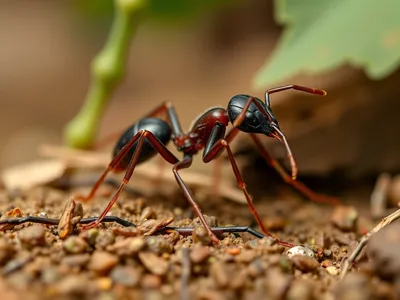
The Argentine ant is a small, light to dark brown ant species native to South America but now found on every continent except Antarctica. It is renowned for forming massive supercolonies, sometimes spanning hundreds of kilometers, due to its lack of aggression toward other colonies of the same species. Argentine ants are highly adaptable, thriving in urban, agricultural, and natural environments where they can outcompete native ant species. Their invasive nature has made them a significant ecological and agricultural pest in many regions. Despite their tiny size, their cooperative behavior and resourcefulness make them one of the most successful invasive insects globally.
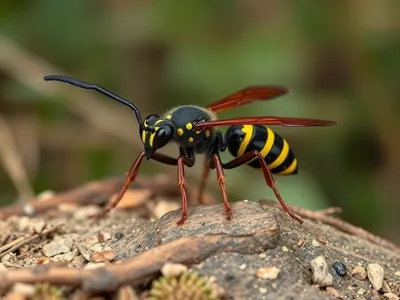
Asian Giant Hornet
Vespa mandarinia
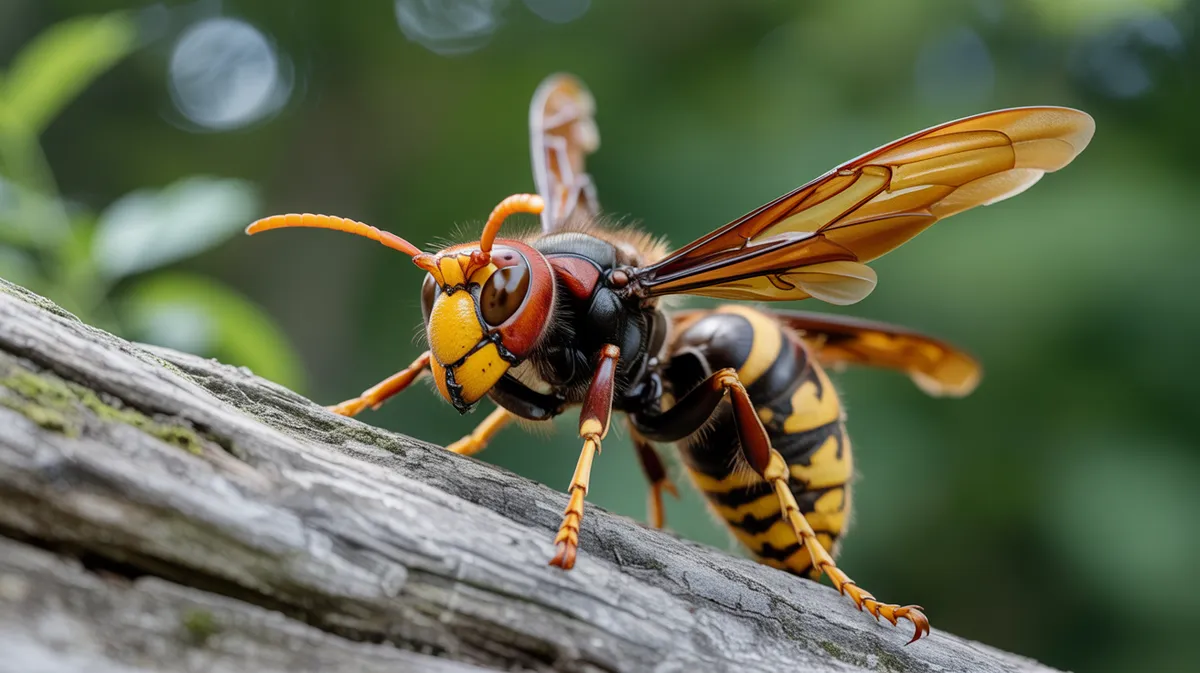
The Asian giant hornet is the largest hornet on Earth, and its reputation rests on what a few dozen of them can do to a beehive. A scout marks a colony with a pheromone, and the raiding party that follows does not sting the bees — it decapitates them, working through a hive of tens of thousands in a matter of hours, then carries the brood home to feed its own young. European honeybees, which never evolved alongside it, have no answer at all. Japanese honeybees do. When a scout is detected, hundreds of bees engulf it in a ball and vibrate their flight muscles, driving the temperature inside the ball above the hornet's tolerance while their own runs just below it, and raising the carbon dioxide at the same time — the combination kills the hornet without a single sting being used. Its own sting is long enough to penetrate beekeeping suits and the venom is potent, though the danger to people has been widely exaggerated.
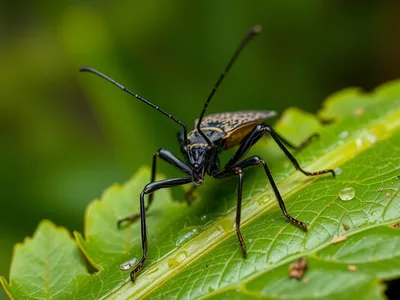
Assassin Bug
Reduviidae
Assassin bugs are a diverse group of predatory insects known for their elongated bodies, narrow heads, and distinctive curved mouthparts used for piercing and injecting venom into prey. These bugs inhabit various environments across the world, from forests and grasslands to gardens and even inside homes. Their predatory nature helps control populations of other insects, making them important contributors to natural pest regulation. While most species are harmless to humans, some, like the kissing bug, can transmit diseases such as Chagas disease.
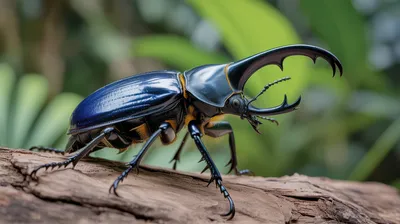
Atlas Beetle
Chalcosoma atlas
The Atlas Beetle is one of the largest and most impressive beetles in the world, recognized for its three prominent horns on males. Native to the tropical forests of Southeast Asia, this beetle is a member of the rhinoceros beetle group and exhibits strong sexual dimorphism, with males being much larger and more heavily armored than females. The Atlas Beetle spends the majority of its life as a larva, feeding on decaying wood, before emerging as an adult to search for mates. Adult beetles are known for their strength, capable of lifting objects up to several times their own body weight.
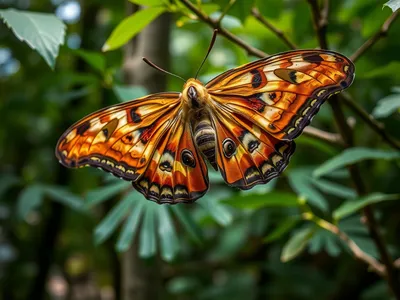
Atlas Moth
Attacus atlas
The atlas moth is among the largest insects in the world by wing area — and the adult has no functional mouth. It cannot eat. It emerges from the cocoon carrying every calorie it will ever have, banked as fat during its caterpillar stage, and it spends the week or two it has left doing one thing: finding a mate. The division of labour is total. The female barely moves, releasing pheromones and waiting; the male flies, sometimes for kilometres, guided by vast feathered antennae sensitive enough to detect a few molecules of her scent on the night air. The wingtips are the moth's other famous feature: each is patterned to resemble the head of a snake, complete with a suggestion of an eye and scales, and a disturbed moth will drop to the ground and slowly writhe its wings to sell the illusion. Its cocoon produces a coarse, durable silk called fagara, which is harvested commercially.
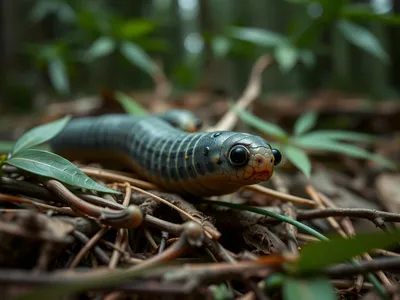
Bamboo Worm
Omphisa fuscidentalis
The bamboo worm is the larval stage of a moth species native to Southeast Asia, particularly found inside bamboo stems. These cream-colored, soft-bodied larvae are renowned for their nutritional value and are harvested as a delicacy in countries like Thailand, Laos, and Myanmar. Bamboo worms feed on the soft tissue inside bamboo, creating small tunnels, and can be found in clusters inside culms. Despite their humble appearance, they play an important ecological role in bamboo decomposition and nutrient cycling. Their popularity as an edible insect is growing due to their rich protein content and sustainable harvesting potential.
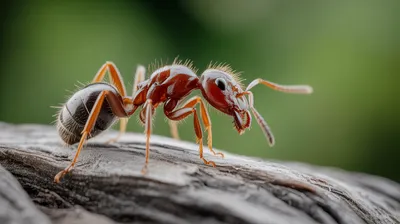
Black garden ant
Lasius niger
The black garden ant is a small, dark-colored insect native to much of Europe, parts of Asia, and introduced areas in North America. These ants are renowned for their intricate social structure, where a single queen can live for many years and lay thousands of eggs, supported by numerous worker ants. They commonly build their nests in soil, under stones, or within lawns and gardens, often creating extensive underground colonies. Black garden ants primarily feed on insects, nectar, and honeydew from aphids, playing a vital role in garden ecosystems.
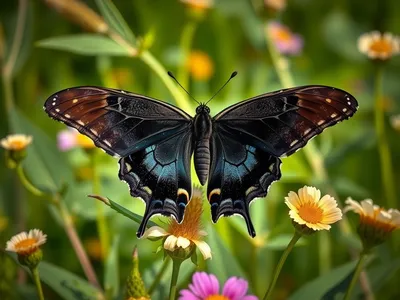
Black Swallowtail
Papilio polyxenes
The Black Swallowtail is a striking butterfly native to North America, recognized by its velvety black wings adorned with rows of yellow spots and, in females, a distinctive blue band on the hindwings. This species is known for its impressive mimicry and vibrant coloration, which help deter predators. Black Swallowtail caterpillars feed on a variety of plants in the carrot family, including parsley and dill, making them a common sight in gardens and meadows. Adults are strong fliers and are often seen fluttering around open fields, gardens, and roadsides from spring through fall.
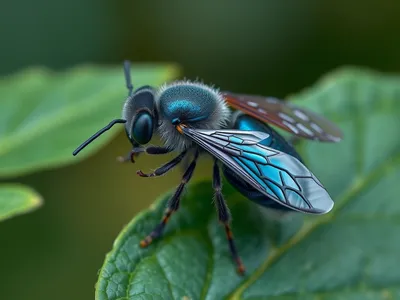
Blue Carpenter Bee
Xylocopa caerulea
The Blue Carpenter Bee is a strikingly colored, large bee species known for its metallic blue body and fuzzy appearance. Unlike honeybees, these solitary bees do not live in colonies; instead, females bore into dead wood or bamboo to create nests for their offspring. They play an important role in pollination, especially for large flowers, thanks to their robust size and strength. Blue Carpenter Bees are generally non-aggressive and are found in a range of habitats from forests to gardens across Southeast Asia and parts of Australia.
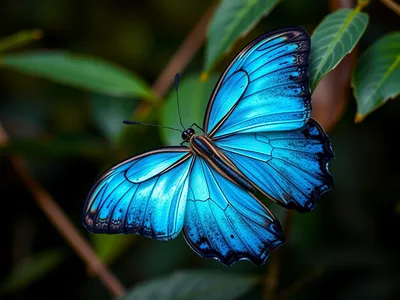
Blue Morpho Butterfly
Morpho menelaus
The blue of a morpho is not a pigment, and it is not really "on" the wing at all. Each scale carries rows of microscopic ridges shaped like Christmas trees in cross-section, and light bouncing between the layers interferes with itself, cancelling most wavelengths and reflecting an intense blue — a structural colour that shifts with viewing angle and is far brighter than any pigment could achieve. The underside of the wing is a drab, eyespotted brown, so a flying morpho flashes on and off like a strobe as it flaps, which makes it maddeningly hard for a bird to track. That blue is also aggressive signalling: males patrol streambeds and will fly at blue objects, and collectors have long lured them with a scrap of blue paper. Adults do not visit flowers at all — they have no interest in nectar, and instead feed on rotting fruit, tree sap, fungi and the juices of carrion, which is why you find them on the forest floor rather than in the canopy flowers. The caterpillar is red-brown and hairy, cannibalistic when crowded, and releases a rancid, butter-like stink from a gland when handled.
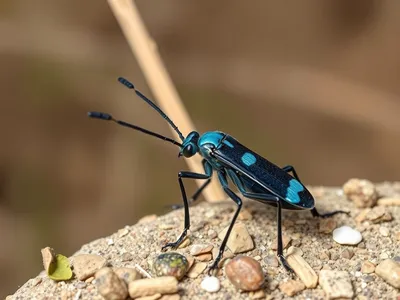
Blue mud dauber
Chalybion californicum
The blue mud dauber is a solitary wasp known for its striking metallic blue coloration and slender body. Unlike social wasps, blue mud daubers do not form colonies, instead building individual nests out of mud, often in sheltered locations such as under eaves or inside garages. They are notable for hunting and paralyzing spiders, particularly black widows, which they provision as food for their larvae. Blue mud daubers are generally non-aggressive and rarely sting humans, preferring to focus their efforts on nest building and hunting.
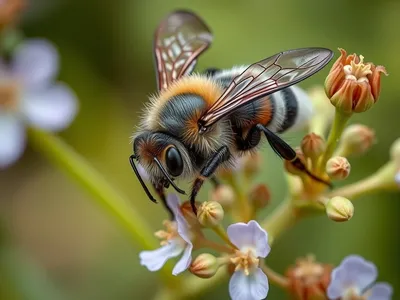
Blue orchard bee
Osmia lignaria
The blue orchard bee is a solitary, native bee species found across North America, known for its striking metallic blue to greenish coloration. Unlike honey bees, these bees do not form large colonies but nest individually in pre-existing cavities such as hollow stems or wood holes. They are highly valued for their exceptional efficiency in pollinating fruit trees, especially apples, cherries, and almonds. Blue orchard bees are active in early spring, coinciding with orchard bloom, and have become increasingly important in agricultural pollination due to their gentle nature and effectiveness.
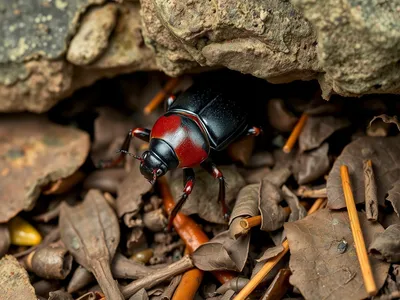
Bombardier beetle
Brachinus crepitans
The bombardier beetle carries a chemical weapon and detonates it inside its own body. It stores two reagents — hydroquinones and hydrogen peroxide — separately and harmlessly in a reservoir, and when threatened it forces them into a reinforced reaction chamber where enzymes are waiting. The reaction is violent and almost instantaneous: the mixture flashes to around a hundred degrees Celsius and blasts out of a swivelling nozzle at the tip of the abdomen, which the beetle aims with real accuracy at whatever is attacking it. It does not fire a single stream but a pulsed burst, hundreds of pulses a second, and that pulsing is what saves it — each explosion is separated by a moment of cooling, so the chamber is never sustained at a temperature that would destroy the beetle itself. It is enough to make a toad spit it back out, and beetles have been recovered alive after being swallowed, having fired inside the stomach until they were rejected.
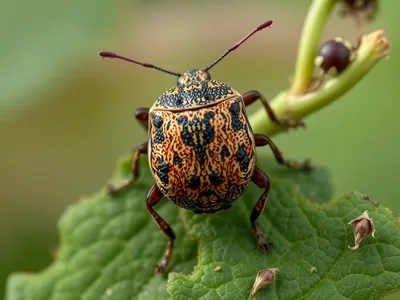
Brown marmorated stink bug
Halyomorpha halys
The brown marmorated stink bug is an invasive insect species originally native to East Asia, particularly China, Japan, and Korea. Recognizable by its shield-shaped body and mottled brown coloration, this bug emits a pungent odor when threatened or crushed, which serves as a defense mechanism against predators. It is considered a significant agricultural pest, feeding on a wide variety of fruits, vegetables, and ornamental plants, causing extensive crop damage. Since its accidental introduction to North America and Europe, the brown marmorated stink bug has rapidly spread, adapting well to both urban and rural environments.
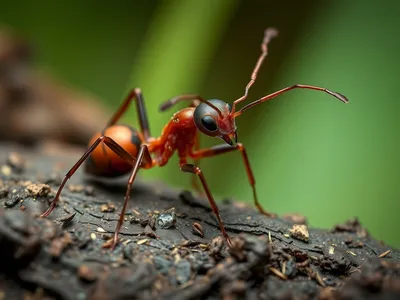
Bullet Ant
Paraponera clavata
The bullet ant is named for a sting that people describe as being shot. It sits at the very top of the Schmidt sting pain index, and Justin Schmidt's own description — pure, intense, brilliant pain, like walking over flaming charcoal with a rusty nail in your heel — is the scale's maximum. The pain arrives in waves for up to twenty-four hours, accompanied by uncontrollable shaking, and the cause is poneratoxin, a neurotoxin that jams the sodium channels nerves use to reset between signals, so the nerve simply keeps firing. Among the Sateré-Mawé people of Brazil, initiation into manhood involves gloves woven full of bullet ants with the stingers turned inward, worn for minutes at a time, and endured many times over. The ant itself is large, forages alone in the rainforest canopy rather than in columns, and is not remotely aggressive — the sting is a defence of the nest, and it gives a warning first, stridulating and releasing a foul odour.
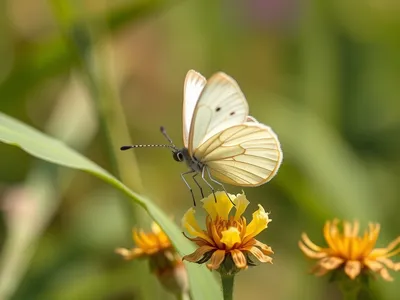
Cabbage White Butterfly
Pieris rapae
The cabbage white is arguably the most successful invasive insect of the modern era. Introduced accidentally into Quebec around 1860, it spread across North America within decades, and it is now on every continent except Antarctica — and the reason is a biochemical arms race that it won. Brassicas, the cabbage family, defend themselves with a "mustard oil bomb": chew a leaf and an enzyme meets a stored glucosinolate, producing toxic isothiocyanates. Cabbage white caterpillars carry a gut protein, a nitrile-specifier protein, that intercepts the reaction and redirects it to produce harmless nitriles instead, which the caterpillar simply excretes. The plant's chemical weapon is defused, so a plant that most insects cannot touch becomes an exclusive private larder. Females can distinguish the sexes at a glance — the male has one black spot on each forewing, the female two — and they inspect plants before laying, avoiding leaves that already carry eggs. It overwinters as a chrysalis, and can produce several generations in a summer.
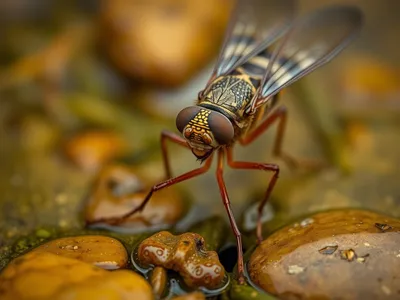
Caddisfly
Trichoptera spp.
Caddisfly larvae are underwater builders. Most spin silk from modified salivary glands — a silk that cures in water, which is a genuinely difficult chemical problem and is being studied intensively as a template for surgical adhesives that can bond wet tissue — and use it to glue a portable case around themselves out of sand grains, twig fragments, snail shells or leaf pieces. The architecture is not random: a family, and often a species, builds a characteristic case, so an expert can identify the animal from the house alone. Others have abandoned the case entirely: the net-spinning Hydropsychidae anchor themselves in the current and weave silk mesh nets to strain food out of the flowing water, effectively fishing with spider webs underwater. Caddisflies are also one of freshwater biology's most important instruments. They are highly sensitive to pollution, sediment and low oxygen, and their presence — counted alongside mayflies and stoneflies in the EPT index — is one of the standard measures of stream health worldwide.
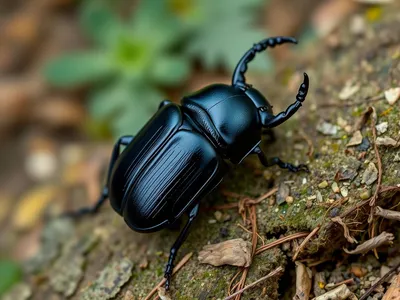
Carrion beetle
Silpha americana
The carrion beetle is a medium-sized beetle renowned for its role in consuming and decomposing dead animals. Sporting a flattened, oval-shaped body, carrion beetles often display distinctive black or dark brown coloration, sometimes with orange or yellow markings. They are primarily nocturnal and are equipped with strong antennae to locate decaying organic matter from a distance. These beetles play a crucial ecological role by recycling nutrients and helping to break down carcasses in forest and grassland ecosystems.
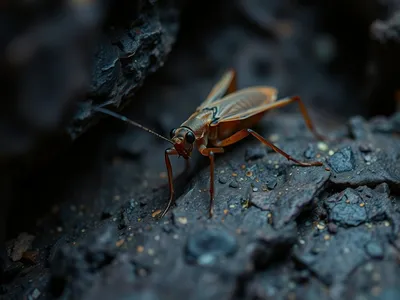
Cave Cricket
Diestrammena asynamora
Cave crickets, also known as camel crickets, are nocturnal insects recognized by their humped backs, long antennae, and powerful hind legs. They are predominantly found in caves, cool damp basements, and other dark, moist environments. Lacking wings, cave crickets rely on their jumping ability to escape predators and navigate their habitats. These insects are generally brownish in color and have a mottled appearance, which helps them blend into their surroundings. Cave crickets are harmless to humans but can become a nuisance when they invade homes in search of moisture.
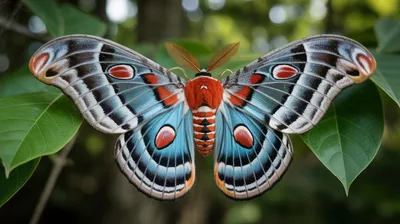
Cecropia Moth
Hyalophora cecropia
The Cecropia Moth is the largest native moth in North America, with a wingspan that can reach up to 7 inches (18 cm). Its striking appearance features reddish-brown wings with bold white, red, and black markings, and crescent-shaped spots. Adults do not eat and live only for a few weeks, focusing solely on reproduction. The caterpillars are equally impressive, growing up to 4 inches long and displaying bright green bodies adorned with blue and yellow tubercles. Cecropia Moths are primarily nocturnal and are often found near light sources during late spring and early summer.
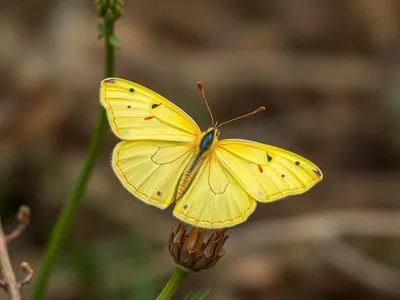
Cloudless Sulfur Butterfly
Phoebis sennae
The Cloudless Sulfur Butterfly is a striking, medium to large butterfly known for its bright, lemon-yellow wings and swift, graceful flight. Commonly seen across the Americas, especially in open, sunny areas, it is easily recognizable by both its vivid coloration and its habit of migrating in large numbers. Adults feed primarily on nectar from a variety of flowers, while their caterpillars prefer plants in the pea family, especially senna. The species plays an important role as a pollinator and as part of the food web, serving as prey for birds and other predators.
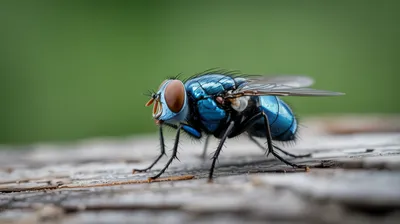
Common Blue Bottle Fly
Calliphora vomitoria
The common blue bottle fly is a large, metallic blue fly frequently found near decaying organic matter and human habitation. Known for its iridescent coloration and robust body, this species plays a critical role in the decomposition process, aiding nutrient recycling in ecosystems. Blue bottle flies are also important in forensic entomology, as their larvae are among the first to colonize decomposing remains. Despite their sometimes unpleasant associations, they contribute to pollination and are a natural part of many terrestrial food webs.