
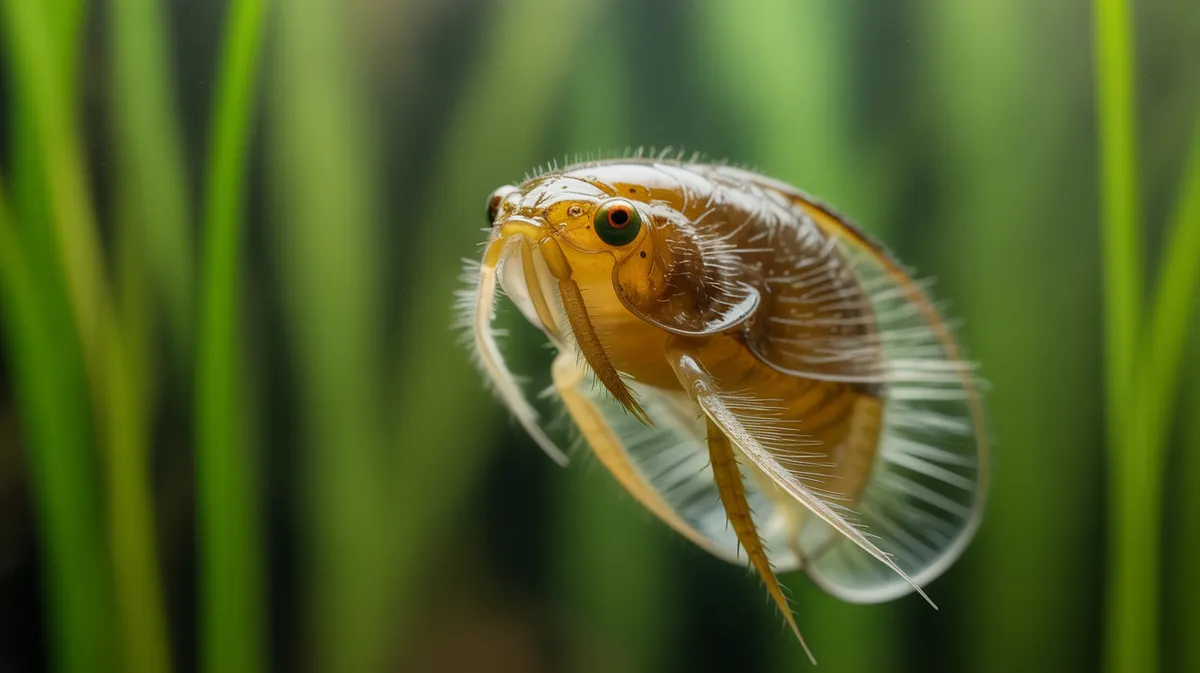
About the Water Flea
Daphnia, the water flea, is not a flea but a small planktonic crustacean, and it is one of the most instructive animals in freshwater biology. It reproduces by cyclical parthenogenesis: in good conditions the population is entirely female and clonal, each mother producing genetically identical daughters, so a lineage can multiply explosively. When conditions deteriorate, through crowding, cold or shortening days, the same females start producing males and switch to sexual reproduction, and the fertilised eggs are packaged in a tough case called an ephippium that can survive drying, freezing and being eaten, sitting dormant in lake sediment for decades. Sex in Daphnia is therefore determined by the environment, not by chromosomes: a genetically identical clone becomes male or female depending on the chemical cues it receives. Even more striking is its inducible defence. If a Daphnia detects the chemical traces of a predator, kairomones from a Chaoborus midge larva or a fish, its offspring grow helmets, neck teeth, elongated tail spines or a larger body, morphologies that never appear when the predator is absent. Because the resting eggs stack up in sediment in datable layers, researchers can hatch century-old eggs and directly compare ancestors with descendants, a technique called resurrection ecology that lets evolution be watched rather than reconstructed.
Fascinating facts
Research Model
Daphnia are extensively used as model organisms in ecological and toxicological studies due to their sensitivity to pollutants.
See-through Body
Their transparent bodies make it easy to observe physiological processes like heartbeat and digestion under a microscope.
Rapid Reproduction
Daphnia can reproduce asexually by parthenogenesis, allowing populations to grow rapidly in favorable conditions.
Detailed description
Daphnia pulex, commonly known as the water flea, is a minute planktonic crustacean typically measuring between 1.0 and 3.0 mm in length. Its body is laterally compressed and enclosed within a transparent, chitinous carapace, allowing for direct observation of internal organs, including the beating heart and developing eggs. The head is distinct, bearing a single compound eye and two pairs of antennae, with the second pair being highly enlarged and adapted for locomotion, producing the characteristic hopping movement. Daphnia pulex possesses five or six pairs of thoracic appendages used for filter feeding, drawing in water and trapping phytoplankton, bacteria, and detritus. The digestive tract is simple and visible through the carapace, often colored by ingested food. Daphnia are primarily solitary but can occur in dense aggregations, especially during population booms. They are highly responsive to environmental cues, exhibiting diel vertical migration to avoid predators and optimize feeding. Daphnia's transparent body and rapid reproductive cycle make them model organisms in ecological, toxicological, and genetic research. Their ability to produce dormant eggs (ephippia) allows survival through adverse conditions such as drought or freezing, contributing to their persistence in variable freshwater habitats.
Did you know?
Daphnia can enter a dormant state by producing hardy eggs that survive harsh conditions, allowing populations to persist even in temporary water bodies.
Research & sources
Wikipedia summary
The Diplostraca or Cladocera, commonly known as water fleas, is a superorder of small, mostly freshwater crustaceans, most of which feed on microscopic chunks of organic matter, though some forms are predatory.
Behaviour & social structure
Daphnia pulex displays a range of behavioral adaptations to its environment. Its primary mode of locomotion is a series of rapid, jerky jumps powered by the rhythmic beating of its second antennae. This movement helps evade predators and maintain position in the water column. Feeding is continuous, with thoracic appendages generating water currents to filter suspended particles. Daphnia are sensitive to changes in light, temperature, and chemical cues, often migrating to deeper waters during the day to avoid visual predators (diel vertical migration) and returning to surface waters at night to feed. Social interactions are minimal, though high densities can lead to competition for resources. When exposed to predator kairomones, Daphnia can develop morphological defenses such as helmets or elongated tail spines, a phenomenon known as inducible defense.
Reproduction & life cycle
Daphnia pulex exhibits cyclical parthenogenesis, alternating between asexual and sexual reproduction. Under favorable conditions, females reproduce asexually, producing clonal offspring every few days, with embryonic development occurring in a brood chamber within the carapace. Each brood can contain 2 to 20 eggs, and juveniles are released after 1–2 days, depending on temperature. When environmental conditions deteriorate (e.g., crowding, food scarcity, or seasonal changes), males are produced, and sexual reproduction occurs. Fertilized eggs are encased in a protective structure called an ephippium, which can withstand desiccation and freezing, remaining viable for years. This reproductive strategy ensures rapid population growth during optimal periods and long-term survival during adverse conditions. There is no parental care beyond the protection of eggs within the brood chamber or ephippium.
Adaptations & survival
Daphnia pulex has evolved several adaptations for survival in freshwater environments. Its transparent body reduces visibility to predators, while the ability to alter body morphology in response to predator presence (inducible defenses) provides additional protection. The production of dormant ephippial eggs ensures persistence through environmental extremes. Daphnia can rapidly adjust reproductive rates and switch between reproductive modes in response to environmental cues. Physiologically, they are tolerant of low oxygen levels, aided by hemoglobin production, which gives some individuals a reddish hue. Their filter-feeding apparatus is highly efficient, enabling exploitation of a wide range of food particles. Behavioral adaptations such as diel vertical migration help balance predation risk and resource acquisition.
Cultural significance
Daphnia pulex holds significant importance in scientific research, particularly in ecology, toxicology, and evolutionary biology. It is a model organism for studying population dynamics, predator-prey interactions, and environmental stress responses. In educational settings, Daphnia are used to demonstrate physiological processes such as heart rate and osmoregulation. While not prominent in folklore or mythology, their role as bioindicators has made them central to water quality monitoring and environmental assessment programs worldwide.
Recent research
Recent genomic studies have revealed that Daphnia pulex possesses one of the largest known numbers of genes among animals, with extensive gene duplication contributing to its adaptability. Ongoing research focuses on the molecular basis of phenotypic plasticity, stress responses, and evolutionary adaptation. Daphnia are widely used in ecotoxicology to assess the effects of pollutants, pharmaceuticals, and microplastics on aquatic ecosystems. Studies on their dormant eggs provide insights into long-term ecological and evolutionary processes, as these eggs can be hatched after decades, allowing for 'resurrection ecology' experiments. Advances in CRISPR and other genetic tools are enabling functional genomics studies in this species.
Videos
Habitat
Freshwater ponds, lakes, and slow-moving streams

Conservation
The Water Flea is currently classified as Least Concern on the IUCN Red List.
Threats & challenges
While Daphnia pulex is not currently threatened and is listed as Least Concern, populations can be impacted by water pollution, eutrophication, habitat loss, and introduction of invasive species. Pesticides, heavy metals, and other contaminants can disrupt reproduction and development. Climate change may alter freshwater habitats, affecting population dynamics and community interactions. Daphnia are also subject to intense predation by fish and invertebrates, which can drive rapid evolutionary changes. Despite these challenges, their high reproductive rate and adaptability generally ensure population resilience.
Taxonomy
Scientific name
Daphnia pulex
- Kingdom
- Animalia
- Phylum
- Arthropoda
- Class
- Branchiopoda
- Order
- Cladocera
- Family
- Daphniidae
- Genus
- Daphnia
- Species
- pulex
Community notes
Share your observations about the Water Flea.
No community notes yet. Be the first!
Discover more wildlife
More fascinating animals from the encyclopedia.