
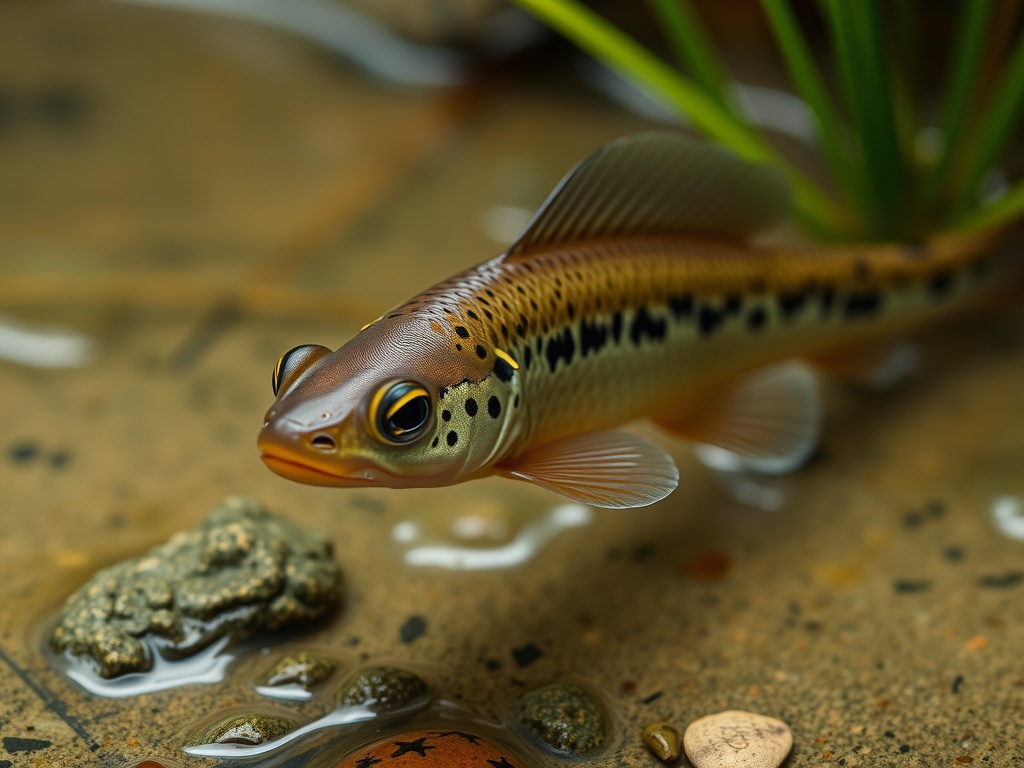
About the Weather Loach
The weather loach, also known as the dojo loach, is a slender, eel-like freshwater fish native to East Asia. It is well known for its sensitivity to changes in barometric pressure, often becoming more active before storms, hence its common name. Weather loaches are bottom-dwellers with barbels around their mouths, which they use to search for food in muddy or sandy substrates. They are hardy, adaptable, and have become a popular species in the aquarium trade and have established populations outside their native range.
Fascinating facts
Weather Predictor
The weather loach becomes notably restless before storms, reacting to drops in barometric pressure.
Air Breather
This species can breathe air directly using its intestine, which helps it survive in poorly oxygenated waters.
Rice Paddy Resident
Weather loaches are commonly found in rice paddies, where their burrowing helps aerate the soil.
Detailed description
The Weather Loach (Misgurnus anguillicaudatus) is a slender, elongated freshwater fish, typically reaching 15–25 cm (6–10 inches) in length, though some individuals can grow up to 30 cm (12 inches). Its body is cylindrical and flexible, covered with small, embedded scales that give it a smooth, slippery texture. The coloration ranges from olive-brown to yellowish or gray, often with dark mottling or spots along the flanks and back. The head is small and slightly flattened, featuring three to five pairs of sensitive barbels around the mouth, which are used to detect food in murky substrates. The dorsal and anal fins are relatively short and set far back on the body, while the caudal fin is rounded. Weather loaches are facultative air-breathers, possessing a highly vascularized posterior intestine that allows them to gulp atmospheric air and extract oxygen, an adaptation for surviving in hypoxic (low-oxygen) waters. They are known for their remarkable activity during changes in barometric pressure, often wriggling energetically before storms. Socially, they are gregarious and often found in loose groups, especially in the wild. Their flexible, burrowing behavior enables them to dig into soft mud or sand to escape predators or unfavorable conditions. This species is long-lived for a small fish, with lifespans of up to 10 years in captivity and somewhat less in the wild.
Did you know?
The weather loach can survive for hours out of water by breathing atmospheric air, thanks to its specialized intestine.
Research & sources
Wikipedia summary
Misgurnus is a genus of true loaches found in Europe and Asia. The origin of the name Misgurnus comes from the Greek word miseo and the Turkish gür (loud), a name given to them due to their habit of becoming very active during barometric pressure changes that occur during thunderstorms. The common names, weather loach or weatherfish, also derive from this behavior. Some species of misgurnus are eaten, mostly in Asia, and are also sold as pets in the aquarium trade. Their average size can range from 6 to over 12 inches.
Behaviour & social structure
Weather loaches are primarily nocturnal and crepuscular, becoming most active during dusk and nighttime hours. They spend much of the day buried in substrate or hiding among aquatic vegetation. Feeding is opportunistic and omnivorous: they consume detritus, small invertebrates (such as insect larvae, worms, and crustaceans), algae, and plant matter. Using their sensitive barbels, they probe the substrate for edible items, often rooting vigorously. In aquaria and natural settings, they are peaceful and non-territorial, frequently seen in small, loosely organized groups. Social interactions include tactile communication, such as nudging or entwining, especially during feeding or stress. Weather loaches are known for their distinctive response to falling barometric pressure, which may involve frenetic swimming, surfacing, and even leaping. This behavior is hypothesized to be an evolved response to impending environmental changes, such as flooding.
Reproduction & life cycle
Breeding typically occurs in late spring to early summer, triggered by rising water temperatures (18–24°C/64–75°F) and increased daylight. Weather loaches are oviparous, with external fertilization. During courtship, males pursue females, displaying increased activity and body undulations. Females lay adhesive eggs (up to several thousand per spawning event) among aquatic plants or submerged debris. Males fertilize the eggs externally. Incubation lasts 2–4 days, depending on temperature. There is no parental care; larvae are free-swimming upon hatching and begin feeding on microscopic organisms. Sexual maturity is reached at 1–2 years of age. In aquaculture, hormonal induction is sometimes used to stimulate spawning.
Adaptations & survival
Key adaptations include the ability to breathe atmospheric air via the posterior intestine, allowing survival in stagnant or oxygen-poor waters. Their elongated, flexible bodies and reduced scales facilitate burrowing and movement through dense substrate. Barbels provide acute chemosensory and tactile perception, essential for locating food in turbid environments. The species’ heightened sensitivity to barometric pressure changes is believed to aid in anticipating environmental disturbances. Weather loaches can tolerate a wide range of temperatures (4–30°C/39–86°F) and water conditions, contributing to their success as both native and introduced species. They also exhibit partial resistance to some pollutants and low pH.
Cultural significance
In East Asian cultures, especially in China and Japan, weather loaches have been valued both as a food source and for their supposed ability to predict weather changes. They are featured in folklore as 'living barometers' and are sometimes kept in jars or ponds for this purpose. In traditional Chinese medicine, they are believed to have health benefits and are used in various remedies. The species is also popular in the aquarium trade worldwide due to its hardiness and unique behaviors. In some regions, they are considered a delicacy and are farmed for consumption.
Recent research
Recent research has focused on the weather loach’s remarkable air-breathing physiology, with studies elucidating the structure and function of the intestinal respiratory system. Genetic studies have explored population structure, hybridization events, and the species’ adaptability to diverse environments. Invasive populations are being monitored for ecological impacts and genetic introgression with native loach species. Behavioral studies continue to investigate the mechanisms underlying barometric pressure sensitivity. Additionally, weather loaches are used as model organisms in toxicology and developmental biology due to their resilience and ease of care.
Videos
Habitat
Slow-moving freshwater streams, ponds, and rice paddies with muddy or sandy bottoms

Conservation
The Weather Loach is currently classified as Least Concern on the IUCN Red List.
Threats & challenges
While the IUCN lists Misgurnus anguillicaudatus as Least Concern, local populations may be threatened by habitat loss (drainage of wetlands, pollution, and river modification), overharvesting for food and the aquarium trade, and competition or hybridization with introduced relatives. Invasive populations, particularly in Europe and North America, can disrupt native ecosystems by competing with indigenous species and altering benthic community structures. Disease transmission and genetic introgression with related loach species are emerging concerns. Climate change, affecting water regimes and temperature, may also pose long-term challenges.
Taxonomy
Scientific name
Misgurnus anguillicaudatus
- Kingdom
- Animalia
- Phylum
- Chordata
- Class
- Actinopterygii
- Order
- Cypriniformes
- Family
- Cobitidae
- Genus
- Misgurnus
- Species
- anguillicaudatus
Community notes
Share your observations about the Weather Loach.
No community notes yet. Be the first!
Discover more wildlife
More fascinating animals from the encyclopedia.