
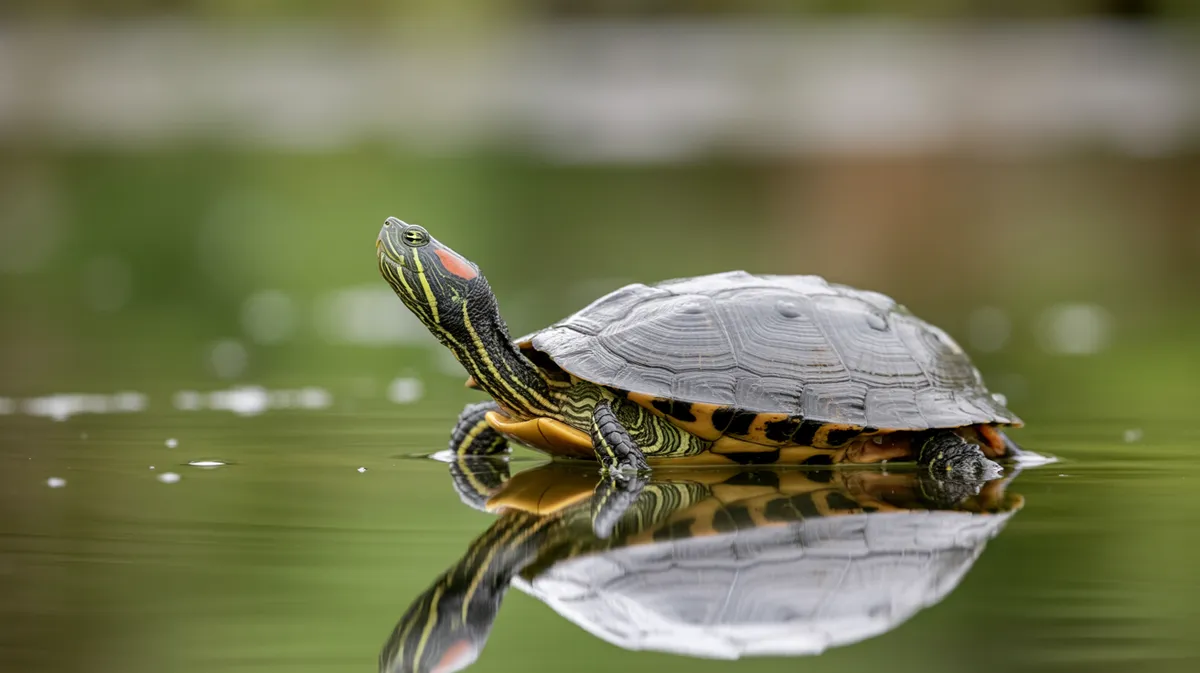
About the Western Painted Turtle
The Western Painted Turtle is the largest subspecies of the painted turtle, recognized by its smooth, olive to black carapace adorned with red and yellow markings along the edges. Native to western North America, these turtles are often found basking on logs or rocks near slow-moving freshwater bodies. Their skin features vibrant yellow stripes, with the undersides of their shells displaying beautiful red and orange patterns. Western Painted Turtles are well-adapted to both aquatic and terrestrial environments, making them one of the most widespread native turtles on the continent.
Fascinating facts
Largest Painted Turtle
The Western Painted Turtle is the largest of all painted turtle subspecies, with adults reaching up to 25 cm (10 inches) in shell length.
Winter Survival
These turtles can survive months in oxygen-poor, icy water by absorbing oxygen directly through their skin and cloaca.
Delayed Hatchlings
Hatchlings often overwinter in the nest, enduring freezing temperatures before emerging in spring.
Detailed description
The Western Painted Turtle (Chrysemys picta bellii) is the largest of the four painted turtle subspecies, with adult females typically reaching carapace lengths of 12–25 cm (4.7–9.8 in), while males are slightly smaller. Its smooth, olive to black carapace is edged with striking red and yellow markings, and the plastron (underside) is often a vivid red or orange with a central dark blotch. The skin is dark green to black with prominent yellow stripes on the head, neck, and limbs. This turtle is highly aquatic, possessing webbed feet and a streamlined shell for efficient swimming, but it also spends significant time basking on logs or rocks to regulate its body temperature. Western Painted Turtles are diurnal, with activity peaking during warm daylight hours. They exhibit a remarkable tolerance for cold, surviving in northern climates by overwintering in mud at the bottom of ponds, where they can absorb oxygen through their skin and cloaca. Their omnivorous diet shifts with age: juveniles are more carnivorous, consuming aquatic invertebrates, while adults eat a greater proportion of aquatic vegetation. Socially, they are often observed basking communally, though they are not territorial. Reproduction involves elaborate courtship behaviors, and females lay eggs in sandy or soft soil near water. Hatchlings may overwinter in the nest, surviving subzero temperatures thanks to physiological adaptations. Fossil evidence indicates that painted turtles have existed in North America for at least 15 million years, demonstrating remarkable evolutionary stability.
Did you know?
Despite being cold-blooded, Western Painted Turtles can remain active at lower temperatures than many other reptiles, even swimming under ice.
Research & sources
Wikipedia summary
The painted turtle is the most widespread native turtle of North America. It lives in relatively slow-moving fresh waters, from southern Canada to northern Mexico, and from the Atlantic to the Pacific. They have been shown to prefer large wetlands with long periods of inundation and emergent vegetation. This species is one of the few that is specially adapted to tolerate freezing temperatures for extended periods of time due to an antifreeze-like substance in their blood that keeps their cells from freezing. This turtle is a member of the genus Chrysemys, which is part of the pond turtle family Emydidae. Fossils show that the painted turtle existed 15 million years ago. Three regionally based subspecies evolved during the last ice age. The southern painted turtle (C. dorsalis) is alternately considered the only other species in Chrysemys, or another subspecies of C. picta.
Behaviour & social structure
Western Painted Turtles are primarily active from late spring through early fall, with peak activity during warm, sunny days. They are adept baskers, often seen in groups on logs or rocks, which helps them thermoregulate and synthesize vitamin D. When threatened, they quickly dive into the water and may bury themselves in mud. Their feeding behavior is opportunistic; they forage for aquatic insects, crustaceans, mollusks, carrion, and a variety of aquatic plants. Juveniles are more carnivorous, while adults consume more plant matter. These turtles use visual and tactile cues during social interactions, particularly during courtship, where males gently stroke the female's face with their elongated claws. They are generally non-aggressive and tolerate the presence of conspecifics, though competition for basking sites can occur. Nocturnal activity is rare, as they rest submerged or buried in substrate at night.
Reproduction & life cycle
Breeding occurs in spring and early summer, often soon after turtles emerge from hibernation. Males court females with a distinctive display, fluttering their long foreclaws against the female's head and neck. Females lay 4–23 eggs per clutch, typically in late spring or early summer, in nests dug in sandy or loose soil up to 200 meters from water. Incubation lasts 72–80 days, but in northern populations, hatchlings may remain in the nest over winter, emerging the following spring. Temperature-dependent sex determination occurs: warmer nest temperatures produce females, cooler temperatures produce males. There is no parental care after egg-laying. Females may lay multiple clutches per season, and sexual maturity is reached at 6–10 years for females and 3–5 years for males.
Adaptations & survival
The Western Painted Turtle exhibits several key adaptations for survival in temperate climates. Its ability to survive months of anoxic (oxygen-deprived) conditions during winter hibernation is facilitated by metabolic depression and the capacity to absorb limited oxygen through the skin and cloaca. Hatchlings produce cryoprotectants (antifreeze-like substances) that prevent lethal ice formation in tissues, allowing them to survive subzero temperatures in the nest. The turtle's flattened, streamlined shell and webbed feet enhance swimming efficiency. Its omnivorous, opportunistic diet allows flexibility in resource use. Bright coloration may serve as camouflage among aquatic vegetation or as a warning to predators. The species' reproductive strategy, including delayed emergence of hatchlings, increases survival in variable climates.
Cultural significance
Painted turtles, including the Western subspecies, hold cultural significance for many Indigenous peoples of North America, often symbolizing longevity, patience, and the Earth itself in folklore and mythology. In some traditions, the turtle is a central figure in creation stories, such as the 'Turtle Island' narrative. Painted turtles are also popular in environmental education and as subjects in art and literature, valued for their vivid coloration and gentle demeanor. However, their collection for the pet trade is now regulated in many areas to protect wild populations.
Recent research
Recent research has focused on the painted turtle's extraordinary physiological adaptations to cold and anoxia, making it a model organism for studies of vertebrate hibernation and freeze tolerance. Genomic studies have revealed genes associated with longevity, immune function, and metabolic depression. Ongoing research is examining the effects of environmental contaminants, such as pesticides and endocrine disruptors, on reproductive success and development. Conservation genetics studies are clarifying subspecies boundaries and hybridization zones. Long-term monitoring projects are tracking population trends in response to habitat alteration and climate change.
Videos
Habitat
Freshwater ponds, lakes, marshes, and slow-moving rivers with soft, muddy bottoms and abundant vegetation.

Conservation
The Western Painted Turtle is currently classified as Least Concern on the IUCN Red List.
Threats & challenges
While the Western Painted Turtle is currently classified as Least Concern by the IUCN, it faces several localized threats. Habitat loss and fragmentation due to wetland drainage, urban development, and agriculture reduce suitable nesting and basking sites. Road mortality is significant, especially for nesting females crossing roads. Pollution, invasive species (such as predatory fish and bullfrogs), and collection for the pet trade also pose risks. Climate change may alter sex ratios through temperature-dependent sex determination and affect overwintering success. Despite these challenges, the species remains widespread and abundant in much of its range, though some populations are declining.
Taxonomy
Scientific name
Chrysemys picta bellii
- Kingdom
- Animalia
- Phylum
- Chordata
- Class
- Reptilia
- Order
- Testudines
- Family
- Emydidae
- Genus
- Chrysemys
- Species
- picta bellii
Where to see a western painted turtle
1 zoo and aquarium in 1 country are recorded as keeping this species.
Community notes
Share your observations about the Western Painted Turtle.
No community notes yet. Be the first!
Discover more wildlife
More fascinating animals from the encyclopedia.