
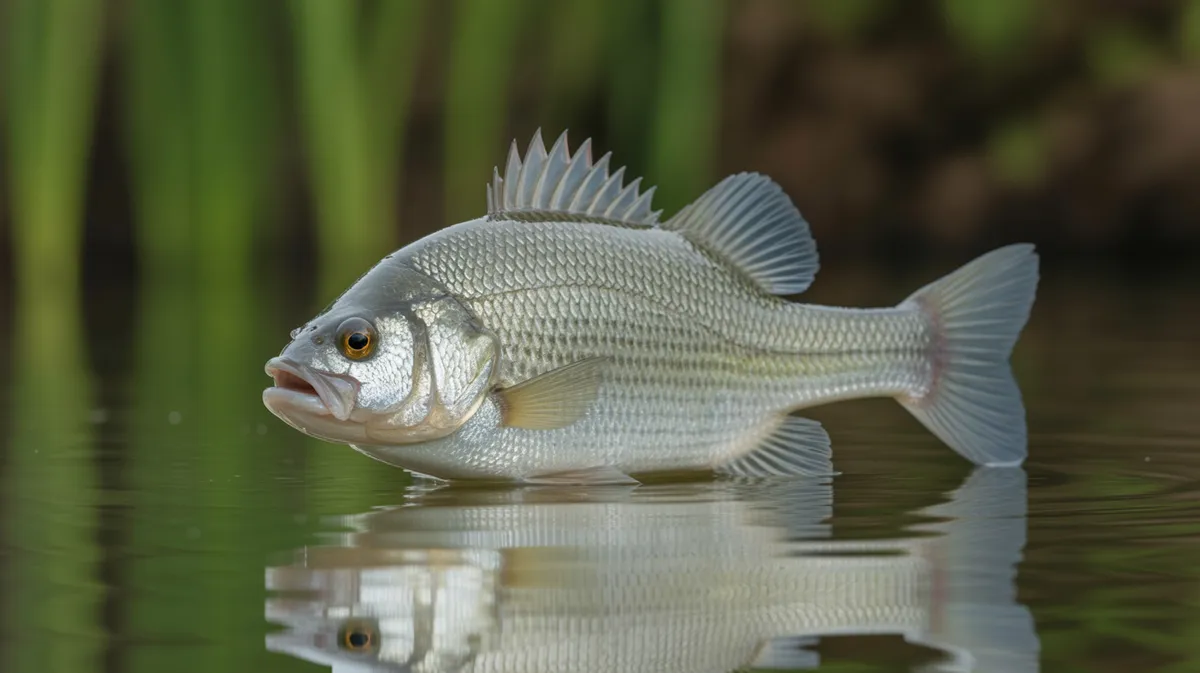
About the White bass
The White bass is a medium-sized freshwater fish native to North America, recognized for its silvery body with distinct horizontal black stripes. It is a schooling fish that thrives in lakes and large rivers, particularly in the Midwestern United States. White bass are known for their vigorous spring spawning runs into tributary streams, where they gather in large numbers. Anglers prize them for their spirited fight, and they play an important role in local ecosystems as both predator and prey.
Fascinating facts
Spawning Runs
White bass migrate upstream in large numbers during spring to spawn, often creating spectacular gatherings in shallow tributaries.
Popular Game Fish
They are highly sought after by anglers for their aggressive strikes and strong, energetic fights when hooked.
Diet
Their diet consists mainly of small fish, crustaceans, and aquatic insects, making them important mid-level predators in their ecosystems.
Detailed description
The white bass (Morone chrysops) is a robust, deep-bodied freshwater fish typically measuring 30–38 cm (12–15 inches) in length, though individuals can reach up to 45 cm (18 inches) and weigh over 2 kg (4.4 lbs). Its body is laterally compressed, with a slightly arched back and a blunt head. The coloration is generally silvery-white to pale green, with a darker, olive-gray back and several narrow, horizontal black stripes running along the sides, which are more pronounced in adults. The scales are large and rough (ctenoid), providing protection and reducing drag in water. White bass possess two dorsal fins: the first is spiny and the second soft-rayed, a characteristic of the Moronidae family. The mouth is large and terminal, equipped with small, sharp teeth adapted for grasping prey. The lateral line is well-developed, aiding in detecting vibrations and movement in the water. White bass are highly migratory within their freshwater habitats, forming large schools that move collectively, especially during spawning runs. Their streamlined body and powerful caudal fin enable rapid bursts of speed, useful for both predation and evasion. They are opportunistic feeders, and their anatomy reflects adaptations for both pelagic and benthic foraging.
Did you know?
Despite their name, white bass are not closely related to true bass like largemouth or smallmouth bass, but are actually members of the temperate bass family.
Research & sources
Wikipedia summary
The white bass, silver bass, or sand bass is a freshwater fish of the temperate bass family Moronidae. commonly around 12–15 inches long. The species' main color is silver-white to pale green. Its back is dark, with white sides and belly, and with narrow dark stripes running lengthwise on its sides. It has large, rough scales and two dorsal fins. They are widely distributed across North America, inhabiting large reservoirs and rivers. When mating in the spring, they are more often found in shallow rivers, creeks, and streams. They have been introduced in some places as sport fish and also to predate on nuisance fish, such as gizzard shad. It is the state fish of Oklahoma.
Behaviour & social structure
White bass are diurnal and display pronounced schooling behavior, especially outside the breeding season. Schools can number in the hundreds or thousands, providing safety in numbers and increasing foraging efficiency. They are active hunters, preying primarily on small fish (such as shad and minnows), aquatic insects, and crustaceans. Feeding activity peaks during dawn and dusk (crepuscular periods), when prey is most abundant near the surface. White bass use coordinated group tactics to herd baitfish into tight balls before striking. During non-breeding periods, they inhabit open waters of lakes and reservoirs, often at mid-depths, but may move into shallower areas to feed. Social hierarchies are not well-documented, but larger individuals may dominate prime feeding locations. In colder months, activity decreases, and schools may move to deeper, more stable thermal refuges.
Reproduction & life cycle
White bass exhibit a distinct annual spawning migration, typically occurring from March to May when water temperatures reach 12–18°C (54–64°F). Mature adults ascend tributary streams, rivers, and shallow gravelly areas of lakes to spawn in large aggregations. Spawning is broadcast-style: females release between 50,000 and 1 million adhesive eggs into the water column, which are then externally fertilized by multiple males. The eggs adhere to submerged vegetation, gravel, or debris and hatch within 2–3 days, depending on temperature. There is no parental care; larvae are planktonic and drift downstream or disperse into open water. Sexual maturity is reached at 2–3 years of age. Spawning success is highly dependent on water levels, temperature, and flow conditions, with high spring flows often resulting in better recruitment.
Adaptations & survival
White bass possess several adaptations for their predatory and migratory lifestyle. Their laterally compressed body and deeply forked tail enable fast, agile swimming, essential for both chasing prey and avoiding predators. The well-developed lateral line system enhances their ability to detect prey and coordinate schooling movements. Their large mouth and sharp teeth are suited for capturing slippery, fast-moving fish. The adhesive nature of their eggs increases the likelihood of survival by anchoring them to substrates, reducing predation and dispersal by currents. Physiologically, they tolerate a wide range of temperatures and low dissolved oxygen, allowing them to thrive in both rivers and large reservoirs. Their schooling behavior is an effective anti-predator strategy and improves foraging efficiency.
Cultural significance
White bass hold considerable value in recreational angling communities, particularly in the Midwest and Southern United States, where spring spawning runs are a celebrated event. They are prized for their spirited fight and are often targeted by both shore and boat anglers. In Oklahoma, the white bass is designated as the state fish, reflecting its importance to local heritage and outdoor traditions. While not a major commercial species, white bass are sometimes harvested for food, with firm, white flesh considered palatable. There is little evidence of significant mythological or symbolic roles, but their presence in local festivals and fishing tournaments underscores their cultural relevance.
Recent research
Recent research has focused on the ecological impacts of white bass introductions outside their native range, particularly regarding competition with native species and hybridization with striped bass. Studies have also examined their role in controlling populations of nuisance fish such as gizzard shad, with mixed results depending on ecosystem context. Ongoing genetic studies are investigating population structure and the extent of hybridization with other Morone species. Advances in telemetry and otolith microchemistry are providing new insights into their migratory patterns, habitat use, and responses to environmental change. Conservation research is increasingly addressing the potential impacts of climate change and habitat fragmentation on spawning success and recruitment.
Videos
Habitat
Freshwater lakes and rivers

Conservation
The White bass is currently classified as Least Concern on the IUCN Red List.
Threats & challenges
Currently, the white bass is classified as Least Concern by the IUCN, with stable populations across much of its native range. However, localized threats include habitat degradation from dam construction, water pollution, and altered flow regimes, which can disrupt spawning migrations and reduce reproductive success. Overfishing is not a significant concern due to high fecundity and widespread distribution, but in some areas, intense angling pressure may impact local stocks. Hybridization with introduced striped bass (Morone saxatilis) can occur, producing hybrid 'wipers,' which may affect genetic integrity. Climate change poses a potential long-term threat by altering hydrological cycles and water temperatures, possibly impacting spawning cues and nursery habitat availability.
Taxonomy
Scientific name
Morone chrysops
- Kingdom
- Animalia
- Phylum
- Chordata
- Class
- Actinopterygii
- Order
- Perciformes
- Family
- Moronidae
- Genus
- Morone
- Species
- chrysops
Community notes
Share your observations about the White bass.
No community notes yet. Be the first!
Discover more wildlife
More fascinating animals from the encyclopedia.