
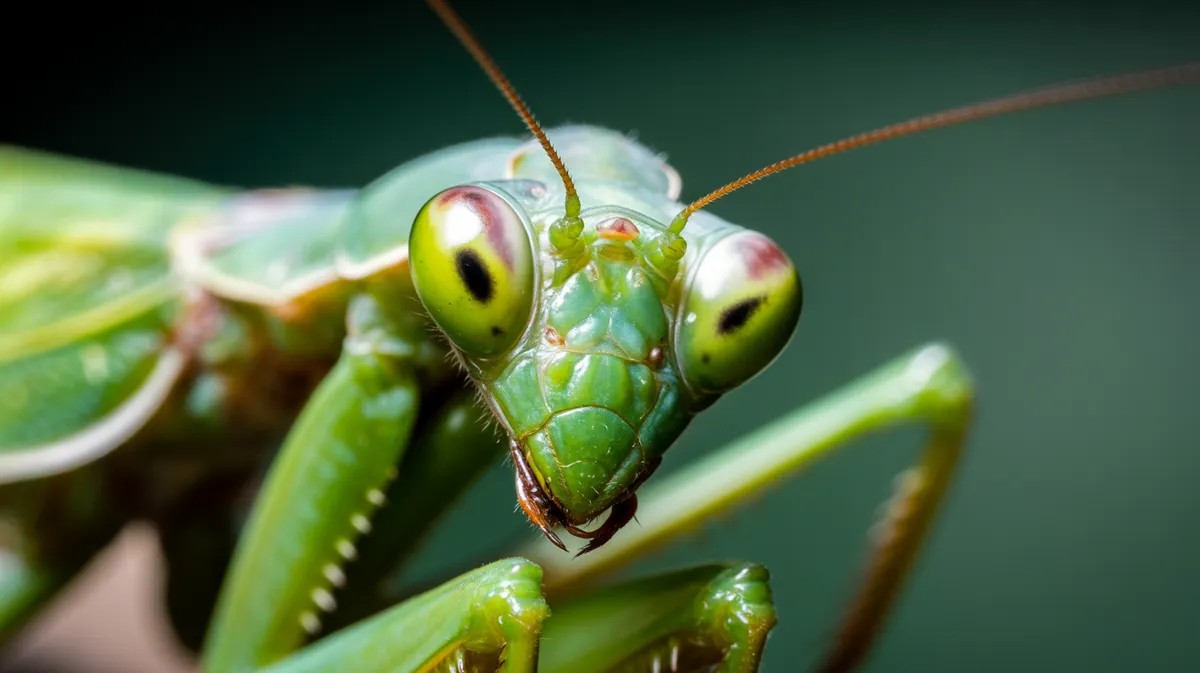
Few insects are as iconic — or as misunderstood — as the praying mantis. We're told the female always bites off her mate's head, that it's illegal to kill one, and that they're harmless little leaf-sitters. The reality is a far stranger predator with five eyes, 3D vision, and a taste for hummingbirds. This entry in our Animal Myths, Debunked series sets the record straight on the insect world's most accomplished ambush hunter.
With around 2,400 species worldwide, mantises are diverse, deadly to their prey, and harmless to you. Here are seven myths to drop. See also Komodo dragons and sloths in the series.
Myth 1: The female always eats the male's head during mating
The most famous "fact" about mantises is that the female decapitates her partner every time they mate.
Sexual cannibalism is real but far from universal. It happens in only a minority of wild matings — often when the female is hungry or stressed — and many pairs mate with no cannibalism at all.
Much of the gruesome reputation comes from early lab studies where stressed, hungry captive females were more likely to attack, exaggerating how often it really occurs.
In some species the male even has tricks to mate safely, approaching cautiously from behind to avoid becoming a meal.
Myth 2: It's illegal to kill a praying mantis
Generations of children have been warned there's a fine for harming a praying mantis.
It's a complete urban legend, especially common in the United States. No such law exists, and mantises have never been a protected species on those grounds.
They're simply beneficial garden insects worth keeping around — but there's no law on the books about them.
The legend may have spread simply because adults wanted to discourage children from harming a helpful garden predator.
Myth 3: Praying mantises are dangerous to humans
Those spiked, grasping forelegs can look menacing.
Mantises are completely harmless to people. They have no venom, and the worst a large one can manage is a startling but minor pinch if handled carelessly.
To a cricket or a fly they're a nightmare; to you they're a harmless, fascinating garden guest.
Mantises are so harmless that they're kept as pets and sold as natural pest control, their egg cases shipped to gardeners worldwide.
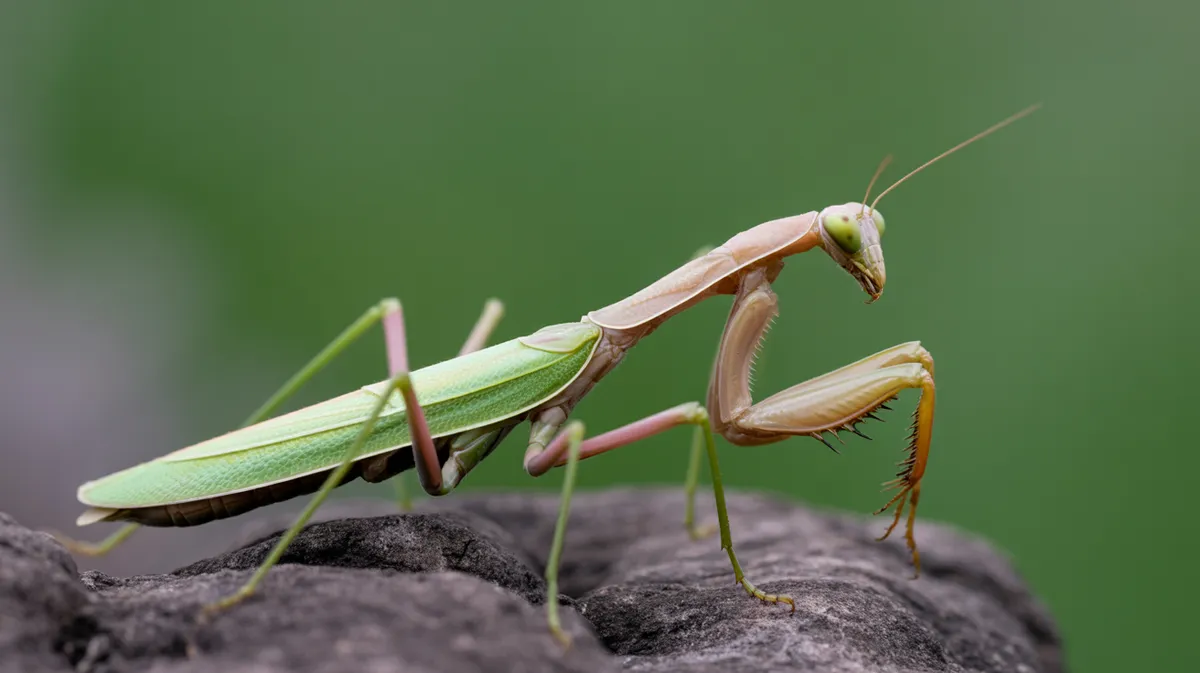
Myth 4: The "praying" pose is peaceful
The folded forelegs that give the mantis its name look serene, even reverent.
That posture is anything but peaceful — it's a coiled ambush stance, holding those spined, grasping legs ready to snap shut on prey in a fraction of a second.
The "praying" mantis is really a "preying" mantis, frozen in the act of lying in wait.
When prey wanders within range, the strike is among the fastest movements in nature — over in about a tenth of a second, too quick for the human eye to follow.
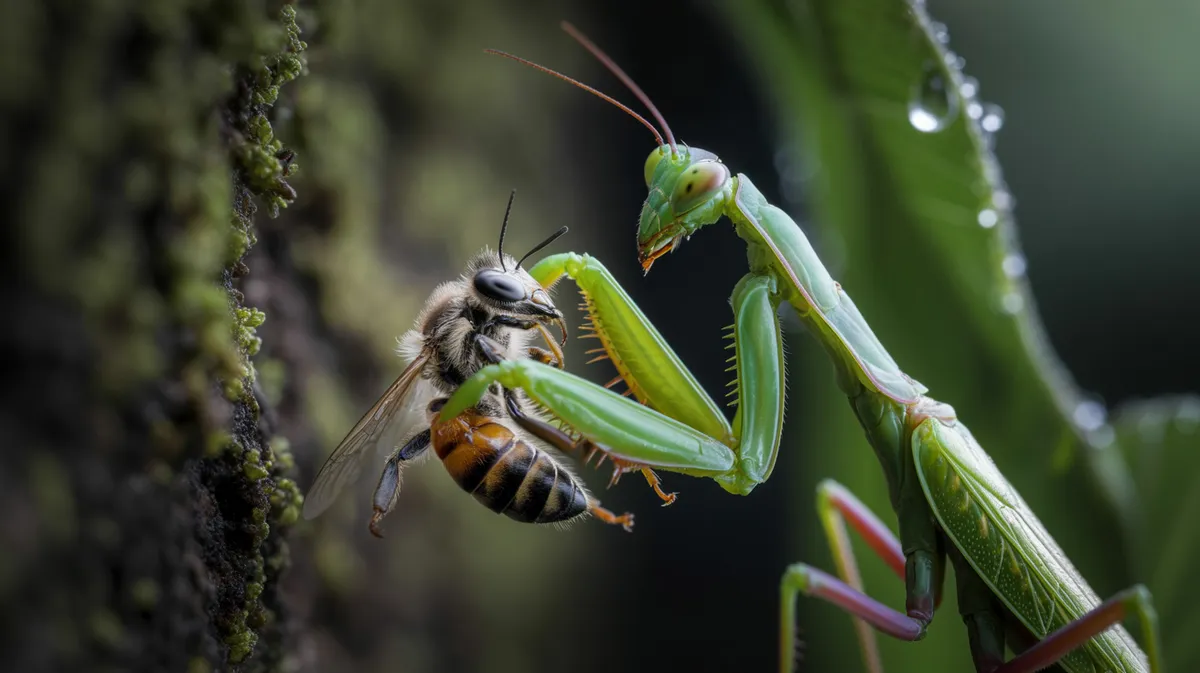
Myth 5: Mantises only eat other insects
We picture mantises snacking on flies and crickets and nothing more.
Large mantises are bold enough to tackle small vertebrates, and there are documented cases of them catching hummingbirds, lizards, frogs, and even small mice.
Anything they can grip and overpower is fair game for a big, hungry mantis.
These vertebrate kills are rare and need a large mantis, but they show just how formidable an ambush predator the insect can be.
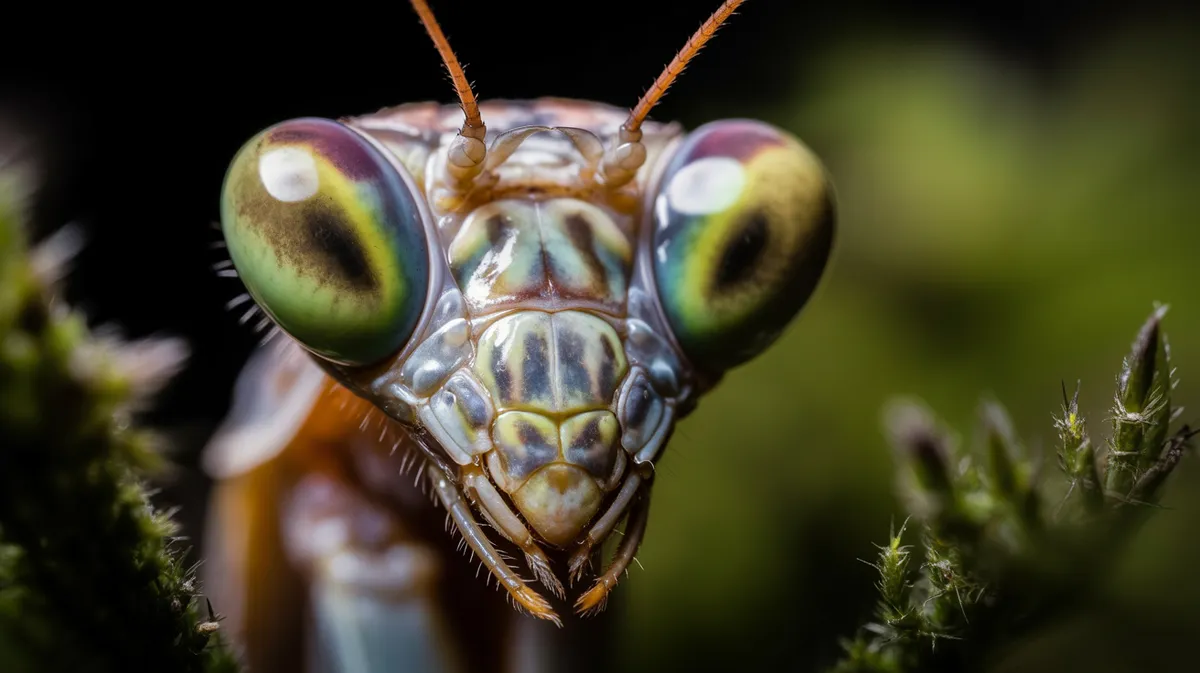
Myth 6: A mantis has just two eyes and poor vision
Like most insects, mantises are assumed to have simple, blurry vision.
A mantis actually has five eyes — two large compound eyes plus three simple eyes between them — and exceptionally sharp sight.
Most remarkably, the praying mantis is the only insect known to have true 3D, stereoscopic vision, letting it judge the exact distance to its prey before it strikes.
The dark spot that seems to follow you around a mantis's eye isn't a pupil but an optical illusion called a pseudopupil, caused by light sinking into the eye's facets.
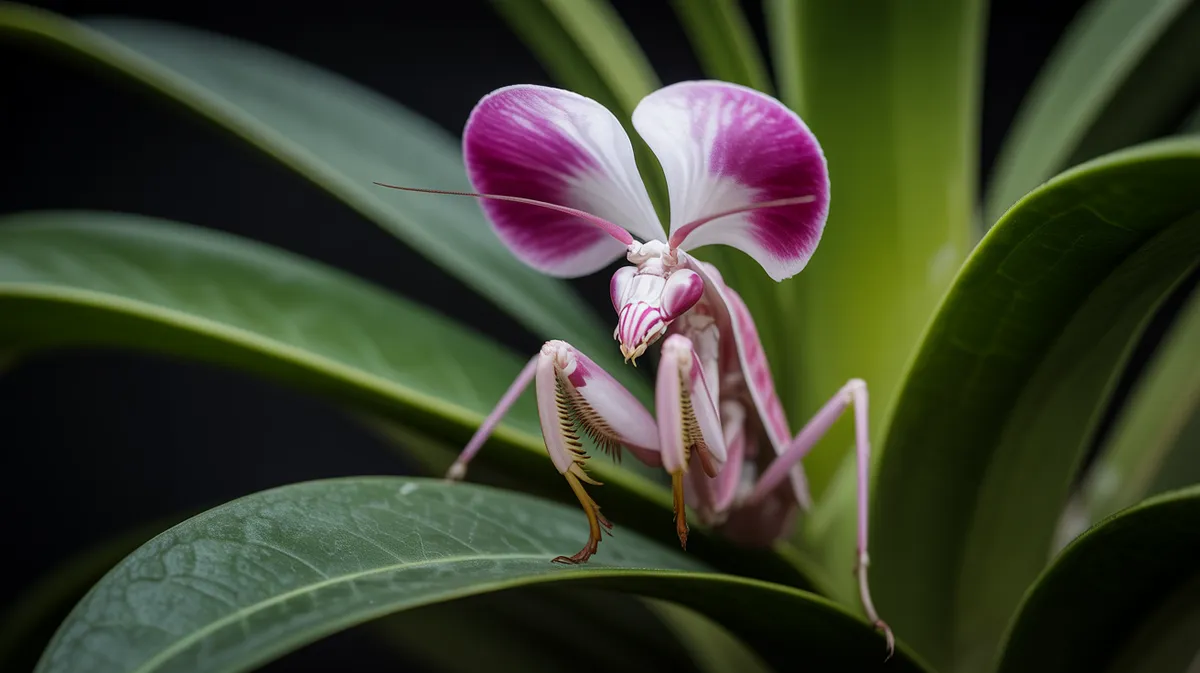
Myth 7: A "praying mantis" is a single kind of insect
We tend to think of "the" praying mantis as one species.
There are roughly 2,400 mantis species around the world, in a dazzling range of shapes and disguises.
Some mimic flowers, like the stunning orchid mantis, while others impersonate dead leaves or twigs so convincingly they vanish in plain sight.
That diversity lets mantises live almost everywhere warm, from rainforest to desert, each species disguised to match its own surroundings.
Three more myths, quickly
"A mantis is pure garden pest control" — They are entirely indiscriminate. A mantis will eat aphids and caterpillars, but it will just as happily eat bees, butterflies, and other beneficial insects.
"Mantises live for years" — Most live less than a year, often just a single season, dying as the cold arrives after leaving their egg case behind.
"A mantis egg case is dangerous" — An ootheca is a harmless foam that hardens into a papery capsule. Left alone, it hatches dozens or hundreds of miniature mantises.
Why mantises deserve a closer look
Strip away the myths and the praying mantis becomes even more impressive: a sharp-eyed, three-dimensional ambush specialist in thousands of disguises. It's one of the most sophisticated hunters in the entire insect world.
Frequently asked questions
Do female mantises always eat the male's head? No — sexual cannibalism happens only in a minority of matings, and was exaggerated by stressed captive studies.
Is it illegal to kill a praying mantis? No, that's an urban legend. There's no such law.
How many eyes does a praying mantis have? Five — two compound eyes and three simple ones — with unique 3D vision.
What do praying mantises eat? Mostly other insects, though the largest species will take small vertebrates such as lizards and hummingbirds.
How big do mantises get? Most are only a few centimetres long, but the largest species reach around 15 centimetres.
Can you keep a mantis as a pet? Yes. They are popular, low-maintenance pets, though they need live food and space to moult safely.
How do mantises reproduce? The female lays an ootheca — a foam egg case that hardens and can contain hundreds of eggs.
Continue with 7 myths about sloths, debunked, or revisit 7 myths about Komodo dragons.