
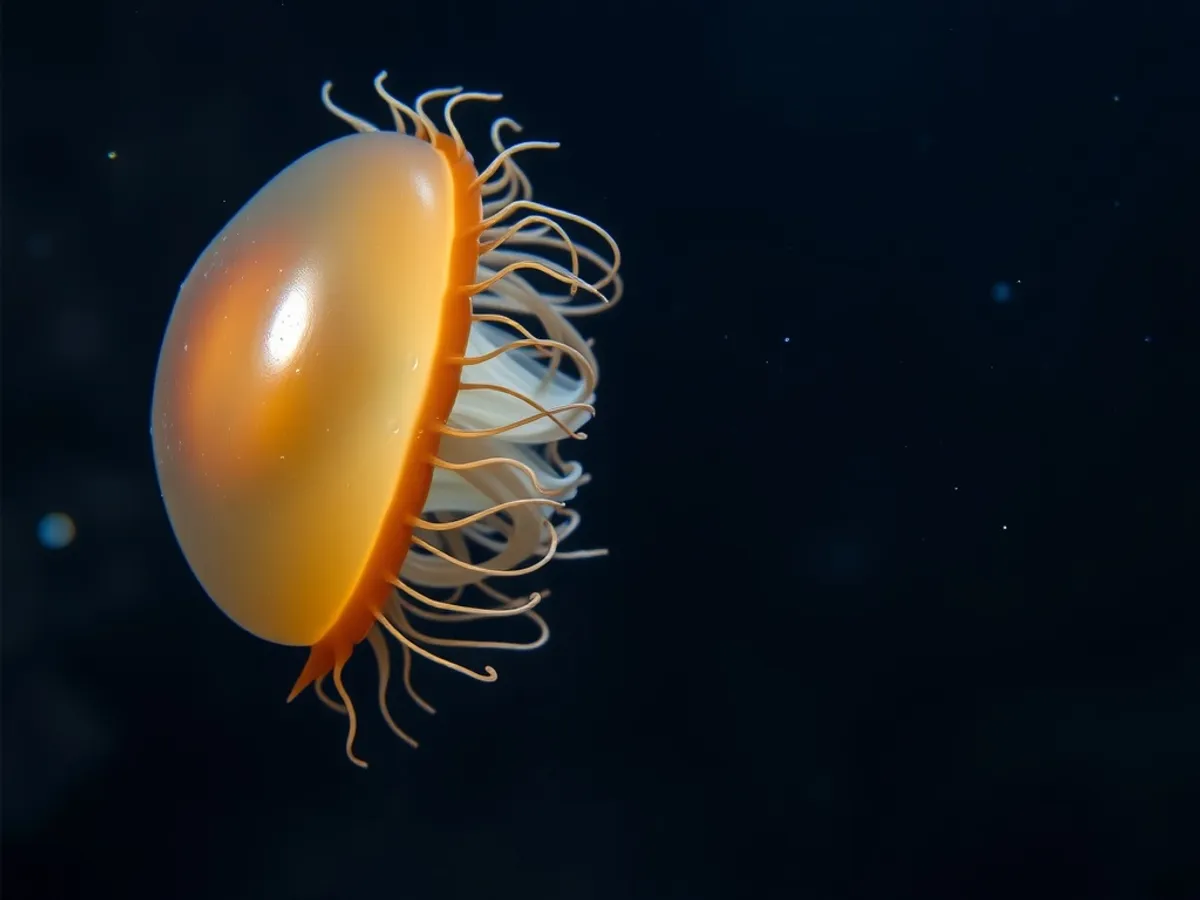
About the Abyssal Comb Jelly
The Abyssal Comb Jelly, Bathocyroe fosteri, is a translucent, deep-sea ctenophore notable for its delicate, balloon-like body and shimmering rows of cilia used for locomotion. Found at great oceanic depths, this invertebrate often drifts in the midwater column, capturing small prey with its lobes. Its bioluminescent capabilities create mesmerizing light displays, which may serve as camouflage or to deter predators. Despite its fragile appearance, the Abyssal Comb Jelly is well-adapted to the extreme pressure and darkness of the deep sea.
Fascinating facts
Deep-sea Drifter
The Abyssal Comb Jelly spends its entire life drifting in the deep ocean, sometimes at depths greater than 2,500 meters below the surface.
Bioluminescent Glow
It produces its own light through bioluminescence, which can help it avoid predators or communicate.
Unique Locomotion
Instead of using muscles to swim, it rows along using bands of tiny cilia, creating waves of rainbow-like light.
Detailed description
Bathocyroe fosteri, commonly known as the Abyssal Comb Jelly, is a lobate ctenophore distinguished by its transparent, gelatinous body, which typically measures 2–4 cm in length but can reach up to 6 cm. Its body is laterally compressed and balloon-like, with two prominent oral lobes that extend from the mouth region and are used to envelop and trap prey. Eight rows of iridescent ciliary plates, or 'combs,' run longitudinally along the body, refracting light to produce shimmering rainbow effects. The animal's tissues are highly hydrated (over 95% water), contributing to its delicate, almost ethereal appearance. Bathocyroe fosteri is bioluminescent, emitting blue-green light when disturbed, a trait thought to serve both as camouflage through counter-illumination and as a predator deterrent. Internally, it possesses a simple digestive system with a central mouth and a pair of short anal pores. Unlike many shallow-water ctenophores, B. fosteri lacks tentacles, relying instead on its lobes and mucus to capture prey. It is a solitary drifter, rarely observed in groups, and is adapted to survive at depths ranging from 700 to over 2,000 meters, where temperatures are near freezing and pressures are immense. Its fragile structure is an adaptation to the high-pressure, low-energy environment of the deep sea, allowing it to maintain buoyancy and minimize energy expenditure.
Did you know?
Abyssal Comb Jellies can withstand pressures over a thousand times greater than at the surface, thriving at depths exceeding 2,000 meters.
Research & sources
Behaviour & social structure
Bathocyroe fosteri is a passive ambush predator, typically drifting motionless in the water column with its oral lobes extended to maximize prey capture. When small zooplankton or copepods contact the sticky mucus coating its lobes, the comb jelly rapidly contracts its lobes to engulf the prey and transfer it to its mouth. Locomotion is achieved by coordinated beating of the ciliary comb rows, allowing for slow, graceful movement and precise orientation in the water. The species exhibits diel vertical migration, occasionally moving to slightly shallower depths at night to exploit prey abundance, though it generally remains within the bathypelagic zone. Social interactions are minimal; individuals are usually solitary, and there is no evidence of cooperative behavior or aggregation. Bathocyroe fosteri is highly sensitive to changes in water movement and light, responding to disturbances with bursts of bioluminescence.
Reproduction & life cycle
Bathocyroe fosteri is hermaphroditic, possessing both male and female reproductive organs, a common trait among ctenophores. Reproduction is believed to occur via external fertilization, with individuals releasing eggs and sperm into the surrounding water. Spawning may be continuous or triggered by environmental cues such as food availability or temperature changes, though specific breeding seasons are not well documented due to the animal's deep-sea habitat. Fertilized eggs develop into free-swimming larvae (cydippid stage), which gradually metamorphose into adult forms. There is no parental care; offspring are planktonic and must survive independently from hatching. Detailed studies on embryonic development and larval dispersal are limited due to the logistical challenges of deep-sea research.
Adaptations & survival
Bathocyroe fosteri exhibits several key adaptations for deep-sea survival. Its gelatinous, low-density body aids in neutral buoyancy, reducing the need for active swimming and conserving energy. The absence of rigid structures allows it to withstand extreme hydrostatic pressures. Bioluminescence serves multiple functions, including predator avoidance (startle displays), camouflage (counter-illumination), and possibly intraspecific signaling. The animal's lobate morphology, with large, mucus-coated oral lobes, is an evolutionary specialization for efficient prey capture in the sparse deep-sea environment. Its slow metabolism and low energy requirements are further adaptations to the limited food supply at abyssal depths.
Cultural significance
Bathocyroe fosteri has no known role in traditional human culture, mythology, or symbolism, largely due to its remote habitat and recent scientific discovery (first described in 1992). However, it has become an emblematic species in deep-sea exploration, often featured in documentaries and educational materials to illustrate the diversity and wonder of abyssal life. Its bioluminescence and delicate appearance have inspired artistic representations and public fascination with deep-sea organisms.
Recent research
Recent research on Bathocyroe fosteri has focused on its bioluminescent mechanisms, ecological role in deep-sea food webs, and physiological adaptations to high pressure and low temperature. Advances in remotely operated vehicle (ROV) technology have enabled in situ observations and specimen collection, revealing new insights into its behavior and distribution. Genetic studies are underway to clarify its evolutionary relationships within the Ctenophora phylum. Notably, a 2016 study using high-definition video from the NOAA Okeanos Explorer provided the first detailed footage of its feeding behavior and bioluminescent displays. Ongoing research aims to understand the impacts of environmental change on deep pelagic ctenophores and their role in carbon cycling.
Sources
Bathocyroe fosteri n. sp., a common midwater lobate ctenophore from the Mid-Atlantic Ridge
Madin, L.P. & Harbison, G.R. (1992)
scientificBathocyroe fosteri: A new species of lobate ctenophore from the deep sea
Maddox, J.R., & R.R. Hopcroft (1996)
scientificObservations on the natural history and behavior of Bathocyroe fosteri
Haddock, S.H.D., & J.F. Case (1999)
scientificIUCN Red List of Threatened Species: Bathocyroe fosteri
International Union for Conservation of Nature (IUCN)
conservationBathocyroe fosteri: A new species of lobate ctenophore from the deep sea
Madin, L.P. & Harbison, G.R. (1992)
scientificVideos
Habitat
Deep ocean (abyssal and bathypelagic zones)

Conservation
The Abyssal Comb Jelly is currently classified as Least Concern on the IUCN Red List.
Threats & challenges
Currently, Bathocyroe fosteri faces few direct threats due to its deep-sea habitat, which is largely inaccessible to human activity. However, emerging concerns include the impacts of deep-sea mining, climate change (such as ocean acidification and warming), and pollution (including microplastics) that may affect deep pelagic ecosystems. Population trends are unknown due to the difficulty of conducting comprehensive surveys at such depths, but the species is not considered at risk and is listed as Least Concern. The main conservation challenge is the lack of baseline data on population size, distribution, and long-term ecological trends.
Taxonomy
Scientific name
Bathocyroe fosteri
- Kingdom
- Animalia
- Phylum
- Ctenophora
- Class
- Tentaculata
- Order
- Lobata
- Family
- Bathocyroidae
- Genus
- Bathocyroe
- Species
- fosteri
Community notes
Share your observations about the Abyssal Comb Jelly.
No community notes yet. Be the first!
Discover more wildlife
More fascinating animals from the encyclopedia.