
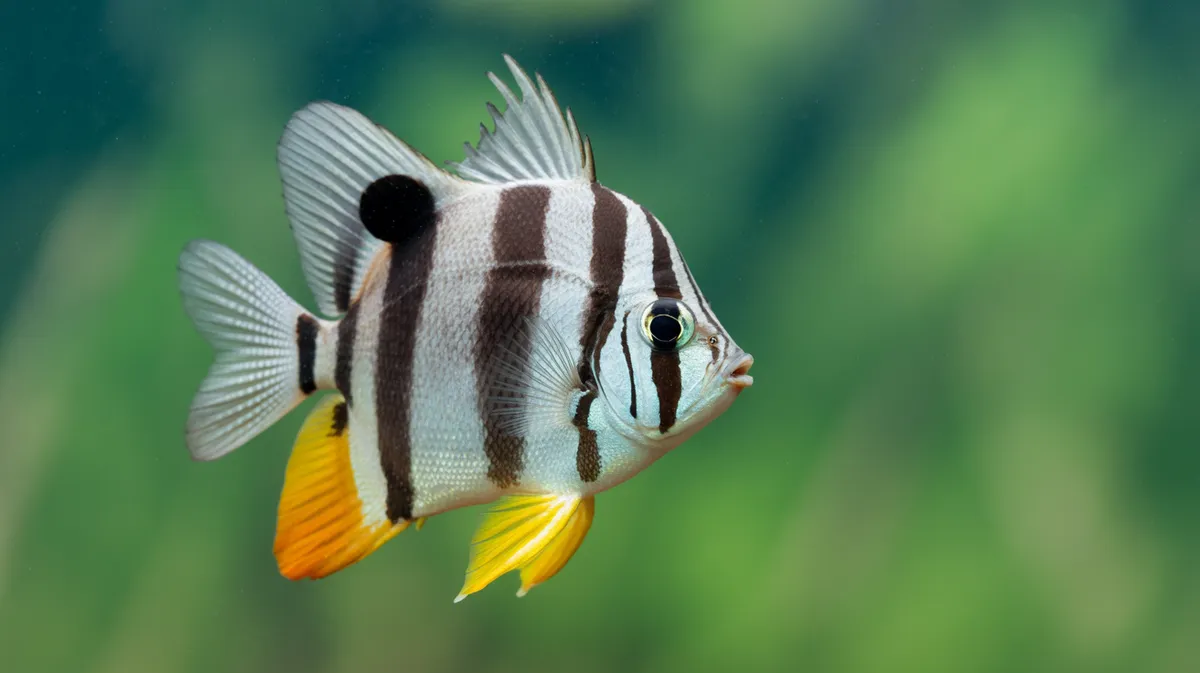
About the African Butterflyfish
The African Butterflyfish is a distinctive freshwater fish known for its broad, wing-like pectoral fins and surface-dwelling lifestyle. Native to slow-moving rivers and swamps of West and Central Africa, this fish is specially adapted for life at the water's surface, where it hunts insects and small invertebrates. Its flattened body and upturned mouth allow it to capture prey efficiently, while its camouflage helps avoid predators. African Butterflyfish are popular in the aquarium trade due to their unique appearance and fascinating behaviors.
Fascinating facts
Wing-like Fins
Their large, fan-shaped pectoral fins resemble the wings of a butterfly, which they use to glide above the water surface.
Surface Hunter
African Butterflyfish spend most of their time at the water's surface, waiting to ambush insects and small animals that land nearby.
Ancient Lineage
They are the only living species in their genus and family, with evolutionary roots dating back more than 100 million years.
Detailed description
The African Butterflyfish (Pantodon buchholzi) is a small, surface-dwelling freshwater fish notable for its highly specialized morphology and behavior. Adults typically reach a maximum length of 13 cm (5 inches), with a laterally compressed, elongated body and an upturned mouth perfectly adapted for surface feeding. Its most striking feature is the pair of large, wing-like pectoral fins, which are not only used for gliding short distances above the water but also for stabilizing the fish at the water’s surface. The dorsal and anal fins are set far back on the body, contributing to its streamlined, surface-oriented profile. The coloration is generally mottled brown and tan, providing effective camouflage among floating vegetation and detritus. The eyes are large and positioned dorsally, allowing the fish to scan the water surface for prey. African Butterflyfish are primarily nocturnal or crepuscular, remaining motionless during the day and becoming more active at dusk. Their unique anatomical and behavioral adaptations make them highly efficient ambush predators in their native habitats, which include slow-moving rivers, swamps, and floodplains across West and Central Africa, particularly within the Congo Basin.
Did you know?
Despite their name, African Butterflyfish are not related to marine butterflyfish; they belong to a unique, ancient lineage of freshwater fish.
Research & sources
Wikipedia summary
African butterflyfish may refer to:Freshwater butterflyfish, Pantodon bulchhozi, a freshwater bonytongue fish Chaetodon dolosus, a saltwater butterflyfish
Behaviour & social structure
African Butterflyfish are solitary and territorial, often occupying a specific patch of surface water among floating plants. They are ambush predators, remaining almost motionless with their pectoral fins spread wide to mimic leaves or debris. When prey such as insects, spiders, or small crustaceans land on the water surface, the fish rapidly lunges upward, snapping them up with its large, upturned mouth. They are also capable of leaping out of the water to catch low-flying insects, using their pectoral fins to glide short distances. Feeding typically occurs at dawn and dusk, aligning with peak insect activity. Social interactions are limited outside of the breeding season, and individuals may display aggression toward conspecifics if space is limited. In captivity, they are best kept singly or in large, well-vegetated tanks to minimize stress and aggression.
Reproduction & life cycle
Pantodon buchholzi exhibits a unique reproductive strategy among freshwater fishes. During courtship, males display to females by spreading their pectoral fins and performing a series of rapid movements at the water surface. Fertilization is external; the female releases up to 200 eggs, which are fertilized by the male and float to the surface due to their oil-rich, buoyant nature. There is no parental care post-spawning. Eggs hatch within 36–48 hours at optimal temperatures (24–28°C), and the fry remain near the surface, feeding on microscopic organisms. Sexual maturity is typically reached within 6–8 months under favorable conditions. Breeding may occur year-round in equatorial regions but is often linked to seasonal flooding in the wild, which increases habitat complexity and food availability.
Adaptations & survival
The African Butterflyfish possesses several remarkable adaptations for surface life. Its large, wing-like pectoral fins allow for both stabilization at the air-water interface and short gliding flights above the surface to escape predators or catch prey. The upturned mouth and dorsally positioned eyes are specialized for detecting and capturing prey at or above the water surface. The fish’s coloration and body shape provide camouflage among floating vegetation, reducing predation risk. Additionally, Pantodon buchholzi has a modified swim bladder that functions as a primitive lung, enabling it to gulp atmospheric air and survive in hypoxic (low-oxygen) environments typical of stagnant waters. This facultative air-breathing ability is crucial during dry seasons when dissolved oxygen levels drop.
Cultural significance
While the African Butterflyfish does not have significant traditional or mythological importance in indigenous African cultures, it has gained popularity worldwide as an ornamental species in the aquarium trade due to its unique appearance and behaviors. Its gliding and hunting techniques often fascinate aquarists and have been featured in educational materials about fish adaptations and surface-dwelling species. In some regions, it is occasionally used in local folklore as a symbol of agility and stealth, but such references are rare.
Recent research
Recent research has focused on the biomechanics of the African Butterflyfish’s gliding ability, revealing convergent evolution with flying fish and certain amphibians. Studies using high-speed videography have documented the precise role of pectoral fins in both stabilization and aerial movement. Genetic analyses have clarified its phylogenetic placement within the Osteoglossiformes, confirming its status as the sole member of the family Pantodontidae. Ongoing ecological studies are examining its role in controlling surface insect populations and its responses to environmental stressors such as hypoxia and habitat fragmentation. There is also interest in the species’ unique air-breathing physiology as a model for evolutionary transitions between aquatic and terrestrial respiration.
Videos
Habitat
Freshwater rivers, swamps, and lakes

Conservation
The African Butterflyfish is currently classified as Least Concern on the IUCN Red List.
Threats & challenges
Currently assessed as Least Concern by the IUCN, the African Butterflyfish faces localized threats from habitat degradation, pollution, and over-collection for the aquarium trade. Deforestation and wetland drainage in parts of its range can reduce suitable habitat, while water pollution from agricultural runoff may impact water quality and prey availability. However, the species’ broad distribution and adaptability to various freshwater habitats have helped maintain stable populations. Climate change poses a potential long-term threat by altering rainfall patterns and water levels in its native range. Sustainable management of wild populations and habitat conservation are important for long-term viability.
Taxonomy
Scientific name
Pantodon buchholzi
- Kingdom
- Animalia
- Phylum
- Chordata
- Class
- Actinopterygii
- Order
- Osteoglossiformes
- Family
- Pantodontidae
- Genus
- Pantodon
- Species
- buchholzi
Community notes
Share your observations about the African Butterflyfish.
No community notes yet. Be the first!
Discover more wildlife
More fascinating animals from the encyclopedia.