
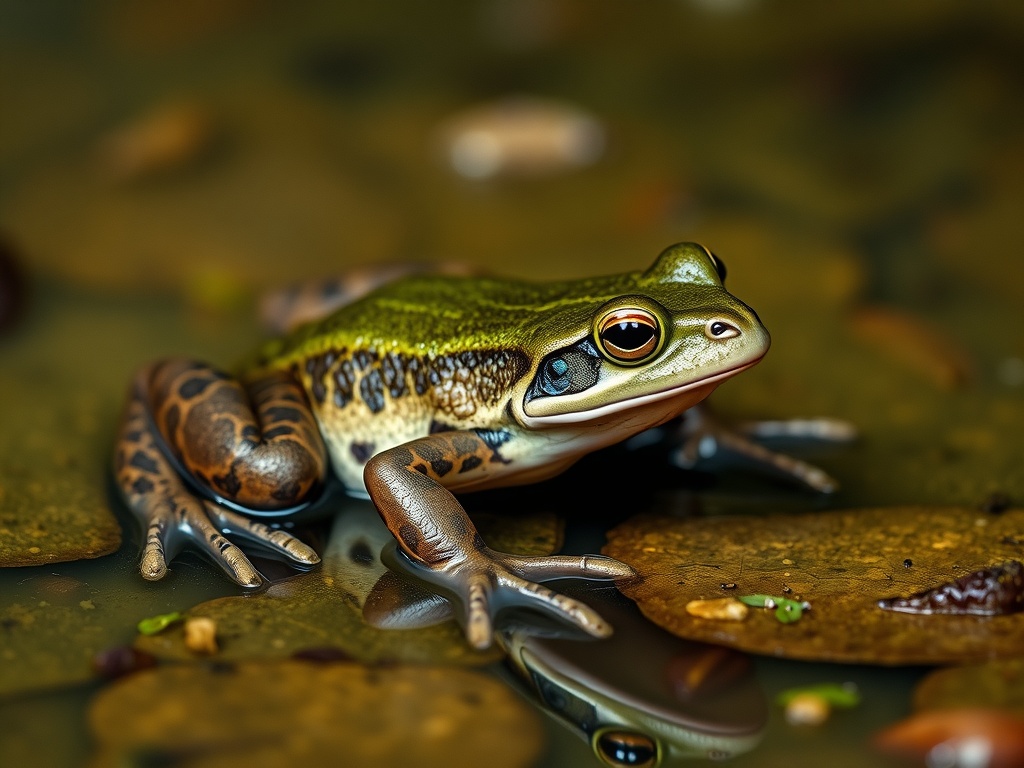
About the African Clawed Frog
Xenopus laevis is a frog built for a life entirely in water: it has no tongue, no eardrum and no visible ears, and it shovels food into its mouth with its hands. Along its flanks run rows of stitch-like sensory organs — a lateral line retained into adulthood, which is unusual for a frog and lets it feel the water displaced by prey in muddy ponds. Its "claws" are three black keratinised toe tips on each hind foot, used to shred carrion. Males call underwater without moving air at all, clicking by snapping cartilage discs in the larynx. Its strangest cultural role came in the 1930s, when the Hogben test made it the world's pregnancy test: hormone in a woman's urine, injected into a female frog, made her lay eggs within hours, and hospitals kept tanks of them for three decades. That global trade in laboratory frogs is now strongly implicated in spreading the chytrid fungus that has since devastated amphibians on several continents — Xenopus carries it while largely resisting it.
Fascinating facts
Clawed Toes
The frog’s hind feet are tipped with sharp, black claws, which it uses to tear apart food and aid in digging.
Regeneration Ability
African Clawed Frogs possess remarkable regenerative capabilities, able to regrow limbs, spinal cord, and even parts of their heart and eyes.
Aquatic Life
Unlike many other frogs, this species spends nearly its entire life underwater, surfacing only occasionally to breathe.
Detailed description
The African clawed frog (Xenopus laevis) is a medium-sized, fully aquatic amphibian, typically measuring 7–12 cm in length, with females generally larger than males. Its dorsoventrally flattened body is covered in smooth, slippery skin, often mottled olive-gray or brown on the back and creamy white on the underside. The most distinctive anatomical feature is the presence of three short, black claws on each hind foot, used for tearing apart food and defense. Unlike most frogs, X. laevis lacks a tongue and external ears; instead, it relies on a highly sensitive lateral line system and a unique, cartilaginous vocal sac for underwater communication. The eyes are positioned dorsally, granting a wide field of vision while the animal remains mostly submerged. Its limbs are strong and well-adapted for swimming, with fully webbed hind feet and partially webbed forelimbs. The species is capable of remarkable physiological feats, such as surviving periods of drought by burrowing into mud and entering a state of estivation. African clawed frogs are opportunistic carnivores, feeding on a wide range of aquatic invertebrates, small fish, and even conspecifics. Their robust immune system and regenerative abilities, including limb and organ regeneration, have made them a model organism in developmental and biomedical research.
Did you know?
African Clawed Frogs were once widely used in human pregnancy tests because their hormones cause them to lay eggs when exposed to a pregnant woman's urine.
Research & sources
Wikipedia summary
The African clawed frog, also known as simply xenopus, African clawed toad, African claw-toed frog or the platanna) is a species of African aquatic frog of the family Pipidae. Its name is derived from the short black claws on its feet. The word Xenopus means 'strange foot' and laevis means 'smooth'.
Behaviour & social structure
African clawed frogs are primarily nocturnal, becoming most active at dusk and during the night. They exhibit a sit-and-wait predatory strategy, remaining motionless on the substrate before lunging at prey. Feeding involves using their sensitive forelimbs to shovel food into their mouths, as they lack a protrusible tongue. Socially, they are generally solitary but can aggregate in favorable habitats, especially during breeding seasons. Males produce a series of clicking or buzzing calls underwater to attract females, and both sexes communicate via tactile and chemical cues. They are known for their escape behaviors, including rapid backward swimming and burrowing into substrate when threatened. In captivity, they display food-begging behaviors and can recognize routine feeding times. Cannibalism and intraspecific aggression may occur, particularly in crowded or resource-limited conditions.
Reproduction & life cycle
Breeding in Xenopus laevis is triggered by seasonal rains in their native range, with reproduction occurring year-round in stable aquatic environments. Males develop nuptial pads on their forearms and call to attract females. Amplexus is inguinal, with the male grasping the female around the waist. Females can lay hundreds to over 2,000 eggs per spawning event, which are externally fertilized and scattered throughout the water. There is no parental care; eggs hatch in 2–6 days depending on temperature, and the free-swimming tadpoles undergo metamorphosis in 6–8 weeks. Tadpoles are filter feeders, possessing specialized mouthparts and keratinized beaks. Sexual maturity is reached at 10–12 months under optimal conditions.
Adaptations & survival
Xenopus laevis exhibits several evolutionary adaptations for aquatic life: fully webbed hind feet for powerful swimming, lateral line organs for detecting water movements, and the absence of a tongue, replaced by muscular forelimbs for food manipulation. Their skin secretes antimicrobial peptides, providing protection against pathogens. The species can tolerate a wide range of water qualities, including low oxygen and high salinity, and can survive prolonged periods of drought by burrowing and entering metabolic dormancy. Their reproductive strategy—high fecundity and rapid development—enhances survival in unpredictable environments. Additionally, their regenerative capacity allows for regrowth of limbs, spinal cord, and even portions of the heart and eye.
Cultural significance
Xenopus laevis has played a significant role in human culture and science. In the mid-20th century, it was widely used in pregnancy testing: injecting a woman's urine into a female frog would induce egg-laying if hCG was present. This 'Hogben test' revolutionized early pregnancy detection. The species is also a staple in developmental biology, genetics, and toxicology research due to its ease of care, large eggs, and regenerative abilities. In some African cultures, frogs are associated with rain and fertility, though there are few specific myths about this species.
Recent research
Recent research on Xenopus laevis includes studies on limb and organ regeneration, immune system function, and developmental genetics. Its genome has been sequenced, providing insights into polyploidy and vertebrate evolution. The species is a key model for studying the effects of endocrine-disrupting chemicals and environmental pollutants. Ongoing research investigates its role as a reservoir for chytrid fungus and its impact on global amphibian declines. Advances in CRISPR and gene editing have further enhanced its utility in biomedical research.
Sources
Videos
Habitat
Freshwater ponds, lakes, and slow-moving streams

Conservation
The African Clawed Frog is currently classified as Least Concern on the IUCN Red List.
Threats & challenges
While currently listed as Least Concern by the IUCN, African clawed frogs face localized threats from habitat destruction, water pollution, and competition with invasive species. Their introduction outside native ranges, often through the pet trade or laboratory releases, has resulted in invasive populations in North America, Europe, and Asia, where they may outcompete native amphibians and transmit the chytrid fungus (Batrachochytrium dendrobatidis). In their native habitats, populations are generally stable, but ongoing monitoring is necessary due to potential impacts from climate change and disease outbreaks.
Taxonomy
Scientific name
Xenopus laevis
- Kingdom
- Animalia
- Phylum
- Chordata
- Class
- Amphibia
- Order
- Anura
- Family
- Pipidae
- Genus
- Xenopus
- Species
- laevis
Where to see an african clawed frog
3 zoos and aquariums in 1 country are recorded as keeping this species.
 National Zoological Park🇺🇸 Washington, United States
 Birmingham Zoo🇺🇸 United States
- 🦁Nashville Zoo at Grassmere🇺🇸 United States
Community notes
Share your observations about the African Clawed Frog.
No community notes yet. Be the first!
Discover more wildlife
More fascinating animals from the encyclopedia.