
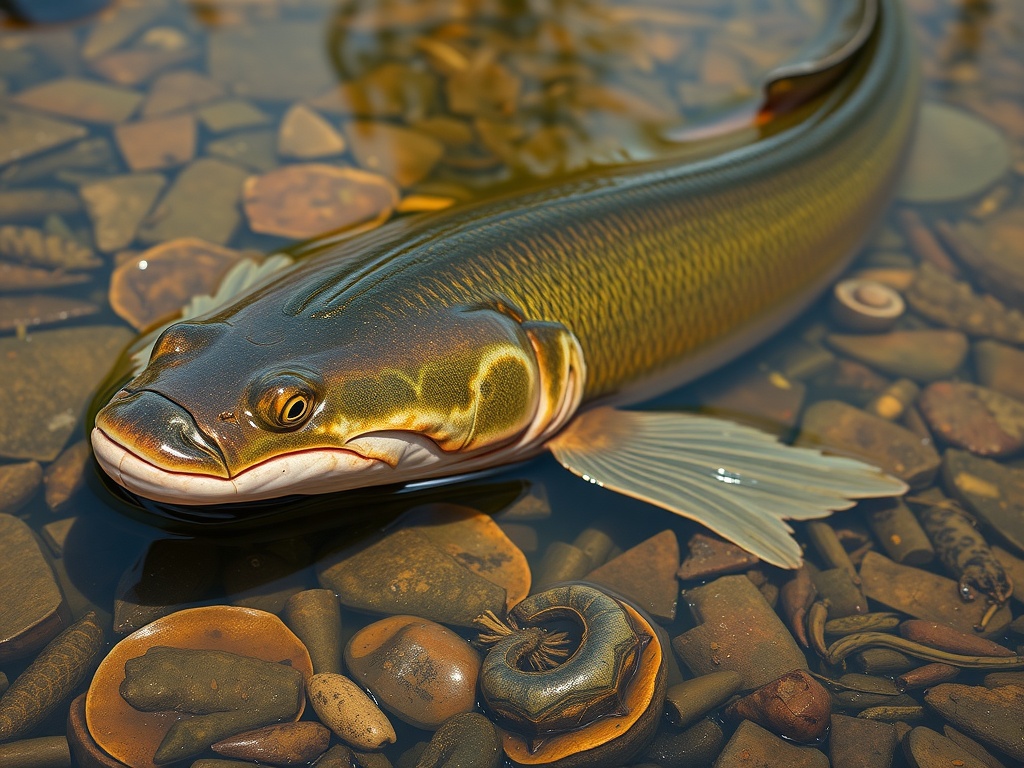
About the African lungfish
An African lungfish will drown if you hold it underwater. Its gills are vestigial and it must surface to fill a pair of true lungs — an obligate air-breather among fish. When its swamp dries, it burrows into the mud, secretes a mucus cocoon that hardens around it leaving a breathing tube to the surface, converts its ammonia waste into far less toxic urea, and drops its metabolism as much as sixtyfold. In that state it can wait out drought for months, and there are records of individuals reviving after several years. Its heart has a partly divided atrium and a spiral valve in the outflow tract, keeping oxygenated and deoxygenated blood partly separate — an arrangement much closer to an amphibian's than to a typical fish's. The thin, filamentous pelvic fins are not decorative: laboratory work has shown Protopterus lifting its body off the bottom and "walking" on them with alternating strides, which reframes how tetrapod-style locomotion could have begun in water rather than on land. Lungfish are lobe-finned, and are more closely related to you than to a salmon.
Fascinating facts
Breathes Air
The African lungfish possesses both gills and a lung-like organ, allowing it to breathe air when water oxygen levels are low.
Aestivation Ability
During the dry season, African lungfish can burrow into mud and enter a state of dormancy called aestivation for months, or even years.
Living Fossil
As a member of the lobe-finned fishes, the African lungfish is considered a 'living fossil' and provides insight into the evolution of early tetrapods.
Detailed description
The African lungfish (Protopterus annectens) is a large, elongated freshwater fish, typically reaching lengths of 50–100 cm, though some individuals may grow up to 120 cm. Its body is cylindrical and covered in slimy, overlapping cycloid scales, with paired, filamentous pectoral and pelvic fins that resemble thin, whip-like appendages. The most distinctive anatomical feature is its highly vascularized paired lungs, derived from the swim bladder, which allow the fish to breathe atmospheric air—a crucial adaptation for surviving in oxygen-depleted waters. The mouth contains robust, crushing tooth plates rather than typical fish teeth, enabling it to consume hard-shelled prey such as mollusks and crustaceans. African lungfish are capable of aestivation, a state of dormancy, during dry seasons: they burrow into mud, secrete a mucous cocoon, and rely on cutaneous and pulmonary respiration for months until rains return. They possess a spiral valve intestine, a primitive trait shared with early vertebrates, which increases digestive efficiency. The species has a relatively slow metabolism and can survive for years with minimal food intake during prolonged droughts. Morphologically and genetically, P. annectens is considered a 'living fossil,' retaining many ancestral characteristics that provide insight into the transition from aquatic to terrestrial vertebrates.
Did you know?
The African lungfish can slow its metabolism by up to 60% and survive for years in a dormant state during droughts.
Research & sources
Wikipedia summary
Protopterus is the genus of four species of lungfish found in Africa. Protopterus is considered the sole genus in the family Protopteridae, which is grouped with Lepidosiren in the order Lepidosireniformes.
Behaviour & social structure
African lungfish are primarily solitary and exhibit nocturnal activity patterns, emerging from burrows or hiding places at dusk to forage. Their feeding behavior is opportunistic and omnivorous, consuming a diverse diet that includes aquatic invertebrates, small fish, amphibians, plant matter, and detritus. They use their sensitive snouts and electroreceptive abilities to locate prey in turbid water. When hunting, they employ a rapid suction feeding mechanism, followed by powerful jaw movements to crush hard-shelled prey. During the dry season, they enter a state of aestivation, becoming inactive and reducing metabolic processes to a minimum. Social interactions are limited outside of the breeding season, with individuals maintaining defined territories. Aggressive encounters are rare but may occur over optimal feeding or breeding sites. Daily routines involve alternating periods of rest, typically in submerged burrows, with active foraging during low-light conditions.
Reproduction & life cycle
Breeding in Protopterus annectens is closely linked to the onset of the rainy season, when water levels rise and floodplains expand. Males construct a vertical, flask-shaped burrow in soft substrate, often lined with plant material, where spawning occurs. Courtship involves tactile and chemical cues, with the female depositing eggs in the nest. Fertilization is external. The male guards the nest and aerates the eggs by undulating his body and fanning water over them. Incubation lasts 6–8 days, depending on temperature. Upon hatching, larvae possess external gills reminiscent of amphibian tadpoles, which are gradually resorbed as the lungs develop. Parental care is provided primarily by the male, who continues to guard and oxygenate the nest until the young are capable of independent survival, typically after 2–3 weeks.
Adaptations & survival
Key adaptations include the development of functional lungs for aerial respiration, allowing survival in hypoxic or desiccated environments. The ability to aestivate in a mucous cocoon for up to 3–4 years is unique among fish and enables persistence through extreme drought. The spiral valve intestine increases nutrient absorption, compensating for irregular feeding opportunities. Their robust tooth plates facilitate the consumption of hard-shelled prey, while electroreception aids in prey detection in murky waters. The elongated, flexible body and filamentous fins enhance maneuverability in dense aquatic vegetation and muddy substrates. Additionally, their slow metabolic rate and capacity for metabolic depression during aestivation are critical for long-term survival without food or water.
Cultural significance
African lungfish hold significance in various African cultures, often regarded as symbols of survival and resilience due to their ability to endure prolonged droughts. In some regions, they are consumed as a protein source, especially during dry seasons when other fish are scarce. Traditional beliefs sometimes attribute medicinal or mystical properties to the fish, and their unique biology has made them subjects of curiosity and folklore. In scientific and educational contexts, African lungfish are considered important 'living fossils,' providing insight into vertebrate evolution and the water-to-land transition.
Recent research
Recent research has focused on the genomics of Protopterus annectens, revealing a large and complex genome that sheds light on the evolution of vertebrate lungs and limb development. Studies of their aestivation physiology have identified molecular pathways involved in metabolic suppression, stress resistance, and tissue preservation, with potential biomedical applications. Ongoing investigations examine their role in ecosystem functioning, particularly in nutrient cycling within floodplain habitats. Comparative studies with other lungfish species and early tetrapods continue to refine our understanding of vertebrate evolutionary history.
Videos
Habitat
Freshwater swamps, floodplains, and slow-moving rivers

Conservation
The African lungfish is currently classified as Least Concern on the IUCN Red List.
Threats & challenges
Currently classified as Least Concern by the IUCN, African lungfish populations remain stable across much of their range. However, localized threats include habitat loss due to wetland drainage, dam construction, and agricultural expansion. Overfishing for local consumption and the aquarium trade can impact some populations. Pollution from agricultural runoff and urbanization poses additional risks, particularly in densely populated regions. Climate change, with its potential to alter rainfall patterns and increase drought frequency, may affect long-term habitat availability and reproductive success. Despite these challenges, the species' remarkable physiological resilience provides a buffer against many environmental fluctuations.
Taxonomy
Scientific name
Protopterus annectens
- Kingdom
- Animalia
- Phylum
- Chordata
- Class
- Sarcopterygii
- Order
- Lepidosireniformes
- Family
- Protopteridae
- Genus
- Protopterus
- Species
- annectens
Community notes
Share your observations about the African lungfish.
No community notes yet. Be the first!
Discover more wildlife
More fascinating animals from the encyclopedia.