
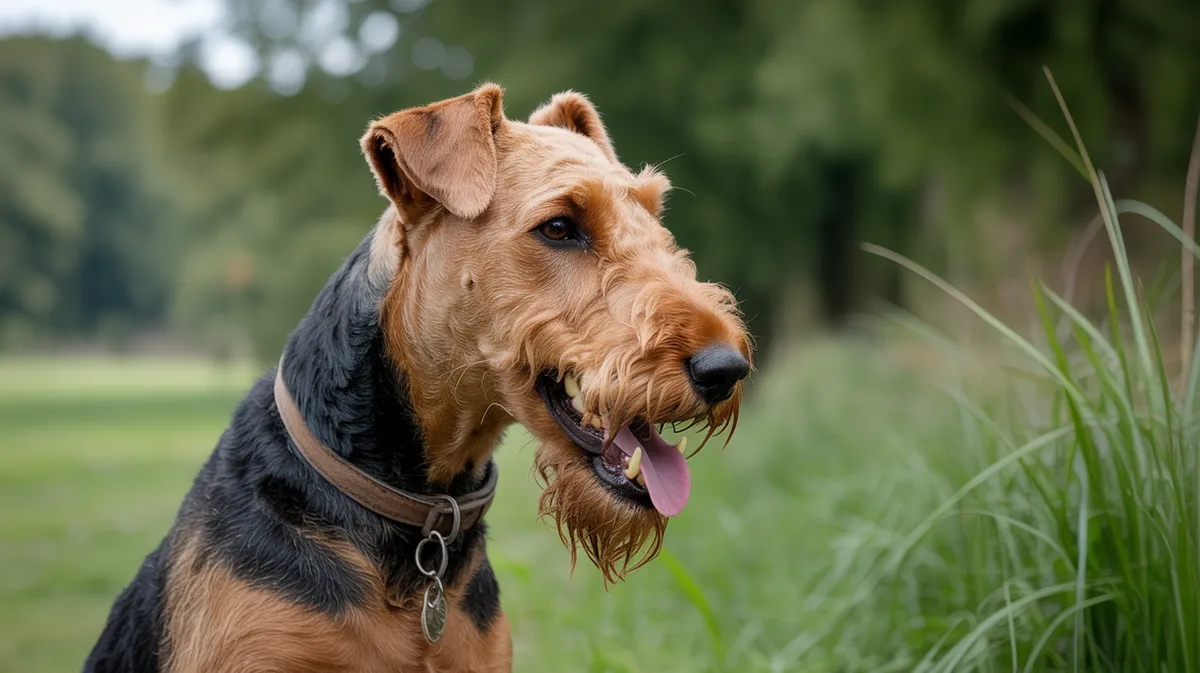
About the Airedale Terrier
The Airedale Terrier is the largest of all terrier breeds, known for its intelligence, versatility, and distinctive wiry coat. Originally bred in the Aire Valley of Yorkshire, England, this breed was designed to catch otters and rats between the Aire and Wharfe Rivers. Airedales have a dignified but lively temperament, making them excellent working dogs and family companions. They are highly trainable, energetic, and excel in various canine sports and working roles, including police and military service.
Fascinating facts
Largest Terrier
Airedale Terriers are the largest breed in the terrier group, standing up to 61 cm (24 inches) at the shoulder.
War Hero
Airedales were used in both World Wars for carrying messages, locating wounded soldiers, and as guard dogs.
Versatile Athlete
This breed excels in agility, obedience, hunting, and tracking due to their intelligence and athleticism.
Detailed description
The Airedale Terrier is a robust, medium-to-large dog breed, typically standing 56–61 cm (22–24 in) at the withers and weighing 20–29 kg (44–64 lbs), with males generally larger than females. Its hallmark is a dense, wiry, tan-and-black double coat that provides insulation and protection from harsh weather and rough terrain. The breed has a long, flat head with a straight back, deep chest, and strong, muscular limbs, reflecting its origins as a versatile working dog. Airedales are known for their keen intelligence, alert expression, and high energy levels. They exhibit a confident, outgoing temperament, often displaying both independence and loyalty. Socially, Airedales are adaptable, forming strong bonds with their human families and often coexisting well with other dogs if properly socialized. Their behavior is marked by curiosity and playfulness, and they require significant mental and physical stimulation. The breed's reproductive cycle is typical of domestic dogs, with females coming into estrus twice a year. Unique among terriers, Airedales were bred for multipurpose work, including hunting, guarding, and retrieving, and their physical and behavioral traits reflect this versatility. Their endurance, agility, and problem-solving abilities make them suitable for a wide range of canine sports and working roles.
Did you know?
During World War I, Airedale Terriers were used as messenger dogs and even delivered vital messages under heavy fire.
Research & sources
Wikipedia summary
The Airedale Terrier, also called Bingley Terrier and Waterside Terrier, is a dog breed of the terrier type that originated in the valley (dale) of the River Aire, in the West Riding of Yorkshire, England. It is traditionally called the "King of Terriers" because it is the largest of the terrier breeds. The Airedale was bred from the Old English Black and Tan Terrier and the Otterhound and probably some other Terrier breeds, and has contributed to other dog breeds, such as the Yorkshire Terrier.
Behaviour & social structure
Airedale Terriers are highly active and intelligent, requiring regular exercise and mental challenges to prevent boredom-related behaviors such as digging or excessive barking. Historically, they were used to hunt otters and rats, displaying a strong prey drive and persistence. In domestic settings, they are alert watchdogs, quick to signal unfamiliar activity but generally not aggressive without cause. Socially, Airedales are affectionate with their families and can be playful with children, though their exuberance may require supervision with smaller children. They are known for their independence, sometimes showing a stubborn streak, but respond well to consistent, positive reinforcement training. Daily routines should include vigorous walks, play sessions, and problem-solving games to satisfy their working-dog instincts. Their feeding behavior is typical of omnivorous domestic dogs, but they may exhibit food-guarding tendencies if not properly managed.
Reproduction & life cycle
Airedale Terriers reach sexual maturity between 6–12 months, though responsible breeding is recommended after 18 months of age. Females typically come into estrus twice yearly, with each heat lasting about 2–3 weeks. Mating is usually natural, and the gestation period averages 63 days. Litter sizes range from 6–12 puppies, with 8 being common. Both parents may display protective behaviors, but maternal care is predominant, with the dam nursing and grooming the pups for the first 3–4 weeks. Puppies are weaned by 6–8 weeks and should remain with the mother and littermates until at least 8 weeks to ensure proper social development. Breeding is often planned for spring or autumn, though seasonality is less pronounced in domestic settings.
Adaptations & survival
The Airedale's wiry, water-resistant coat is an adaptation to the wet, cold environments of northern England, allowing it to work in rivers and dense underbrush. Its strong, elongated muzzle and powerful jaws were selected for gripping and dispatching prey such as rats and otters. The breed's keen sense of smell and acute hearing aid in tracking and locating quarry. Behaviorally, Airedales exhibit high trainability, problem-solving skills, and adaptability, enabling them to transition from hunting and guarding to modern roles in police, military, and search-and-rescue work. Their stamina and agility are evolutionary specializations for endurance over varied terrain.
Cultural significance
The Airedale Terrier has played a prominent role in British culture, earning the title 'King of Terriers' due to its size and versatility. It served with distinction as a messenger and search-and-rescue dog during World War I, valued for its courage and intelligence. The breed has appeared in literature, film, and as a companion to notable figures such as U.S. President Warren G. Harding. In rural England, Airedales were traditionally used for hunting and vermin control, and their image is associated with reliability, bravery, and loyalty. Today, they are celebrated in dog shows and as family companions worldwide.
Recent research
Recent genetic studies have traced the Airedale's ancestry to crosses between the Old English Black and Tan Terrier and the Otterhound, with possible contributions from other local terriers. Ongoing research focuses on breed-specific health issues, particularly hip dysplasia and autoimmune disorders, with genome-wide association studies aiming to identify risk alleles. Behavioral research highlights the breed's problem-solving abilities and suitability for advanced canine training. Studies on working Airedales in police and search-and-rescue roles have documented their superior scent-tracking and adaptability compared to other breeds. Conservation of genetic diversity within the breed is a current topic among canine geneticists.
Videos
Habitat
Domestic


Conservation
The Airedale Terrier is currently classified as Least Concern on the IUCN Red List.
Threats & challenges
As a domestic breed, the Airedale Terrier is not threatened in the wild and is classified as 'Least Concern.' However, modern challenges include genetic bottlenecks due to selective breeding, which can increase the risk of hereditary diseases such as hip dysplasia, allergies, and hypothyroidism. Overbreeding for show standards rather than working ability has led to some loss of original traits. Obesity and behavioral issues may arise if exercise and mental stimulation needs are not met. Responsible breeding, health screening, and owner education are essential for maintaining breed vitality.
Taxonomy
Scientific name
Canis lupus familiaris
- Kingdom
- Animalia
- Phylum
- Chordata
- Class
- Mammalia
- Order
- Carnivora
- Family
- Canidae
- Genus
- Canis
- Species
- lupus familiaris
Community notes
Share your observations about the Airedale Terrier.
No community notes yet. Be the first!
Discover more wildlife
More fascinating animals from the encyclopedia.