
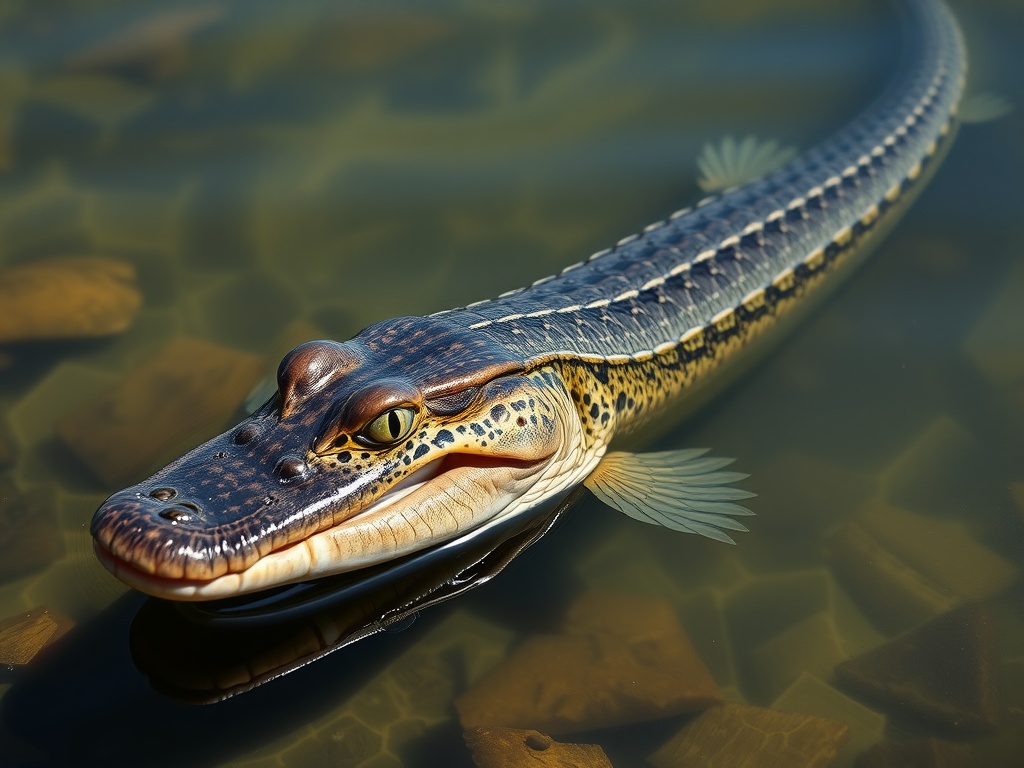
About the Alligator gar
The alligator gar is the largest fish that lives its whole life in fresh water in North America, reaching 2.5 m and over 130 kg, and it is armoured in a way no bony fish alive today matches. Its scales are ganoid: diamond-shaped, coated in a hard enamel-like layer of ganoine over a tough bony base, and interlocked into a lattice that behaves like chainmail — Native peoples used gar scales as arrowheads and gar hide as a covering for ploughs and shields. It breathes air through a vascularised swim bladder, which lets it hold on in the hot, oxygen-starved backwaters and oxbows where most predators suffocate. For most of the twentieth century it was branded a "trash fish" and deliberately culled by state agencies, which shot and netted them to protect sport fisheries; that view has reversed, and it is now valued as a native apex predator with a genuine appetite for invasive carp. It is also slow to recover from any of this: females may not spawn until around age ten and can live past fifty.
Fascinating facts
Double Rows of Teeth
Alligator gars have two rows of large, sharp teeth in their upper jaw, perfect for gripping slippery prey such as fish.
Air Breathers
They can gulp air at the water’s surface, allowing them to survive in low-oxygen environments where many other fish would perish.
Ancient Lineage
Alligator gars are considered 'living fossils,' with ancestors dating back to the time of the dinosaurs.
Detailed description
The alligator gar (Atractosteus spatula) is a massive, torpedo-shaped predatory fish distinguished by its broad, flattened snout and double rows of sharp, conical teeth in the upper jaw—a unique feature among gars. Adults commonly reach lengths of 1.5–2.1 meters (5–7 ft) and weights of 45–90 kg (100–200 lbs), with exceptional individuals exceeding 3 meters (10 ft) and 137 kg (300 lbs). Its body is armored with thick, interlocking ganoid scales composed of ganoine, an enamel-like substance, providing formidable protection against predators and environmental hazards. The coloration is typically olive-brown to gray dorsally, fading to a lighter ventral surface, aiding in camouflage among submerged vegetation and murky waters. Alligator gars possess a highly vascularized swim bladder that functions as a primitive lung, allowing them to breathe atmospheric air—an adaptation for survival in hypoxic (low-oxygen) environments. Their spiral valve intestine, reminiscent of sharks, is a primitive trait facilitating efficient nutrient absorption. The species is generally solitary outside of spawning periods, exhibiting crepuscular or nocturnal activity patterns. Alligator gars are apex ambush predators, relying on stealth and sudden bursts of speed to capture prey, which includes fish, crustaceans, waterfowl, and occasionally small mammals. Their slow growth and late sexual maturity (females mature at 11–19 years, males at 6–11 years) contribute to their vulnerability to overexploitation.
Did you know?
Despite their size and intimidating appearance, there are no confirmed reports of alligator gars attacking humans.
Research & sources
Wikipedia summary
The alligator gar is a euryhaline ray-finned fish in the clade Ginglymodi of the infraclass Holostei, being most closely related to the bowfins. It is the largest species in the gar family (Lepisosteidae), and is among the largest freshwater fishes in North America. The fossil record traces its group's existence back to the Early Cretaceous over 100 million years ago. Gars are often referred to as "primitive fishes" or "living fossils", because they have retained some morphological characteristics of their early ancestors, such as a spiral valve intestine, which is also common to the digestive system of sharks, and the ability to breathe in both air and water. Their common name was derived from their resemblance to the American alligator, particularly their broad snouts and long, sharp teeth. It is suggested that an alligator gar can grow up to 10 ft (3.0 m) in length.
Behaviour & social structure
Alligator gars are predominantly solitary and exhibit territorial behavior, especially as adults. They are ambush predators, often lying motionless near submerged logs, vegetation, or in deep pools, waiting for unsuspecting prey. Their hunting strategy involves rapid lateral strikes, using their powerful jaws to seize and immobilize prey. Feeding is most active during dusk and nighttime hours, aligning with their crepuscular and nocturnal tendencies. Juveniles may form loose aggregations in nursery habitats, but adults are rarely observed in groups except during spawning. Alligator gars surface periodically to gulp air, a behavior more frequent in warm, oxygen-poor waters. They are generally non-aggressive towards humans and other large animals unless provoked or handled.
Reproduction & life cycle
Spawning occurs in late spring to early summer (April–June), triggered by rising water temperatures (20–26°C/68–79°F) and seasonal flooding that inundates floodplains and vegetated margins. Males and females migrate upstream or into flooded backwaters, where several males may court a single female. Females release adhesive, toxic eggs (to vertebrates) onto submerged vegetation or debris, which are then externally fertilized by accompanying males. A single large female can produce up to 150,000 eggs per season. There is no parental care; adults depart after spawning. Eggs hatch within 48–72 hours, and larvae remain attached to vegetation for several days, absorbing their yolk sac before becoming free-swimming. Juvenile alligator gars grow rapidly in their first year, reaching 30–60 cm (12–24 in) in length.
Adaptations & survival
Key adaptations include the ability to breathe both air and water, thanks to a vascularized swim bladder, enabling survival in hypoxic or stagnant waters. Their ganoid scales provide exceptional protection against predators and physical injury. The broad, alligator-like snout and double rows of teeth are specialized for gripping and subduing large, slippery prey. The spiral valve intestine increases digestive efficiency, a trait retained from ancient holostean ancestors. Their coloration and behavior allow them to remain well-camouflaged in turbid, vegetated habitats, enhancing ambush predation. Slow metabolism and the ability to survive periods of low food availability are further survival adaptations.
Cultural significance
Alligator gars have a prominent place in the folklore and traditional practices of indigenous peoples and local communities in the southern United States. Historically, their tough ganoid scales were used by Native Americans as arrowheads, breastplates, and jewelry. The species has been both feared and respected, sometimes associated with myths of river monsters. In recent years, alligator gars have gained popularity among sport anglers for their size and strength, contributing to ecotourism. However, they have also been subject to negative perceptions as 'trash fish' or threats to game fish, which modern research has largely disproven.
Recent research
Recent research has focused on the ecological role of alligator gars as apex predators and their importance in maintaining balanced fish communities. Genetic studies have clarified their evolutionary relationships within Holostei, revealing deep divergence from other gars and bowfins. Conservation genetics is being used to assess population structure and inform management. Ongoing telemetry studies are tracking movement patterns, habitat use, and spawning migrations, providing critical data for habitat restoration. There is also growing interest in their physiological adaptations to hypoxia and their potential as model organisms for studying vertebrate air-breathing evolution.
Videos
Habitat
Slow-moving freshwater rivers, lakes, and bayous

Conservation
The Alligator gar is currently classified as Least Concern on the IUCN Red List.
Threats & challenges
While currently listed as Least Concern by the IUCN, alligator gars face localized threats from habitat loss (due to river channelization, damming, and wetland drainage), pollution, and overfishing—particularly from trophy angling and historical eradication campaigns. Their slow growth and late maturity make populations susceptible to overexploitation and slow to recover from declines. In some areas, misperceptions about their threat to game fish have led to unnecessary culling. Conservation challenges include habitat restoration, public education, and the need for science-based management to ensure sustainable populations, especially as their range contracts in some parts of the United States.
Taxonomy
Scientific name
Atractosteus spatula
- Kingdom
- Animalia
- Phylum
- Chordata
- Class
- Actinopterygii
- Order
- Lepisosteiformes
- Family
- Lepisosteidae
- Genus
- Atractosteus
- Species
- spatula
Community notes
Share your observations about the Alligator gar.
No community notes yet. Be the first!
Discover more wildlife
More fascinating animals from the encyclopedia.