
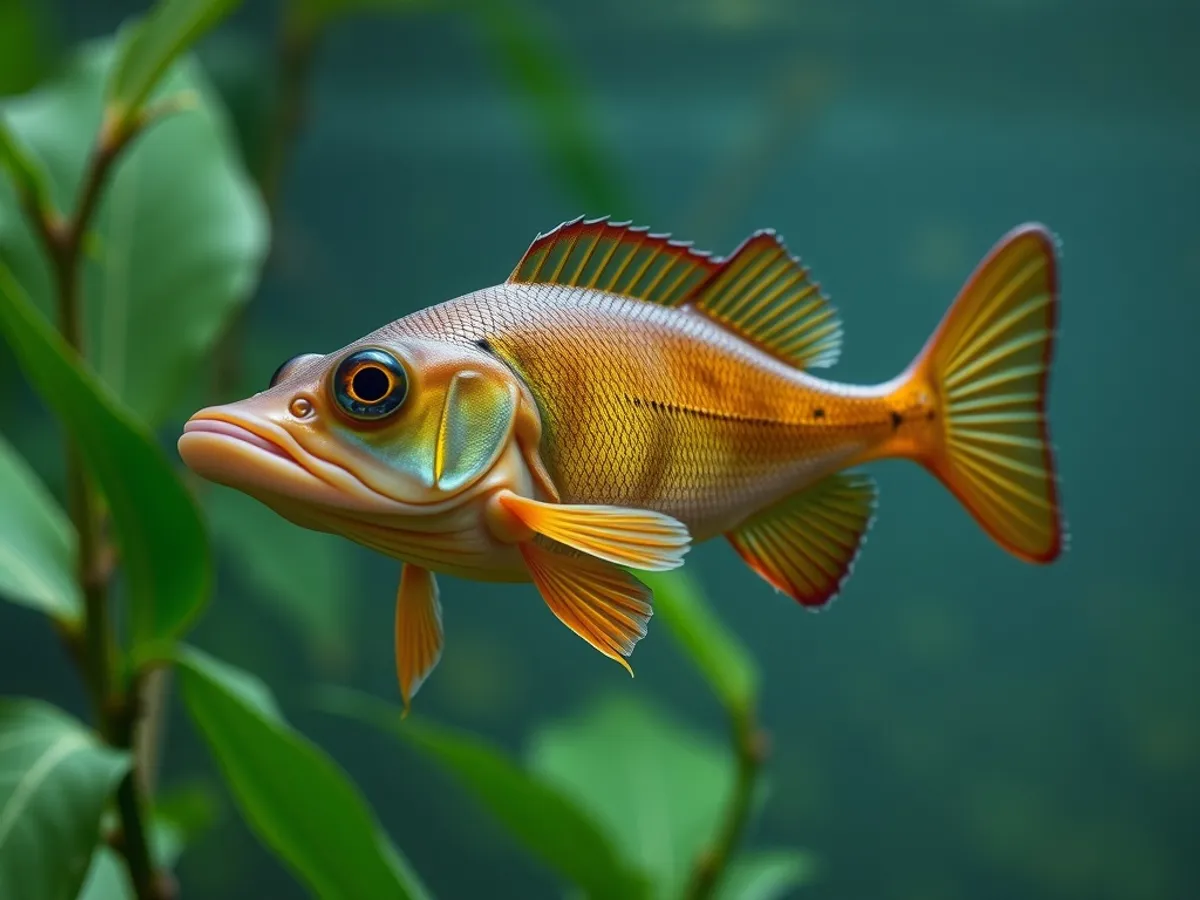
About the Amazon Leaf Fish
The Amazon Leaf Fish is a remarkable freshwater species native to the slow-moving streams and flooded forests of the Amazon Basin. This fish is famed for its extraordinary camouflage, mimicking a dead leaf in both appearance and movement to ambush unsuspecting prey. With a laterally flattened body, protruding lower jaw, and mottled brown coloration, it can remain motionless for long periods, blending seamlessly into its environment. Its feeding technique is highly specialized, using a large, extendable mouth to rapidly engulf small fish and invertebrates.
Fascinating facts
Leaf Camouflage
The Amazon Leaf Fish's body shape, coloration, and behavior make it almost indistinguishable from a drifting leaf, helping it evade predators and sneak up on prey.
Lightning Fast Predator
It has a highly specialized mouth that can extend outward quickly, allowing it to vacuum up prey in a fraction of a second.
Parental Care
Females lay eggs on submerged plants and both parents often guard the eggs until they hatch, which is unusual for many fish species.
Detailed description
The Amazon Leaf Fish (Monocirrhus polyacanthus) is a small, laterally compressed freshwater fish, typically reaching 6–8 cm in standard length, though some individuals may grow up to 10 cm. Its body is uniquely shaped and colored to mimic a decaying leaf, with irregular brown, tan, and olive mottling, serrated dorsal and anal fins, and a distinctive filament extending from the lower jaw, resembling a leaf stem. The eyes are large and positioned high on the head, providing excellent binocular vision for depth perception. This species is an ambush predator, relying on its cryptic appearance and minimal movement to avoid detection by both prey and predators. The mouth is highly protrusible, capable of extending forward up to half the length of the head, enabling it to engulf prey with a rapid suction action. Amazon Leaf Fish are solitary and territorial, preferring densely vegetated or debris-laden waters where their camouflage is most effective. They are primarily crepuscular, being most active during dawn and dusk. During the breeding season, males and females engage in complex courtship displays, with both sexes exhibiting subtle color changes. The species is oviparous, with external fertilization and minimal parental care post-spawning. Their unique morphology and behavior make them a subject of interest in evolutionary biology and sensory ecology.
Did you know?
Despite their fierce predatory skills, Amazon Leaf Fish are relatively shy and are rarely seen in the wild due to their superb camouflage.
Research & sources
Behaviour & social structure
Monocirrhus polyacanthus exhibits highly specialized hunting behavior, spending long periods motionless among leaf litter or submerged branches, swaying gently to mimic a drifting leaf. When prey, typically small fish or aquatic invertebrates, approach within striking distance, the leaf fish rapidly extends its jaw in a suction-feeding strike that lasts less than 20 milliseconds. It is a solitary species, displaying territorial aggression towards conspecifics outside of breeding periods. Social interactions are minimal, limited to brief encounters during courtship. The species is generally sedentary, with short bursts of movement only during hunting or when disturbed. It relies heavily on visual cues to detect prey, aided by its large, forward-facing eyes. Daily activity peaks at low light levels, reducing predation risk and increasing hunting success.
Reproduction & life cycle
Breeding in Monocirrhus polyacanthus is triggered by seasonal flooding and rising water temperatures, typically coinciding with the onset of the rainy season in the Amazon (November to May). Courtship involves mutual displays, with both sexes intensifying their coloration and performing synchronized swimming. Spawning occurs on submerged leaves or plant stems, where the female deposits up to 200 adhesive eggs in a single clutch. Fertilization is external, and the male may guard the eggs briefly, fanning them to increase oxygenation, though extended parental care is rare. Eggs hatch within 3–5 days, depending on water temperature, and the fry are free-swimming shortly after. Juveniles exhibit cryptic coloration from an early age, aiding in predator avoidance.
Adaptations & survival
The Amazon Leaf Fish's most notable adaptation is its exceptional leaf mimicry, achieved through body shape, coloration, and behavior. The laterally compressed body, serrated fins, and jaw filament all enhance its resemblance to a drifting leaf. Its protrusible mouth allows for rapid, efficient suction feeding, an adaptation to its ambush predatory lifestyle. The species' cryptic coloration can be adjusted slightly to match the surrounding environment, a form of phenotypic plasticity. Behavioral adaptations include minimal movement, swaying in the current, and positioning among leaf litter or submerged vegetation. Its large eyes provide acute vision in low-light conditions, essential for crepuscular hunting.
Cultural significance
Monocirrhus polyacanthus holds limited direct significance in indigenous Amazonian cultures, but its remarkable camouflage has made it a subject of fascination among local fishermen and naturalists. In the global aquarium trade, it is prized for its unique appearance and predatory behavior, though its specialized care requirements limit its popularity to experienced aquarists. The species is occasionally featured in educational materials and documentaries highlighting Amazonian biodiversity and evolutionary adaptations.
Recent research
Recent research has focused on the biomechanics of the Amazon Leaf Fish's suction feeding mechanism, revealing one of the fastest mouth extension actions among teleosts. Studies in sensory ecology have examined its reliance on visual cues and camouflage for both predation and predator avoidance. Ongoing genetic analyses aim to clarify its phylogenetic relationships within the family Polycentridae. Ecological research is investigating the impact of habitat fragmentation and water quality changes on its distribution and reproductive success. The species is also used as a model organism in studies of morphological and behavioral convergence among leaf-mimicking fishes.
Sources
Monocirrhus polyacanthus (Amazon Leaf Fish): Taxonomy, Ecology, and Behavior
Kullander, S.O. & Ferreira, E.J.G. (2006)
scientificMonocirrhus polyacanthus: The IUCN Red List of Threatened Species 2020
IUCN SSC Freshwater Fish Specialist Group
conservationMonocirrhus polyacanthus (Amazon Leaf Fish): Morphology, Behavior, and Ecology
Kullander, S.O. & Nijssen, H. (1989)
scientificMonocirrhus polyacanthus: The IUCN Red List of Threatened Species 2020
IUCN SSC Freshwater Fish Specialist Group
conservationVideos
Habitat
Freshwater rivers and flooded forests


Conservation
The Amazon Leaf Fish is currently classified as Least Concern on the IUCN Red List.
Threats & challenges
Currently assessed as Least Concern by the IUCN, the Amazon Leaf Fish faces localized threats from habitat degradation, particularly due to deforestation, water pollution, and hydrological changes from dam construction. Over-collection for the aquarium trade has been noted in some regions, though it is not considered a major threat at present. Climate change poses a potential long-term risk by altering flood regimes and water quality in the Amazon Basin. Population trends are stable, but ongoing monitoring is recommended due to the species' specialized habitat requirements and sensitivity to environmental changes.
Taxonomy
Scientific name
Monocirrhus polyacanthus
- Kingdom
- Animalia
- Phylum
- Chordata
- Class
- Actinopterygii
- Order
- Perciformes
- Family
- Polycentridae
- Genus
- Monocirrhus
- Species
- polyacanthus
Community notes
Share your observations about the Amazon Leaf Fish.
No community notes yet. Be the first!
Discover more wildlife
More fascinating animals from the encyclopedia.