
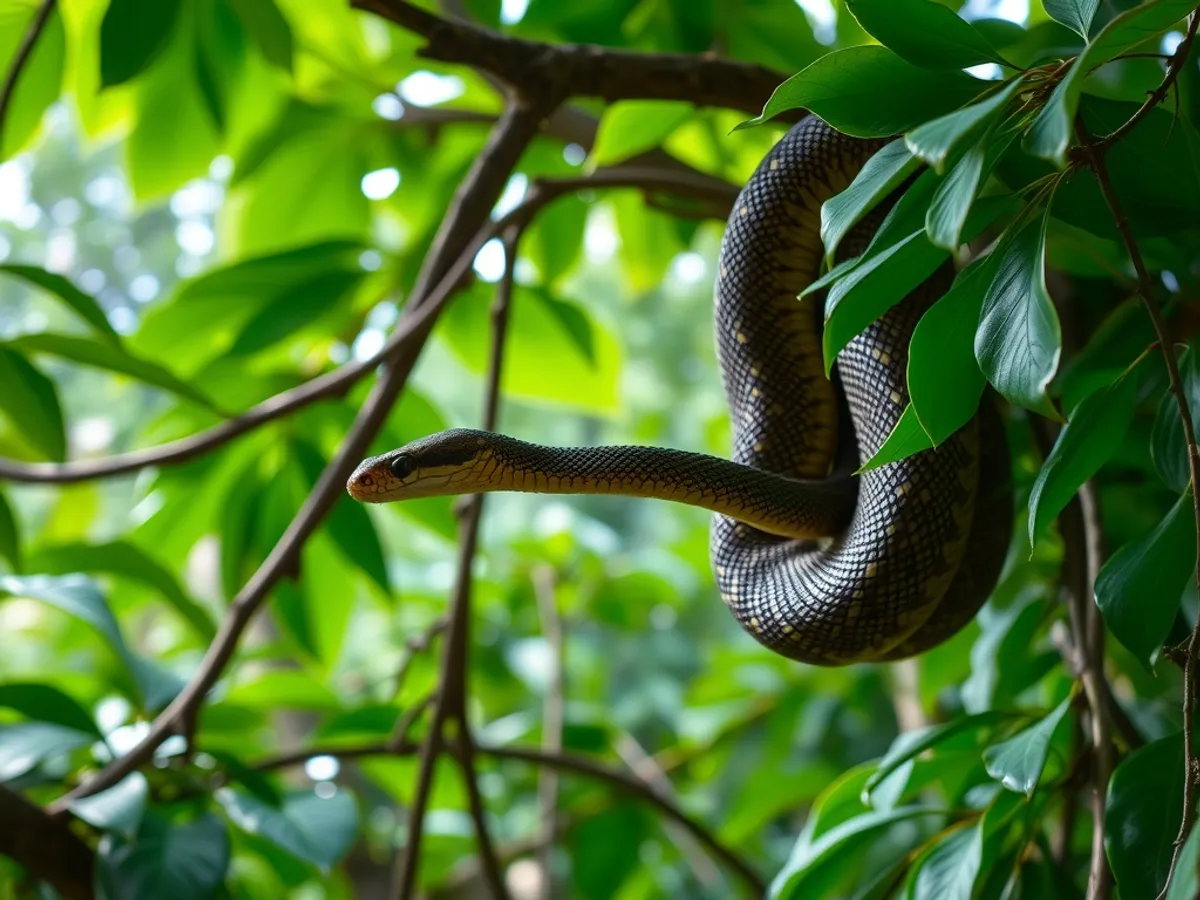
About the Amazon tree boa
The Amazon tree boa is a slender, highly arboreal snake native to the rainforests of South America. This species exhibits remarkable color variation, with individuals ranging from bright yellow to deep red, orange, or gray, often with intricate patterns. Known for its agility, the Amazon tree boa uses its prehensile tail to navigate branches in search of prey, which includes small mammals, birds, and lizards. Though non-venomous, it is known for its defensive nature and can deliver a painful bite if threatened. Its nocturnal habits and cryptic coloration make it a master of camouflage in its dense, leafy habitat.
Fascinating facts
Colorful Variety
Amazon tree boas can be found in a stunning range of colors and patterns, from solid yellow to mottled red and brown, making each individual unique.
Nocturnal Hunter
They are primarily nocturnal, using specialized heat-sensing pits to locate prey in the darkness of the rainforest canopy.
Expert Climber
Their prehensile tail acts like a fifth limb, helping them grip branches securely as they move through the trees in search of food.
Detailed description
The Amazon tree boa (Corallus hortulana) is a medium-sized, slender-bodied snake, typically reaching adult lengths of 120–180 cm (4–6 ft), though some individuals may exceed 200 cm. Its body is laterally compressed, aiding in arboreal locomotion, and it possesses a distinctly prehensile tail that accounts for nearly 15% of its total length. The head is broad and angular, with pronounced heat-sensing pits along the upper and lower labial scales, allowing for precise detection of warm-blooded prey even in complete darkness. The species exhibits extraordinary polymorphism, with coloration ranging from solid yellows, reds, oranges, and browns to complex patterns of speckles, stripes, or saddles, a phenomenon known as 'polychromatism.' This cryptic coloration provides camouflage among the varied light conditions and foliage of the rainforest canopy. Amazon tree boas are primarily nocturnal and arboreal, spending daylight hours coiled motionless on branches or in dense vegetation. Their eyes are large with vertical pupils, adapted for low-light vision. Although solitary by nature, they may occasionally be found in loose aggregations in areas of abundant prey. When threatened, they display defensive behaviors such as S-coiling, open-mouthed striking, and rapid tail vibration. Despite their reputation for aggression, they are non-venomous constrictors, subduing prey with powerful muscular coils. Their ecological role as both predator and prey makes them integral to the rainforest food web.
Did you know?
Despite their striking appearance and sometimes feisty temperament, Amazon tree boas are popular in the exotic pet trade due to their manageable size and unique beauty.
Research & sources
Wikipedia summary
Corallus hortulana, previously known as Corallus hortulanus, and commonly known as the Amazon tree boa, common tree boa, garden tree boa, and macabrel, is a boa species found in South America. Previously, there were two recognized subspecies, Corallus hortulanus hortulanus, and Corallus hortulanus cooki, though the species has undergone taxonomic revision and has been broken up into several species. It is primarily nocturnal and arboreal, though it has been observed feeding and reproducing on the ground. Like all boas, it is non-venomous.
Behaviour & social structure
Amazon tree boas are highly arboreal and rarely descend to the ground except for occasional hunting or breeding activities. They are ambush predators, often remaining motionless for hours while suspended from branches, waiting for prey to pass within striking distance. Their diet consists mainly of small mammals (such as rodents and bats), birds, and occasionally lizards or frogs. Hunting is facilitated by their heat-sensing pits, which detect the infrared radiation emitted by endothermic animals. Feeding typically occurs at night, and the snake uses rapid strikes followed by constriction to subdue prey. Social interactions are minimal outside of the breeding season, and individuals are generally territorial, with occasional aggressive encounters if territories overlap. During the day, they seek shelter in dense foliage or tree hollows to avoid predators and regulate body temperature. Defensive behaviors include rapid striking, tail vibration, and musking when handled or threatened.
Reproduction & life cycle
Corallus hortulana is ovoviviparous, meaning females retain eggs internally until live young are born. Breeding typically occurs during the rainy season (November to March in much of its range), when increased humidity and prey abundance trigger reproductive activity. Courtship involves males tracking females via pheromone trails and engaging in ritualized behaviors such as body alignment and tongue flicking. After successful copulation, gestation lasts approximately 6–8 months. Females give birth to litters ranging from 4 to 20 neonates, each measuring 30–40 cm in length. Neonates are independent at birth, receiving no parental care, and often display more vivid coloration than adults. Sexual maturity is reached at 3–4 years of age, depending on environmental conditions and food availability.
Adaptations & survival
The Amazon tree boa exhibits several key adaptations for arboreal life. Its prehensile tail acts as a fifth limb, providing stability and grip when navigating branches. The laterally compressed body and keeled ventral scales enhance climbing ability. Heat-sensing pits enable the detection of warm-blooded prey in low-light conditions, a crucial adaptation for nocturnal hunting. The species’ remarkable color and pattern polymorphism provides camouflage against both predators and prey in the dappled light of the rainforest canopy. Behavioral adaptations include ambush predation and defensive displays such as S-coiling and tail vibration, which may deter predators. The ability to go for extended periods without food allows survival during times of prey scarcity.
Cultural significance
While not as prominent in indigenous mythology as some larger Amazonian snakes, the Amazon tree boa is occasionally referenced in local folklore as a guardian of the forest canopy. Its striking appearance and defensive behavior have inspired both fear and fascination among rural communities. In recent years, its popularity in the exotic pet trade has increased, particularly among herpetoculturists interested in its diverse coloration. There are no significant traditional medicinal or utilitarian uses documented for this species.
Recent research
Recent genetic studies have clarified the taxonomic status of Corallus hortulana, leading to the recognition of several distinct species previously grouped under C. hortulanus. Ongoing research focuses on the genetic basis of its extreme color polymorphism and the ecological significance of this variation. Studies using radio telemetry have provided new insights into its home range, arboreal movement patterns, and habitat preferences. There is also increasing interest in its role as a bioindicator for rainforest health, given its sensitivity to habitat disturbance. Research into its reproductive biology and neonate survival rates is ongoing, with implications for both conservation and captive breeding programs.
Videos
Habitat
Tropical rainforest canopy


Conservation
The Amazon tree boa is currently classified as Least Concern on the IUCN Red List.
Threats & challenges
Currently classified as Least Concern by the IUCN, the Amazon tree boa faces localized threats from habitat loss due to deforestation, agricultural expansion, and logging in the Amazon basin. Collection for the pet trade, while regulated, can impact certain populations, especially those with rare color morphs. Natural predators include birds of prey, larger snakes, and some mammals. Climate change poses a long-term threat by altering rainfall patterns and forest structure, potentially affecting prey availability and habitat suitability. Despite these challenges, the species’ wide distribution and adaptability have allowed it to maintain stable populations in most areas.
Taxonomy
Scientific name
Corallus hortulana
- Kingdom
- Animalia
- Phylum
- Chordata
- Class
- Reptilia
- Order
- Squamata
- Family
- Boidae
- Genus
- Corallus
- Species
- hortulana
Community notes
Share your observations about the Amazon tree boa.
No community notes yet. Be the first!
Discover more wildlife
More fascinating animals from the encyclopedia.