
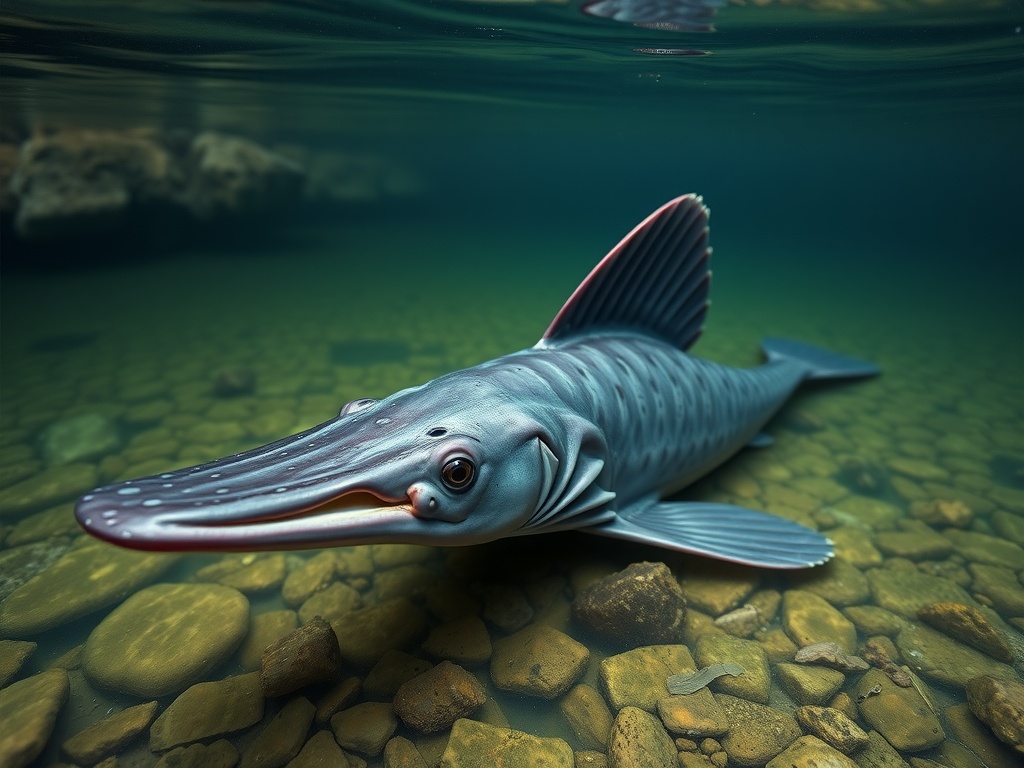
About the American Paddlefish
The American Paddlefish is a large, ancient freshwater fish known for its long, paddle-shaped snout, called a rostrum, which can be up to one-third of its body length. It inhabits slow-moving waters of large rivers and reservoirs in the Mississippi River basin of North America. Paddlefish are filter feeders, primarily consuming zooplankton by swimming with their mouths open. This species is highly adapted to sensing electrical fields in the water with electroreceptors on its rostrum. Due to habitat fragmentation, overfishing, and pollution, American Paddlefish populations have declined in recent decades.
Fascinating facts
Unique Snout
The paddlefish's long, flat rostrum can make up to one-third of its body length and is highly sensitive to electric fields, helping it locate food in murky waters.
Filter Feeder
Unlike most fish, paddlefish feed by swimming with their mouths open, filtering zooplankton from the water using specialized gill rakers.
Living Fossil
Paddlefish belong to an ancient lineage of ray-finned fish, with little change in their appearance since the time of the dinosaurs.
Detailed description
The American paddlefish (Polyodon spathula) is a large, primitive freshwater fish distinguished by its elongated, spatula-shaped rostrum, which can comprise up to one-third of its total body length. Adults typically reach 1.0–1.5 meters (3.3–4.9 ft) in length, with some individuals exceeding 2 meters (6.6 ft), and can weigh over 70 kg (154 lbs). The body is smooth and scaleless, with a gray to bluish coloration dorsally and a lighter, often white, ventral surface. The skeleton is primarily cartilaginous, contributing to its flexibility and buoyancy. Paddlefish possess a heterocercal tail, similar to that of sharks, and a large, gaping mouth adapted for filter feeding. Their rostrum and head are covered in thousands of ampullary electroreceptors, enabling them to detect the weak electrical fields generated by zooplankton, their primary prey. Paddlefish are highly migratory, moving long distances within river systems in response to seasonal changes and spawning cues. They are generally solitary but may aggregate in large numbers during spawning migrations. The species is long-lived, with individuals capable of reaching ages of 20–30 years, and exhibits slow growth and late sexual maturity, with females typically maturing at 7–10 years and males at 5–8 years. Their unique combination of primitive and derived anatomical features makes them a key subject in studies of vertebrate evolution.
Did you know?
Paddlefish are among the few North American fish species that use filter feeding, sweeping plankton into their large, gaping mouths as they swim.
Research & sources
Wikipedia summary
The American paddlefish, also known as a Mississippi paddlefish, spoon-billed cat, or spoonbill, is a species of ray-finned fish. It is the last living species of paddlefish (Polyodontidae). This family is most closely related to the sturgeons; together they make up the order Acipenseriformes, which are one of the most primitive living groups of ray-finned fish. Fossil records of other paddlefish species date back 125 million years to the Early Cretaceous, with records of Polyodon extending back 65 million years to the early Paleocene. The American paddlefish is a smooth-skinned freshwater fish with an almost entirely cartilaginous skeleton and a paddle-shaped rostrum (snout), which extends nearly one-third its body length. It has been referred to as a freshwater shark because of its heterocercal tail or caudal fin resembling that of sharks, though it is not closely related. The American paddlefish is a highly derived fish because it has evolved specialised adaptations, such as filter feeding. Its rostrum and cranium are covered with tens of thousands of sensory receptors for locating swarms of zooplankton, its primary food source. The only other species of paddlefish that survived to modern times was the Chinese paddlefish, last sighted in 2003 in the Yangtze River in China and considered to have gone extinct no later than 2010.
Behaviour & social structure
American paddlefish are primarily pelagic and exhibit a cruising, filter-feeding lifestyle. They swim slowly with their mouths wide open, allowing water to pass through their gill rakers, which trap zooplankton and small aquatic invertebrates. Feeding activity is often crepuscular, peaking at dawn and dusk when zooplankton concentrations are highest. Paddlefish rely heavily on their electroreceptive rostrum to locate dense patches of prey, especially in turbid or dark waters where vision is limited. Outside of the breeding season, they are generally solitary, although multiple individuals may be found in areas with abundant food. During spawning migrations, paddlefish may form temporary aggregations. They are known to undertake extensive upstream movements, sometimes traveling hundreds of kilometers, to reach suitable spawning habitats. Paddlefish are not territorial and show minimal aggressive interactions, with social behaviors largely limited to breeding activities.
Reproduction & life cycle
American paddlefish are broadcast spawners, reproducing in late spring (April to June) when water temperatures reach 14–21°C (57–70°F) and river flows are high due to seasonal flooding. Spawning occurs on gravel bars or clean, rocky substrates in fast-flowing river channels. Males arrive at spawning sites before females and may remain for several days. Females release tens of thousands to several hundred thousand adhesive eggs, which are externally fertilized by multiple males. There is no parental care; eggs adhere to the substrate and hatch after 7–10 days, depending on temperature. Larvae are initially planktonic and drift downstream to nursery habitats with slower currents and abundant food. Sexual maturity is delayed, with males maturing at 5–8 years and females at 7–10 years, and females may only spawn every 2–3 years due to the energetic cost of egg production.
Adaptations & survival
The most distinctive adaptation of the American paddlefish is its elongated, paddle-like rostrum, which is densely packed with electroreceptors (ampullae of Lorenzini) that detect the bioelectric fields of zooplankton, facilitating efficient foraging in turbid waters. The absence of scales and the presence of a cartilaginous skeleton reduce body weight and increase flexibility, aiding in maneuverability within large river systems. Their large, gaping mouth and specialized gill rakers are highly adapted for filter feeding, allowing them to efficiently extract small prey from the water column. Paddlefish are also capable of long-distance migrations, an adaptation for exploiting widely dispersed spawning habitats. Their slow metabolism and ability to survive in low-oxygen environments further enhance their resilience in variable riverine conditions.
Cultural significance
The American paddlefish has played a role in the cultural heritage of indigenous peoples and early settlers, valued for its meat and roe. Its unique appearance has inspired local folklore, and it is sometimes referred to as the "spoonbill cat" or "freshwater shark" in regional vernacular. Paddlefish caviar is considered a delicacy and has been exported internationally, leading to increased commercial interest and regulatory oversight. The species is also of scientific importance, serving as a model organism in studies of vertebrate evolution, sensory biology, and conservation management.
Recent research
Recent research has focused on the paddlefish's electroreceptive capabilities, revealing that the rostrum is not only a sensory organ but also plays a hydrodynamic role in feeding efficiency. Genetic studies have clarified population structure and informed restocking efforts. Conservation research emphasizes the importance of restoring river connectivity and natural flow regimes to support successful spawning and recruitment. Hatchery propagation and reintroduction programs have been implemented in several states, with mixed success depending on habitat quality. Ongoing studies are investigating the impacts of climate change and invasive species on paddlefish ecology and distribution.
Videos
Habitat
Large freshwater rivers and reservoirs

Conservation
The American Paddlefish is currently classified as Vulnerable on the IUCN Red List.
Threats & challenges
Major threats to American paddlefish include habitat fragmentation from dam construction, which blocks access to traditional spawning grounds and alters river flow regimes. Overharvesting for their meat and roe (used as caviar) has historically contributed to population declines. Pollution, especially from agricultural runoff and industrial contaminants, degrades water quality and affects reproductive success. Invasive species, such as Asian carps, compete for zooplankton resources and may further stress paddlefish populations. Climate change poses additional risks by altering river hydrology and temperature regimes. Although some populations are stable or recovering due to conservation measures, the overall trend remains vulnerable, with localized extirpations and ongoing challenges to natural recruitment.
Taxonomy
Scientific name
Polyodon spathula
- Kingdom
- Animalia
- Phylum
- Chordata
- Class
- Actinopterygii
- Order
- Acipenseriformes
- Family
- Polyodontidae
- Genus
- Polyodon
- Species
- spathula
Community notes
Share your observations about the American Paddlefish.
No community notes yet. Be the first!
Discover more wildlife
More fascinating animals from the encyclopedia.